Valletta should be a unique experience, open to all. This is Valletta 2018’s key vision for the bustling capital. A group of people focused on making this a reality is the Valletta Design Cluster team. Located at the Old Abattoir site in Valletta, the initiative is going to create a community space for cultural and creative practice. Words by Caldon Mercieca.
According to Anna Wicher from the PDR International Centre for Design and Research, design is ‘an approach to problem-solving that can be applied across the private and public sectors to drive innovation in products, services, society and even policy-making by putting people first.’ This people-centred approach to design is not just a theoretical framework, but a concrete method that engages people in a co-creative process.
By bringing together people active in the cultural and social spheres, we want to have a concrete and meaningful impact on Malta’s diverse communities. We aim to provide support for students, start-ups, and creative enterprises and give social groups the necessary tools to empower those with different interests who nonetheless share the common purpose of using creativity for the social good. We also want to provide a new networking space for everyone. From students, to cultural and creative professionals, to residents, budding businesses and civil society groups, everyone will be welcomed at the Valletta Design Cluster.
This philosophy of openness and diversity is one that has permeated every aspect of the project from the very beginning. Over the past three years, we have consulted with residents, students, schools, higher education institutions, artists, makers, and creatives to build the vision for the space. A range of public and independent organisations are also contributing to the project, providing both expertise and generous support.
Thanks to the support from the European Regional Development Fund, the physical space for the Cluster as well as the urban public spaces around it are currently undergoing serious regeneration. Once finished, the Cluster will have a range of facilities, which were decided on following consultation with potential users. It will include a makerspace, coworking spaces, studios, a food-space, several meeting rooms and conference facilities, an exhibition space, and a public roof garden. All of these facilities have benefitted from input contributed by various potential users, by residents, and by organisations that have been interacting regularly with the team working on the Valletta Design Cluster.
We believe that a community can only truly reach its potential when it opens itself up to collaborations which share a common goal. This does not mean turning a blind eye to the challenges faced by the community on a daily basis, or to the ever-evolving scenario that surrounds it, but rather cultivating a readiness to learn, an aptitude to develop networks built on trust, and a capacity to address problems with a practical, positive, can-do attitude.
One valuable experience we are developing with our community stakeholders is Design4DCity. This annual initiative, which the Valletta Design Cluster team started back in 2016, sees creatives, residents, and local authorities joining forces to rework and improve a public space. We worked with the Valletta community in 2016, and continued with the Birżebbuġa community in 2017. In 2018 we plan to work again in Birżebbuġa as well as in Siġġiewi, and will involve children and young people in our public space projects. Such initiatives are providing very important insights into the application of collaborative, co-creative approaches involving multiple stakeholders.
But the work of the Valletta Design Cluster is not restricted to the restoration or transformation of space. For the past three years, we have collaborated with the Malta Robotics Olympiad, teaming up with artistic curators and student organisations from the University of Malta (UM) to design and construct the pavilion for Valletta 2018. By the end of the project, participants had constructed a fully-recyclable 300 square meter pavilion and presented it to the public. This year we also supported SACES, the architecture students’ association at the UM, through a number of design and construction workshops. Branching out, we have done work with a number of creatives from various backgrounds in projects involving video-capture, artifact-curation, narrative development linked to cultural identities, and flexible use of available space through appropriately constructed spatial modules.
Several workshops have also been held where project stakeholders were fully involved in training sessions, with the aim of building skills in user-centred design, applied to specific contexts. This meant interacting with students, researchers, creatives, residents, and organisations in developing what the Cluster can offer. One tool used in this process is the construction of a user persona, where the characteristics, interests and concerns of the user are gathered through interaction with potential users of a service. Students from a number of faculties have also provided their input in this process through dedicated workshops at the UM.
They also stressed that the Cluster needed to serve as a catalyst for networking and for strengthening entrepreneurial skills for people working in the creative sector.
All of this has become possible thanks to continuous collaboration and international networks which have contributed their resources to our projects. To assist us in this, the Valletta 2018 Foundation has joined Design4Innovation, an Interreg Europe project bringing together eight European countries all working towards using design to benefit society.
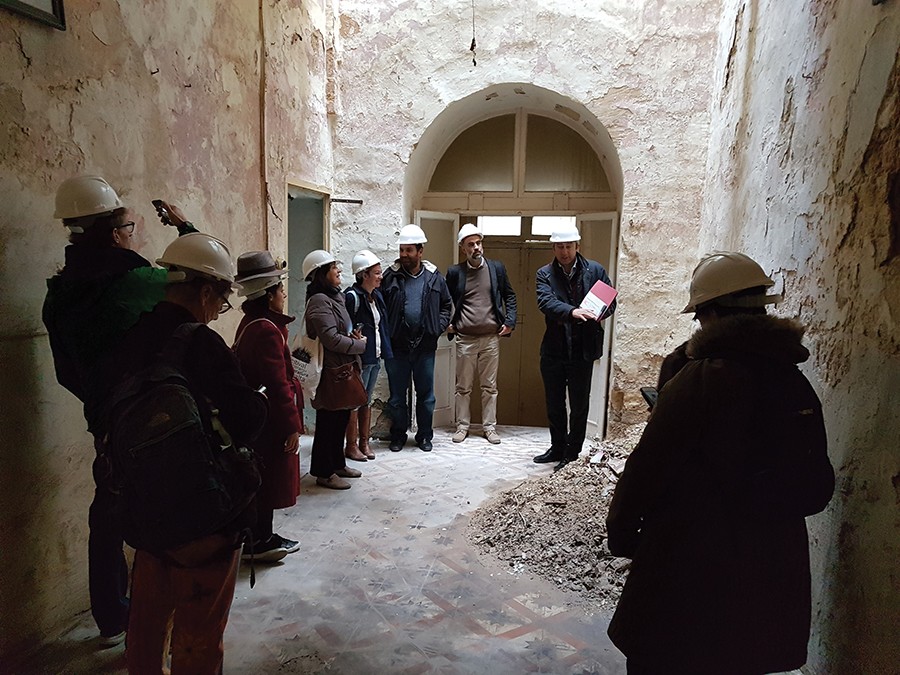
While we have been on the receiving end of a lot of support, translating our philosophy of openness into practice involved an element of risk. During a series of tours that we organised on site for potential users of the Cluster, we had to be open to various views and perspectives about what the Cluster could be. Participants highlighted issues related to accessibility and affordability as key concerns. They also stressed that the Cluster needed to serve as a catalyst for networking and for strengthening entrepreneurial skills for people working in the creative sector. In some cases, we had to revisit some of our plans and open new discussions with the architects to made adjustments. On other occasions, we called people in again to discuss their ideas further and see how we could integrate their suggestions into our vision.
Although we speak of cultural and creative industries, we should realise that the average number of people working in any single company is two. Indeed, 40% of designers in Malta are actually freelancers. The challenge for the Valletta Design Cluster here is to ensure flexibility and adaptability both in the physical infrastructure as well as the management of the Cluster. In this way, we can make the facility relevant for our users’ current needs, as well as cater to future ones.
The next stage in understanding our community of potential users better is to work together on the creation of a Design Action Plan. The Design Action Plan will highlight concrete actions to be undertaken by the Cluster during the first three years of its operation. It will serve as the main reference tool to structure the Valletta Design Cluster’s interaction with its community of users, practitioners, enterprises, and beneficiaries. Based on this open process, the Valletta Design Cluster aims at establishing itself as a new community-driven platform for cultural and creative practice in Malta.
Author: Caldon Mercieca