
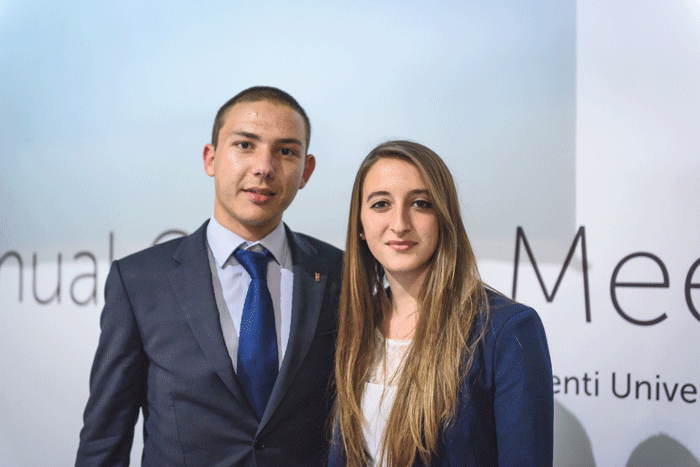
KSU gives its opinion about research
Why do we need research? Why should the University of Malta invest in research? The answer is simple: knowledge. Education has no meaning without a thirst for new information through research.
Universities should be obliged to generate new knowledge by creating thinkers and investing in them. This includes creating an environment where both students and corporations are eager to invest time and money into knowledge worth pursuing. How can this be achieved if students, once they graduate, lose their enthusiasm to find new knowledge? Postgraduate students are faced with insufficient funds and extremely short time frames. Our University has already started moving in the right direction. However, we lack a stable workforce capable of sustaining continued research. This is not easy. Only through dedication, planning, and investment can we break the surface and become a self-sustaining organisation worthy of an academic university.
As a move towards this direction, Kunsill Studenti Universitarji (KSU) believes that students should be incentivised to embark on projects which will further enhance their educational experience. Projects like these introduce a more practical approach to study programmes. Therefore, for the 2014/2015 scholastic year, KSU enhanced its own Research and Opportunity Fund by offering €20,000 in funds for students to pursue research.
The funds supported research projects, travel grants abroad, and greater access to academic resources. These are how KSU is trying to incentivise more research and active participation in student life. We hope that this contribution will make a difference for these students. This fund receives many applications. This shows that students want to enhance their educational experience if they have the necessary resources.
Over the last few years the University of Malta has invested in its research infrastructure. By participating in EU-wide research projects, University is supporting more postgraduate students, postdoctoral students, and resident academics. The institution has also engaged in various activities to tap into a number of funds to step up research activity, in collaboration with both the industry and international counterparts. Significant progress has already been made but there are still financial restrictions which hinder the continuous improvement of local research. The Students’ Council will continue to put pressure on the Government to invest in this area especially fundamental (basic) research.
Research is an important pillar to create a Third Generation University, which we should all strive to enhance. For more information on the KSU Research and Opportunity Fund visit http://bit.ly/KSURnIFund.




Comments are closed for this article!