
Curious matters
Society is built on curiosity; the drive to find answers to life’s abounding questions. This curiosity continues to fuel our brightest minds today. Cassi Camilleri talks to ALICE experiment leader Prof. Paolo Giubellino about his work at CERN and how it impacts our daily lives.
Initiating Alice
A magnificent feat of engineering, the LHC goes where no other machine has gone before.
Continue readingFurther down the rabbit hole
The European Organisation for Nuclear Research—CERN—is synonymous with the world’s brightest minds, cutting-edge research and groundbreaking discoveries. Lars Lorenz interviews Dr Kevin Vella (Faculty of ICT) about the University of Malta’s involvement at CERN and its game-changing tech contribution to the ALICE experiment.
Attacking the silent epidemic of diabetes

Diabetes prevalence is burgeoning on a global scale. In 2012, 1.5 million people worldwide died as a direct result of the disease, cementing it as an epidemic. By 2030, diabetes is expected to become the world’s seventh leading cause of death. With 12% of the Maltese population suffering from the disease, a research team has come together looking into new methods of detection to stop the disease in its tracks. Words by Yasmine Gatt.
Politics, policy and risky business

As a child, Prof. Noellie Brockdorff was fascinated by the robots that inhabited the world of Isaac Asimov’s novels. She wanted to know why humans are different to robots. So why are human beings not perfectly rational creatures like robots? Dr Claude Bajada finds out more.
Radio Telescope

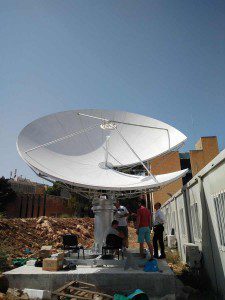
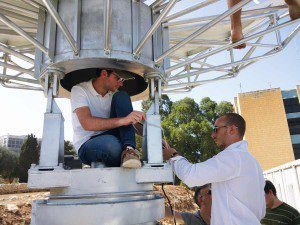
Malta now has a radio telescope. This is a great step forward for the University of Malta as it helps speed up research.
The Department of Physics, Faculty of Science and the Institute of Space Sciences & Astronomy (ISSA; both at the University of Malta) have just acquired a 5.3m dual-reflector parabolic dish, as part of a European Regional Development Fund (ERDF) project to extend postgraduate research lab facilities. The radio telescope will now allow students and researchers to study celestial objects such as the sun or the centre of the galaxy through the radio waves they emit.
| Quick Specs |
| Dish diameter: 5.3m
Feed horns: L-Band and K-band Gain: 44 dBi @ 4GHz Observing modes: Continuum and line observation Total weight (including pedestal): 1900 kg Surface accuracy: 0.5mm PC-based automated control unit |
 When pointed to a radio-loud celestial object (an object which emits large amounts of radio waves, such as the sun), the telescope will receive radio waves from these sources and convert them to voltage readings in the feed. The converted signal is then transmitted to a digitiser that converts these signals into bits and bytes.
The digitised signals are then processed and broken down into the different frequency counterparts (similar to what a car radio does with the radio waves it receives from its antenna), which allows for continuum observation of the skies above. The telescope provides a test-bed for several research initiatives being undertaken at ISSA.
Some of its specialisations include improving the hardware and software processing back-ends for radio telescopes. The on-site telescope can speed up this sort of research immensely. ISSA is part of the largest radio telescope project in the world: the SKA (Square Kilometre Array).
Giving back to the research community

Wilfred Kenely, the Research Trust (RIDT) CEO, speaks to THINK about new initiatives coming to fruition thanks a new scheme.
From Immigrants to Theology

Over 1.82 million migrants entered the EU in 2015 and this has triggered much dialogue across member states. In May 2015, the Archbishop of Malta, H.G. Mons Charles J. Scicluna, after the Vatican announcement of the Year of Mercy, reached out to the academic community to reflect on the immigrant phenomenon. This call set in motion The Mercy Project, which aims to create a set of reflections and recommendations around immigration.
The project has four stages. It first reflected on the issues of mercy and immigration within the Maltese context. During this stage, staff members from various University of Malta (UoM) faculties explored the local situation, reflecting on the terminology used, prevailing concepts and current practices. This was followed by a second stage. Academics held meetings to discuss various viewpoints and realities around migration. Those involved included members from the Faculties of Theology, Arts, Social Wellbeing, Laws, Education, and Health. At the third stage, a symposium on ‘Mercy and the Immigrant’ was held on 6 June 2016. The symposium brought together interested parties and agency representatives to reflect on the issue. This provided a platform for a dialogue between theologians and society. Rev. Dr René Micallef S.J. (Gregorian University in Rome) spoke about the mercy, justice, and policies needed to be considered by Malta and the rest of the EU.
The final forth step is underway. A publication of the project’s position papers is being prepared. This will make available to various sectors of the public some of the philosophical, social, legal, educational, and theological ideas which surfaced during the project’s dialogues and consultations. It will provide concrete recommendations for the University of Malta, State, and the Church.
Dr Pauline Dimech and Rev. Dr Stefan Attard are the project co-ordinators.
What Do You Need to Setup An Indie Gaming Community?
