
Google’s deepest dreams and nightmares


 Under Europe lies a 27 km tunnel that is both the coldest and hottest place on Earth. The Large Hadron Collider (LHC) has already found out what gives mass to all the matter in the Universe. It is now trying to go even deeper into what makes up everything we see around us. Dr Marija Cauchi writes about her research that helped protect this atom smasher from itself. Photography by Jean Claude Vancell.

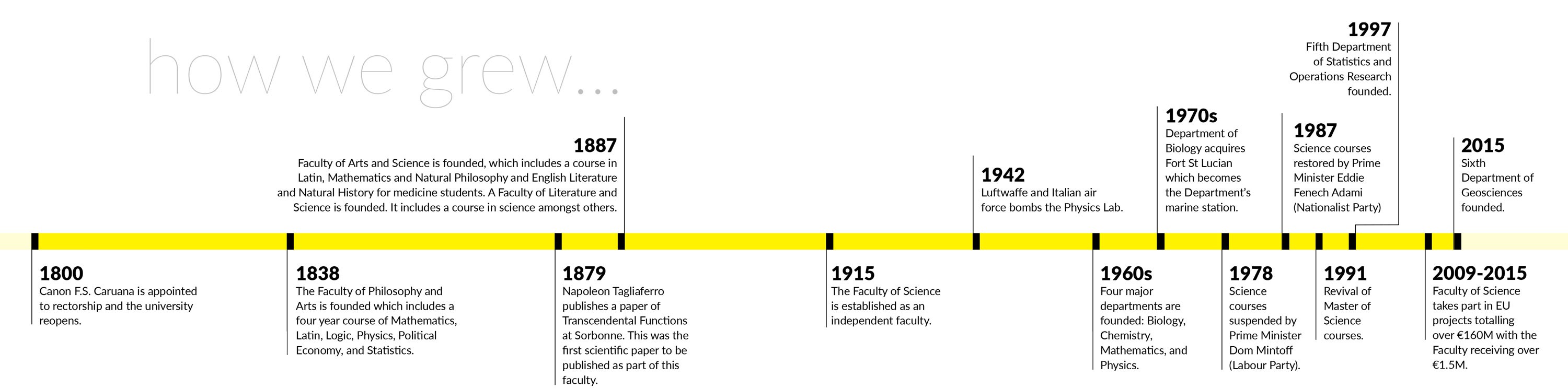
During the mid-1970s, the Faculties of Science and Arts were closed down, and the Bachelor programmes phased out. Most of the foreign (mainly British) academics left Malta, as did some Maltese colleagues. Those few who stayed were assigned teaching duties at the newly established Faculty of Education and Faculty of Engineering. Relatively little research took place, except when funds were unneccessary, and it is thanks to these few that scientific publications kept trickling out.
In 1987, the Faculties of Arts and Science were reconstituted. The Faculty of Science had four ‘divisions’ which became the Departments of Biology, Chemistry, Physics, and Mathematics. In the same year, I returned from the UK to join the Faculty.
Things gradually improved as more staff and students joined. However, equipment was either obsolete or beyond repair. The B.Sc. (Bachelor of Science) course was re-launched with an evening course. Faculty members worked flat out in very poor conditions. The Physics and Mathematics building was still shared with Engineering. Despite these problems, we had a Faculty and identity. Nevertheless, we wanted our courses to be of international repute—our guiding principle.
During the 1990s, yearly budgets had improved slightly along with experimental facilities. Computers and the occasional capital investment helped immensely. Research output increased, as did student numbers, while postgraduate Masters and Ph.D. students started to appear.
Since 2005, some faculty members have been working hard to secure European Regional Development Funds (ERDF) by submitting proposals to reinforce our research infrastructure. A total of six projects were approved with a combined budget of nearly €5 million. This has resulted in new, state of the art research facilities and an exponential increase in research output, bolstered by additional academic staff and research student numbers of close to 80.
Students are now organised and active through S-Cubed, the Science Students’ Society. This leading organisation is one of the three faculty pillars: the academic and support staff, and the student body. Together, we have made giant strides and the future looks bright.
Special thanks to Prof. Stanley Fiorini who helped us compile our timeline, aided by Prof. Josef Lauri.


 Gone are the days when learning a new language meant sitting in a classroom, reading books and practising with classmates. There are language learning apps, programs and games now. But can we really learn a new language just by using this technology? Veronica Stivala finds out. Illustrations by NO MAD.


