
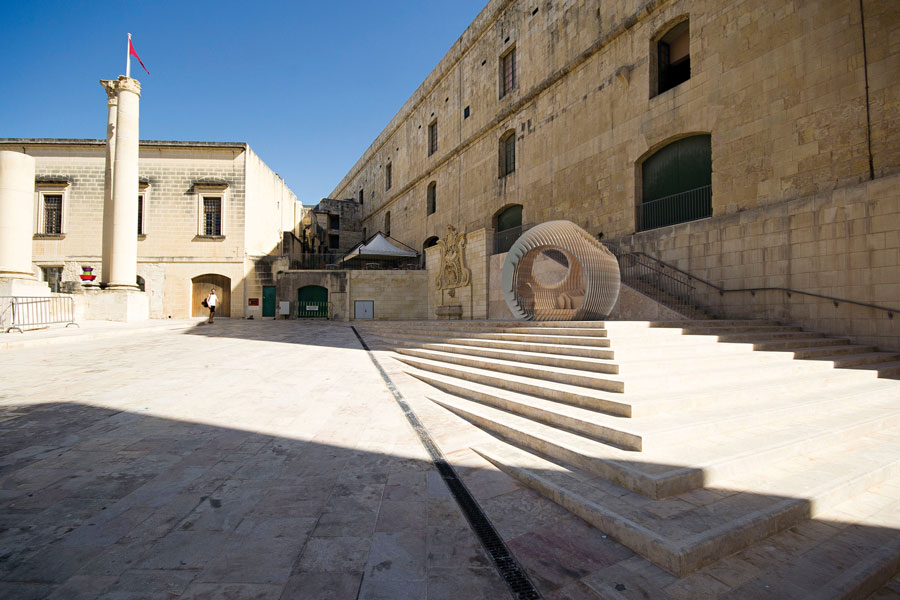
Come relax in Il-Boċċa, a playful wooden sphere created with cutting-edge design tools. Its shape helps reduce the structure’s scale. Valletta has grand buildings with narrow streets that cannot handle large structures.
Il-Boċċa was constructed in a workshop for EASA (Europe Architecture Students Assembly) 2015 Malta during which three Maltese tutors led a team of 21 architecture students from around the world. The workshop combined several techniques. First they drew sketches which were then developed into a digital form. Modelling software allowed easy modification and experimentation with the initial idea. This was followed by a physical 3D model (1:10 scale) to test the idea.
Out of the workshop came 47 wooden boards connected together using bolts and wooden spacers. Each board consists of a double layer of 11-plywood beech sheet. One layer of each board was Computer Numerical Control (CNC) cut. CNC cutting uses computers to guide precision shaping. This layer was used as a template to handcut a second board. Each set of two was then glued and nailed together with overlapping joints to provide strength.
The final product is a 3.5m loosely spherical structure providing shaded seating without obstructing Valletta’s historic views. The project will be placed in the capital city as part of Valletta 2018 Capital of Culture.
The workshop was led by Kristine Pace, Danjel Attard and Sacha Cutajar (Faculty of the Built Environment, University of Malta).




Comments are closed for this article!