
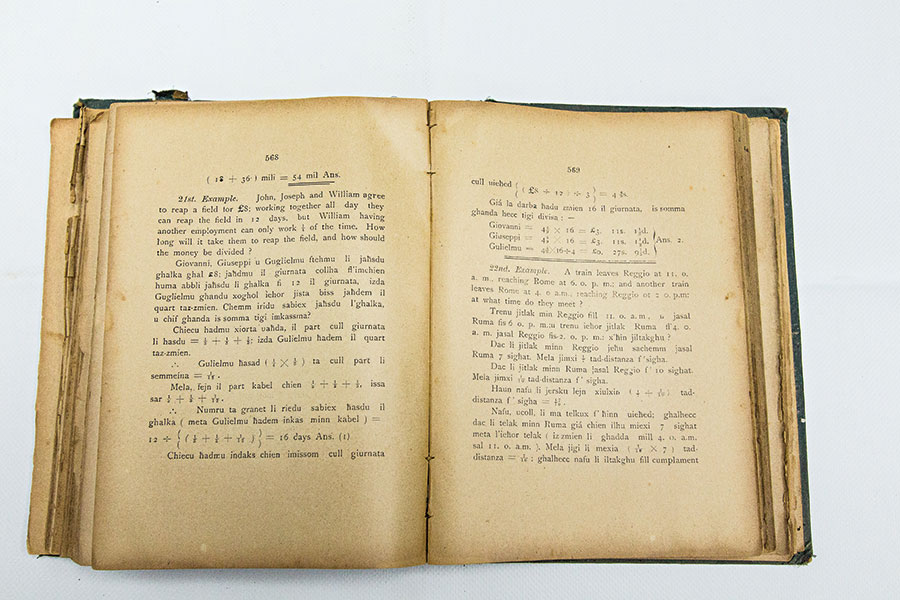
In 1913, Tommaso Vella published an arithmetic textbook in both English and Maltese called Aritmetica Bil Malti u Bl’Inglis. Dr Claude Bajada explores this intriguing book.
Aritmetica Bil Malti u Bl’Inglis is fascinating linguistically. Its title nods towards the book’s material being duplicated in English and Maltese. Strangely this is not the case. In a similar style to modern spoken Maltese, the book is full of code-switching. Vella starts a sentence in Maltese and then, as if it is the most natural thing to do when writing a textbook, switches to English. Some sections are written in Maltese and then translated to English, other sections are written only in Maltese. The book is a treasure for anyone interested in how Maltese was used a hundred years ago.
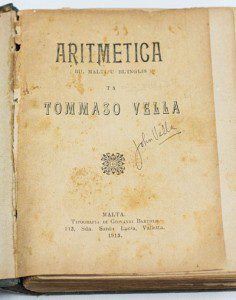 The content of Aritmetica is straightforward. Its intention is lofty, to teach practical mathematics. In Vella’s words, ‘our aim is to escape definitions that confuse the mind, or ones that one can do without. In this way we can give students the ability to learn the science and art of arithmetic.’
Tommaso Vella is unknown in Malta. There is no trace of him on the internet. Without the Vella family’s oral history he would be lost forever. Tommaso was a philanthropist who dedicated his life to teaching mathematics to dry-docks workers. He worked side by side with Manwel Dimech and later Lord Strickland. His legacy was maths, science, and teaching. It was passed down through his family who continue to contribute to Maltese science. His book serves as a reminder that mathematics is a practical subject, which is the language that describes our world. We must not forget that.
Dr Claude Bajada was speaking to Tommaso Vella’s grandson Wally Vella-Zarb, and great-granddaughter Dr Liana Vella-Zarb.



Comments are closed for this article!