Design

Prostitution no.2 by Abigail Attard Prostitution is known as the oldest profession. It is also the one with the highest human cost. This artwork reflects the pain female prostitutes feel contrasted by the coldness of the men who fuel the business. Attard was inspired by news items on these issues, and her belief that more measures are needed to bring an end to the business that fuels the objectification of women.
Prostitution no.2
by Abigail Attard
Prostitution is known as the oldest profession. It is also the one with the highest human cost. This artwork reflects the pain female prostitutes feel contrasted by the coldness of the men who fuel the business. Attard was inspired by news items on these issues, and her belief that more measures are needed to bring an end to the business that fuels the objectification of women.


CuriouSedative by Sharon McLean Many idioms reflect how curiosity is not always a good thing. This artwork personifies the mental struggle suffered when a curious mind tries to seek tranquility. It also represents a person’s cautiousness sheltering the self from exposing their state of mind.
CuriouSedative
by Sharon McLean
Many idioms reflect how curiosity is not always a good thing. This artwork personifies the mental struggle suffered when a curious mind tries to seek tranquility. It also represents a person’s cautiousness sheltering the self from exposing their state of mind.


Untitled 1 by Lara Gove This artwork is part of a series interpreting a text known as Cities and the Dead 4 which is found in Italo Calvino’s book Invisible Cities. The painting reflects a state of decay, an entire city turned into a burial ground with confined spaces with restricted movement.
Untitled 1
by Lara Gove
This artwork is part of a series interpreting a text known as Cities and the Dead 4 which is found in Italo Calvino’s book Invisible Cities. The painting reflects a state of decay, an entire city turned into a burial ground with confined spaces with restricted movement.


Wooden Sculpture no.1 by John Paul Muscat This artwork’s imagery reflects multiculturalism. It is the artist’s first wood carving.
Wooden Sculpture no.1 by John Paul Muscat
This artwork’s imagery reflects multiculturalism. It is the artist’s first wood carving.


Hollow by Nicolai Schembri Cyberbullying can have dreadful repercussions. This art installation with figures made of transparent tape reflects the emptiness a person can feel when they are the victims of online harassment. The figures merged with their surroundings and became part of the space, with an almost ghost-like effect.
Hollow
by Cristina Formosa
Cyberbullying can have dreadful repercussions. This art installation with figures made of transparent tape reflects the emptiness a person can feel when they are the victims of online harassment. The figures merged with their surroundings and became part of the space, with an almost ghost-like effect.

Bridging (through) the performing arts

Theatre, dance, and music are changing at the University of Malta. Recently, three new research groups were launched by the School of Performing Arts (SPA) with the aim of bridging different disciplines through  the development of shared work processes and research areas. Through interdisciplinary research, these groups want to look outwards towards new concepts.

The groups cover three themes. First, ‘Twenty-first-Century Studies in Performance’, which is committed to the locating, reimagining, and development of performance practices in the 21st century. Second, ‘Culture and Performance’, which is guided by the premise that culture and performance refer to complexities that emerge from the multitude of phenomena these terms describe. Third, ‘Performing Arts Histories and Historiographies’, which investigates and archives material related to historical events across the performing arts. These themes are possible thanks to a web of local and international collaborations, ranging from the Digital Arts and Humanities to Cognitive Science and Intelligent Computer Systems.

These new research platforms seek to facilitate dialogue between scholars and practitioners, academics and citizens.
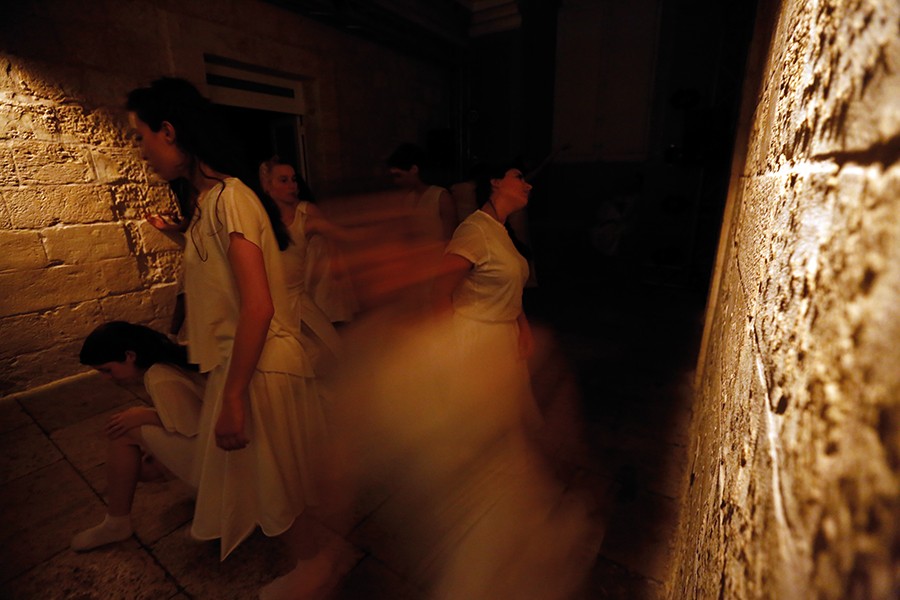
Annual Collective Performance of the School of Performing Arts. White White is a performance about space, or the absence of it. Once upon a time, characters were in search of an author. Today they are in search of a space. The characters, played by the students of the School of Performing Arts at the University of Malta, are lost in a corridor in-between places. Around them all is empty. A void. Like a vault, all they have isÖWhite! Photo: Darrin Zammit Lupi
Annual Collective Performance of the School of Performing Arts.
White
White is a performance about space, or the absence of it.
Once upon a time, characters were in search of an author. Today they are in search of a space. The characters, played by the students of the School of Performing Arts at the University of Malta, are lost in a corridor in-between places. Around them all is empty. A void. Like a vault, all they have is White!
Photo: Darrin Zammit Lupi
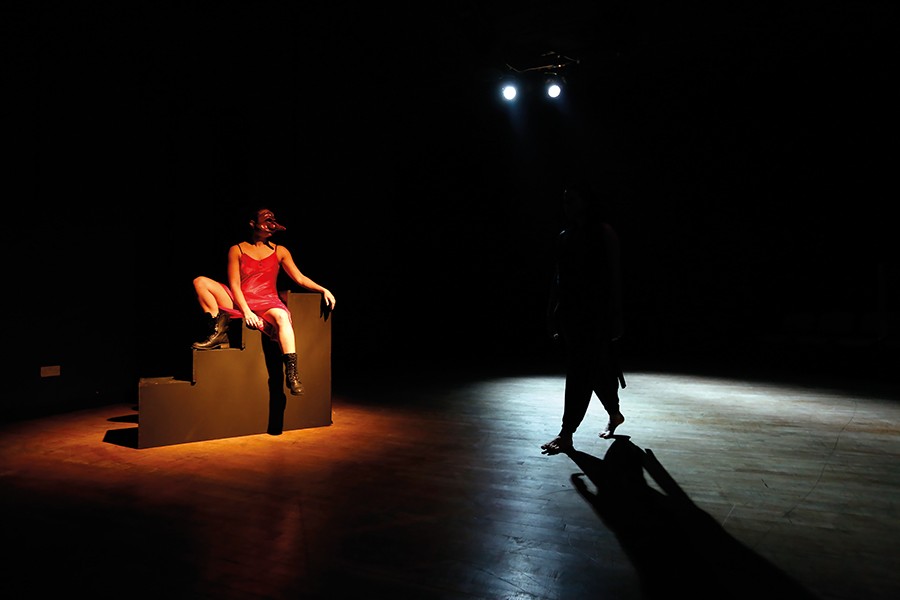
inFragments A devised performance created by the students of the School of Performing Arts, University of Malta MITP Photo by Darrin Zammit Lupi
inFragments
A devised performance created by the students of the School of Performing Arts, University of Malta
MITP
Photo by Darrin Zammit Lupi


SPA has an upcoming conference featuring some of the above topics called Interweaving Cultures: Theory and Practice in March 2017. For more information contact Dr Stefan Aquilina (stefan.aquilina@um.edu.mt) or, on the conference, Prof. Vicki Ann Cremona (vicki.cremona@um.edu.mt).

Time to go

Kristina Mifsud
Kristina Mifsud

The start of a new scholastic year can bring about feelings of excitement to some and dread to others. After the relatively quiet summer months, children need to start making their way to school in the mornings. The result is traffic, an ugly monster that brings Malta to a standstill every morning. One solution could be the grouping of school trips to and from homes.

Kristina Mifsud (supervised by Ms Amanda Borg) decided to investigate the issue of traffic congestion caused by school transport by studying a hypothetical scenario in which the free school transport policy for government-run schools was extended to church and independent schools. First she conducted a survey: parents who have children at church and independent schools answered a questionnaire. These parents drove their children to school using their private vehicles. The results were very promising with more than 70% of mothers indicating that they would switch to the government-provided school transport if it was implemented. Those who said they would not take up the service gave three main reasons for this: mistrust of minivan drivers, their children being too young, and that the drive to school was a distraction-free time with their children.

Then Mifsud estimated the benefits and costs for the service using the take-up percentage from the questionnaire. The list of benefits was plentiful; time and fuel would be saved, while air pollution and environmental costs would be reduced. The costs included the initial investment (minivans), fuel, maintenance, and staff payment. When compared, the total estimated benefits far exceeded these costs! For every €1 invested by the government into this school transportation system, society would reap €2.66 in benefits. Additionally, the direct cost (time and fuel) of individual school runs per child per year amounts to €993.22, based on the average time taken per child of 48.8 minutes per school day. Given that the average fee by minivan drivers for a year worth of school runs is around €600, the minivan school transport option is much more sensible, economically speaking, and all the more so with regards to protecting our environment and solving the traffic headache.


This research was carried out as part of a Bachelor of Commerce in Economics at the Faculty of Economics, Management and Accountancy, University of Malta.

Green fingers

A love for botany, the birth of her children, and a strong interest in public health problems—this is what led Assistant Professor Shirley Micallef to her current position in the Department of Plant Science and Landscape Architecture (University of Maryland). She speaks to Veronica Stivala about beer brewing, native plant gardening, and the safety of our salads.

Continue reading

Leaving a legacy

A legacy gift is a planned future donation to a charity or trust which is given through a will or other designation. It allows individuals to express personal values by integrating charitable, family, and financial goals. Planned gifts drawn up in wills can be made in cash, or by donating assets such as stocks, real estate, and art pieces. The possibilities are endless.Continue reading

Insects taking over

Malta is thought to harbour around 6,000 to 8,000 species of insects. In the last two years almost 200 new records of these fascinating creatures were found around the Maltese Islands, and a new endemic species, unique to Malta, was also described as new to science. Jessica Edwards meets up with Dr David Mifsud to find out more about these amazing findings and why insects really do run the world. Photography by Dr Edward Duca.

Continue reading