
As part of his Ph.D. at the Faculty of Media and Knowledge Sciences, Department of Digital Arts (University of Malta), Matthew Galea has developed an interactive sound art piece entitled (Re)diffusion.
Glider South: Exploring the sea south of Malta
To map pristine areas in the Mediterranean, CAMPE is going where no glider has gone before. Prof. Aldo Drago writes.
Mainstream gender = mainstream funding
Research agendas change throughout the years. Historical context and economics play a distinct part in what is placed on the priority list. Presently, gender is on top.Keeping in line with the ‘gender mainstreaming’ policies within the EU, researchers are now being asked to put on their ‘gender lens’.
Sounds of silence
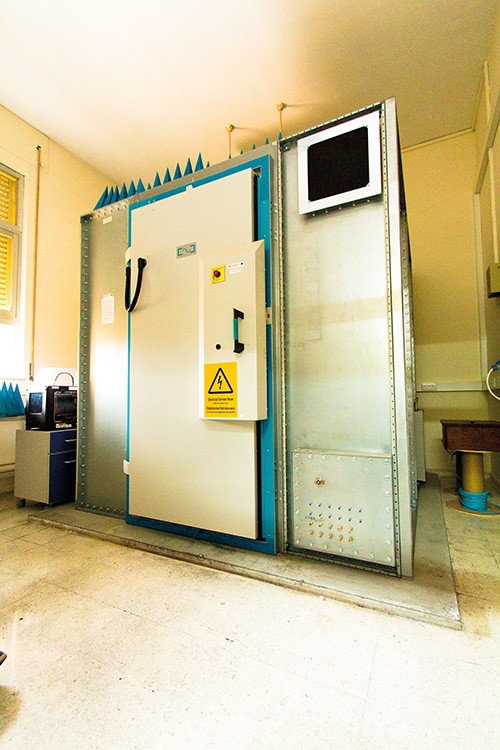
| Tech Specs |
Dimensions: 2.5m x 2.5m x 2.5m Weight: 2 tonnes Frequency: 800MHz – 18GHz Price: €140,000 |
Everything in the world can emanate sound waves. These are invisible, consisting of vibrating particles in the air which can strike our eardrums, which lets humans hear. But what if you want to measure waves coming from a particular object?
An anechoic (echo-free) chamber is a heavy, metal enclosure with inner walls covered in foam wedges made from a radiation absorbent material. Any emitted sound or electromagnetic waves become trapped between these wedges until all their energy is completely absorbed. The chamber also eliminates all noise from exterior sources. Simply put, speak in an anechoic chamber, and you will hear the pure sound of your voice echo-free. The volume of these chambers is dictated by the size of the objects as well as the frequency of the device under investigation. They can be anywhere from the size of an old television monitor to the size of an aircraft hanger.
So what are they used for?
Testing electronic devices that radiate acoustic or electromagnetic waves and mapping out radiation patterns of antennas. It’s useful for systems such as satellites, radars, computers, missiles, and vehicles. Measurements aim to determine characteristics such as susceptibility, system sensitivity, effective radiated power, tracking ability, and comparability. The chambers can also be used to evaluate the effect of electromagnetic fields on human tissues, a type of experiment that has already been carried out in the University of Malta (UoM) anechoic chamber. Manufacturers of electronic equipment are required to conduct electromagnetic compatibility and immunity testing prior to placing a device on the market. This ensures that they won’t generate too much electromagnetic disturbance and will also be sufficiently immune from fields generated by other sources. Due to this new equipment, the UoM will be able to provide pre-compliance testing services to companies, which will prepare their devices for expensive compliance testing in certified laboratories, saving them a good sum of money.
Designing the factory of the future
With consumer demand reaching new highs, automation in industry is essential. Dr Ing. Emmanuel Francalanza writes about his contribution to streamlining the complex factory design process for contemporary engineers.
From smartphones, to smartwatches, smart cars to smart houses, intelligent technology is inescapable. Busier people have made efficiency a valuable currency and thus the ‘Internet of Things’ (IoT), and its plethora of connected devices, has become a necessary part of everyday life. The application of this model goes way beyond the regular consumer, however. Continue reading
Once upon a time we had sharks
Human beings may be adversely affecting biodiversity, but can we be a help as well as a hindrance? Greg Nowell writes.
Marine life once thrived in the waters surrounding the Maltese islands, sharks included. But that is no longer the reality we see today. So, what happened? Where have all the fish gone? How can we bring them back?
Through the VR glass
As societies evolve and take in a greater number of distinct cultures, histories, and traditions, the ability to empathise with each other becomes vital, for all our sakes. In an effort to get as close as possible to seeing life through another’s eyes, researchers from the University of Malta are creating a virtual reality experience that allows users to step into someone else’s shoes.
Words by Dr Vanessa Camilleri.
From a young age we are often taught that if we want to understand someone else’s perspective, we must first walk a mile in their shoes. This ability to place ourselves in another’s position is what we call empathy. This component of emotional intelligence is known to increase prosocial behaviour and reduce individualistic traits, meaning that it can lead to a better quality of life where practiced, whether at home, in the workplace, or any other environment.
Stuck in the middle with the fumes
Since the 1960s heavy fuel oil (HFO) has reigned supreme as the king of maritime fuels. It was efficient and cheap; its use spread far and wide. International shipping boomed on its success. Even today, this industry handles 90% of the world’s trade volume. For many, HFO is the lifeblood of the maritime shipping industry. But it has a dark side…
Placing Maltese artists under the world’s spotlight
La Biennale di Venezia is the world’s biggest art event. Every two years, Venice erupts in a glorious art extravaganza as artists from all over the world descend on the city in celebration. This year marks the 57th edition of the International Art Exhibition. It also marks Malta’s return to the event. Emma Pettit tells us more.
Making Tourism Work
Tourism has long been an integral part of the Maltese economy. But a big dose of change is sorely needed if we’re to keep the money coming in without selling our souls in the process. Julian Christopher Zarb explains why.


