Skip to content

(Re)diffusion

Facebook
Twitter
LinkedIn

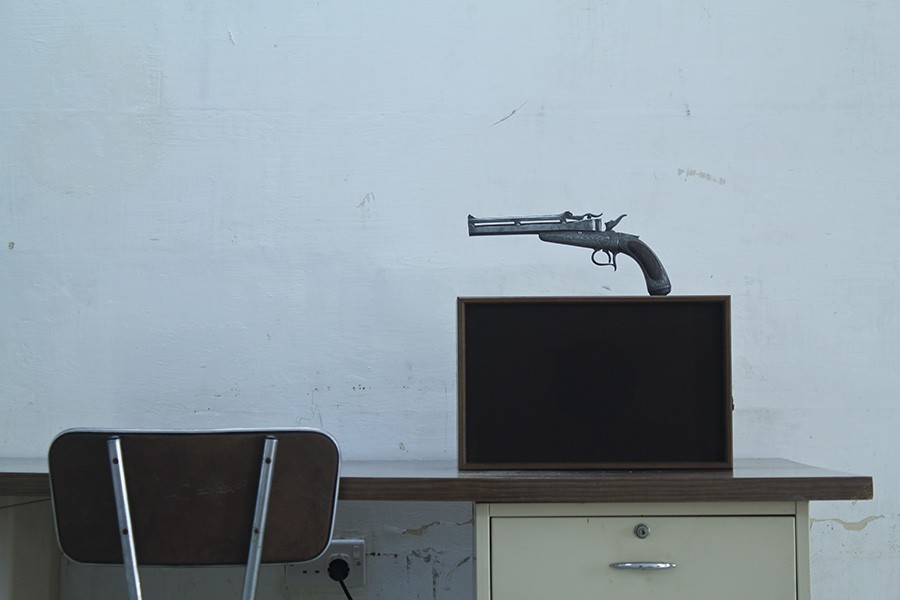
As part of his Ph.D. at the Faculty of Media and Knowledge Sciences, Department of Digital Arts (University of Malta), Matthew Galea has developed an interactive sound art piece entitled (Re)diffusion.

(Re)diffusion comes from Weapons of Mass Distraction, a series Galea has been working on which draws analogies between agents of mass communication and firearms. In language, terms like ‘point’ and ‘shoot’ are shared between the two devices, illustrating how both can be used for a positive or negative effect. ‘Mass communication has been weaponised in some cases and can perhaps cause more harm than firearms,’ Galea says.

Galea believes that sculpture is an intervention in society rather than matter, and that it makes use of space as an agent that connects everything: objects, sounds, and time. However, sound has long been ignored in the medium. As Marshall McLuhan remarked, no object can be considered as purely visual, sonic, or tactile, but rather a blend of sensory stimuli. This idea of sensory ratios applies to how media comes into being.

‘I believe that sculpture can go beyond simply being looked at’

Objects moving in space or triggered on a computer, always require some kind of physical intervention that comes with visual and other sensory consequences. Similarly, sound does not exist in isolation. Sound always requires some kind of physical media to propagate it. Galea notes that whilst the human characteristic of observing things in isolation is beneficial in some areas, in an artistic context is rather pointless. In (Re)Diffusion, he attempts to create a sculptural situation that has the ability to distort space and modify it in real time. ‘I believe that sculpture can go beyond simply being looked at,’ Galea says. 


(Re)Diffusion will be part of IN TRANSIT, an exhibition curated by Prof. Vince Briffa, which showcases the works of emerging Maltese artists that work with digital media. The exhibition will travel to Dusseldorf (Germany) and Leeuwarden (Netherlands).

Author

More to Explore

The Legacy of Press Freedom

At this year’s Mabel Strickland Memorial Lecture, international negotiator and mediator Nomi Bar-Yaacov argued that democracies are entering a period in which the crisis extends beyond censorship or attacks on journalists alone. As wars multiply, trust in institutions weakens, and information becomes increasingly mediated through algorithmic systems, the deeper problem may be that societies are losing their ability to agree on what is true in the first place.

Squeezing Out Waste: Transforming Malta’s Olive Waste into Green Goods

While olive oil production generates vast amounts of nutrient-rich waste, approximately 98% of the antioxidant-rich phenolics in olives are lost during oil extraction. To combat rapid degradation, the OliveGREEN team is exploring a novel strategy using sulphur dioxide and enzymes to stabilise olive pomace. THINK speaks with Dr Frederick Lia to learn why saving this discarded byproduct makes a difference.

More Than Four Walls: The Influence of the Library Space on Student Wellbeing

Academic libraries are often framed as quiet repositories of knowledge, but their influence runs deeper. As student mental health concerns intensify, these spaces are emerging as critical environments for connection, comfort, and care. Beyond books and databases, the design, atmosphere, and activities of a library can shape how students feel, cope, and belong within the wider university experience.

Comments are closed for this article!