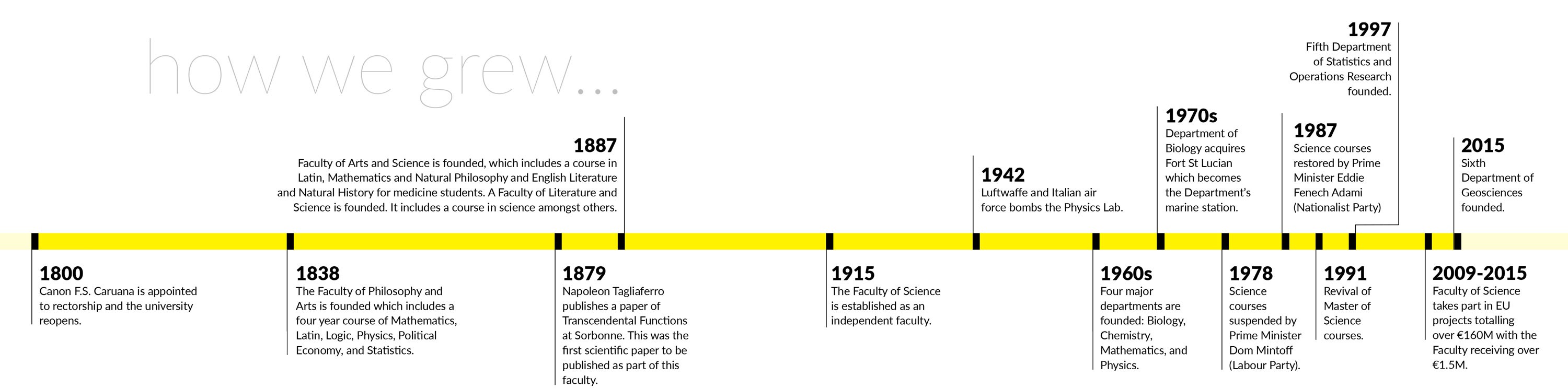
A Faculty Reborn

During the mid-1970s, the Faculties of Science and Arts were closed down, and the Bachelor programmes phased out. Most of the foreign (mainly British) academics left Malta, as did some Maltese colleagues. Those few who stayed were assigned teaching duties at the newly established Faculty of Education and Faculty of Engineering. Relatively little research took place, except when funds were unneccessary, and it is thanks to these few that scientific publications kept trickling out.

In 1987, the Faculties of Arts and Science were reconstituted. The Faculty of Science had four ‘divisions’ which became the Departments of Biology, Chemistry, Physics, and Mathematics. In the same year, I returned from the UK to join the Faculty.

Things gradually improved as more staff and students joined. However, equipment was either obsolete or beyond repair. The B.Sc. (Bachelor of Science) course was re-launched with an evening course. Faculty members worked flat out in very poor conditions. The Physics and Mathematics building was still shared with Engineering. Despite these problems, we had a Faculty and identity. Nevertheless, we wanted our courses to be of international repute—our guiding principle.

During the 1990s, yearly budgets had improved slightly along with experimental facilities. Computers and the occasional capital investment helped immensely. Research output increased, as did student numbers, while postgraduate Masters and Ph.D. students started to appear.

Since 2005, some faculty members have been working hard to secure European Regional Development Funds (ERDF) by submitting proposals to reinforce our research infrastructure. A total of six projects were approved with a combined budget of nearly €5 million. This has resulted in new, state of the art research facilities and an exponential increase in research output, bolstered by additional academic staff and research student numbers of close to 80.
Students are now organised and active through S-Cubed, the Science Students’ Society. This leading organisation is one of the three faculty pillars: the academic and support staff, and the student body. Together, we have made giant strides and the future looks bright.


Special thanks to Prof. Stanley Fiorini who helped us compile our timeline, aided by Prof. Josef Lauri

Timeline

Into The Crystal Maze

To many, crystals are pretty and mysterious rocks with magical properties. But real crystals are nothing of the sort. They are groups of atoms or molecules arranged in a highly regular way. Their study is important in many fields including chemistry, biology and pharmaceuticals. Dr Liana Vella-Zarb, Dr Rosalin Bonetta and Dr Daphne Attard explain to Francesca Vassallo why crystals are better than diamonds.

Continue reading

Every Breath You Take

The air we breathe is vital to our health. Researchers at the Department of Geosciences (University of Malta) are measuring how clean Malta’s air is. They are also optimising a model of the Mediterranean atmosphere to see how climate change will affect the Maltese Islands and their surrounding region. Words by Natasha Padfield. Photography by Jean Claude Vancell.

Continue reading

The first Maltese mathematics textbook

In 1913, Tommaso Vella published an arithmetic textbook in both English and Maltese called Aritmetica Bil Malti u Bl’Inglis. Dr Claude Bajada explores this intriguing book.

Continue reading

A Patchwork Mediterranean: Knitting It Together

The Mediterranean is surrounded by over 20 countries each of which claim ownership over its nearby sea. To try and prevent over fishing and other pressures, many countries have set up protected areas. Jessica Edwards talks to Prof. Patrick J. Schembri who leads the Marine Ecology Research Group (Department of Biology) to find out how all of these areas are being linked to protect the Mediterranean Sea from the threats it faces.

Continue reading

The Underbelly of the Graph

How does Facebook suggest new long lost friends? And, how does Google get your searches right so often. The answer is Graph Theory, an area of mathematics being investigated by Prof. Josef Lauri. Dr Claude Bajada finds out more.

Continue reading

Magnets, Spinning Nuclei, and Light

An NMR (Nuclear Magnetic Resonance) spectrometer is a vital machine for the organic chemist. Using its powerful magnet the type, number of atoms, and how they are connected can be figured out. This is key for understanding the structure of organic chemicals such as drugs, pharmaceuticals, and those used in chemical computers.

Continue reading

Should Information be Free?

Words by Dr Claude Bajada

Research is kept behind the closed doors of academic publishers. This creates a problem to access the information for scientific, social, and economic growth.

In a perfect world, results from this research would be accessible to everyone since most research is funded by governments and public institutions. It is not.

Research results are not read by the public for two reasons. First, articles are targeted to the expert reader and are very complex to understand. Public communicators are needed to interpret findings and convey them to the public. Second, the business model of academic publishers places a steep paywall to access articles.

A solution is open access. These articles can be read at no cost. But someone must foot the bill. This is one of the topics that was discussed at the 19th International Conference on Electronic Publishing (ElPub) held at St. James Cavalier in Valletta. It was organised by the University of Malta.

Publishing houses have already started to change their business model to ensure that a certain percentage of their articles are freely available to researchers and to the public. Wim van der Stelt (vice president, Springer) explained that open access publications are increasingly demanded by the academic community. Research that is funded by the public will be accessible to the public. He believes that ‘it is the future’ of publishing.

Countries like the United Kingdom lead the way in this area. In fact research councils in the UK require that publicly funded research is freely accessible to the general public.

Mark Poulton, a librarian at the University of Malta, tells Think that Malta is following suite. ‘The University Library is working on an institutional policy for open access.’ says Poulton. ‘With this in place, all work done at the University of Malta will be freely accessible to anyone who is interested.’ The library has already set up an institutional repository. It contains articles from Maltese academics that have been published with an open access licence. ‘They are freely available to everyone’ explains Poulton.

It is hard to imagine why this topic would be controversial. The answer is money. People are divided in opinion as to who should bear the brunt of having to pay for publication?

Authors are required to pay high premiums to publish their articles  under an open access licence. This is not a problem if they come from a wealthy institution, but what if they do not? Some academics also express concerns that high premiums for open access may entice certain journals to publish articles based on payment rather than academic quality.

Van der Stelt says that, ‘while rogue journals do exist, due to the highly competitive nature of academic publications reputable publishers have no incentive to accept low quality work’.


Watch this space for an upcoming podcast discussing the controversies of open access…

Thanks to Prof. Milena Dobreva who organised the conference

UPDATE: There will be a debate about access to information at Science in the City Malta on 25 September, 7pm at Palazzo Ferreria. Join us and have your say!