
Analysing the building blocks

Gene sequencing for disease treatment
A staggering amount of diseases can be traced back to a genetic cause. Dr Rosienne Farrugia talks to THINK about her team’s efforts to use genome sequencing to eventually secure timely treatment for some very serious conditions.
Continue readingAspirin and Cancer

Aspirin is often considered a wonder drug due to its versatile use in treating inflammation, reducing pain, and helping to prevent heart-related disease. However, there is more to it. Aspirin is actually cancer-preventive. Studies have shown that a daily low dose of aspirin, medically prescribed for more than five years, lowers the risk of cancer-related deaths by at least 30%. So, should we all start taking aspirin on a daily basis to lower our chances of getting cancer?
No, not exactly. This is because many aspects of aspirin’s cancer-preventive effects are still poorly understood. Particularly, researchers have not yet pinpointed what enables aspirin to selectively kill early-stage cancer cells and not healthy cells. This is the scope of the research currently being carried out at the Yeast Molecular Biology and Biotechnology Laboratory (headed by Prof. Rena Balzan).
The secret behind aspirin’s tendency to kill certain cells but not others seems to lie in the physiology of the exposed cells. Aspirin exploits the natural differences between healthy and cancerous cells to eliminate malignant cells before they can take over.
Oxygen, if transformed into ‘Reactive Oxygen Species’, is known to cause DNA mutations that can lead to cancer. Through this research, we studied mutated yeast cells which are a relevant model of early-stage cancer cells due to their low tolerance to oxygen-associated stress. We then identified genes in these mutant yeasts which are affected by aspirin.
One of aspirin’s targets is a key metabolite required for the production of energy-rich compounds vital for cell survival. We found that aspirin creates a shortage of this metabolite in mutated yeast cells, causing them to run out of energy and die.
This implies that early-stage human cancer cells may suffer a similar fate and, more importantly, partly explains how aspirin prevents tumour formation. Such knowledge may prove useful in the development of novel anti-cancer treatments.
This research was carried out as part of Project “R&I-2015-001”, financed by the Malta Council for Science & Technology through the R&I Technology Development Programme. This research is being carried out as part of Azzopardi’s Ph.D. project at the Centre for Molecular Medicine & Biobanking and the Department of Physiology & Biochemistry, University of Malta
Author: Maria Azzopardi
Titan: Life on another world?

 By Josef Borg
 By Josef Borg
If you were to travel back in time to Earth’s distant past, about three billion years ago, you would find a planet bearing barely any semblance to today’s world. A toxic atmosphere primarily composed of methane swathed our planet as its surface, devoid of liquid water at the time, was incessantly bombarded by small asteroids. While time travel evades our current realm of possibilities, we do have a replica of this past, primordial Earth right in our cosmic backyard!Continue reading
Green fingers

A love for botany, the birth of her children, and a strong interest in public health problems—this is what led Assistant Professor Shirley Micallef to her current position in the Department of Plant Science and Landscape Architecture (University of Maryland). She speaks to Veronica Stivala about beer brewing, native plant gardening, and the safety of our salads.
Continue readingOf Science & Literature

Prof. Rena Balzan (Department of Physiology and Biochemistry, Faculty of Medicine & Surgery, University of Malta) stands out as one of the first women in Malta to carve out a scientific research career. She is also the author of numerous poems and novels in Maltese. Research colleague Dr Gianluca Farrugia delves into her backstory underlying her lifelong pursuit of both Maltese literature and science, which includes research on the anti-cancer properties of aspirin using Baker’s Yeast. Illustrations by NO MAD.
A Faculty Reborn

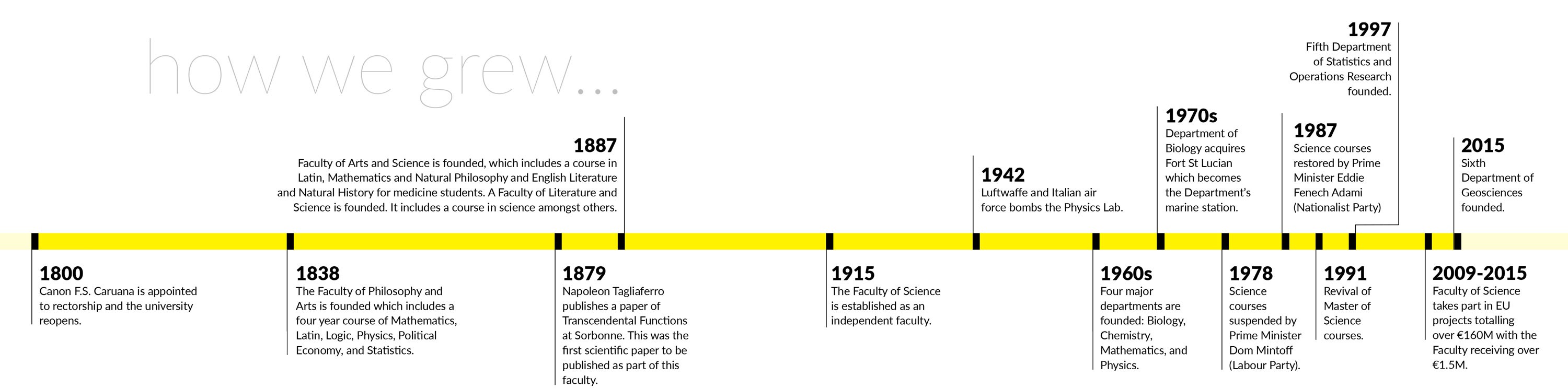
During the mid-1970s, the Faculties of Science and Arts were closed down, and the Bachelor programmes phased out. Most of the foreign (mainly British) academics left Malta, as did some Maltese colleagues. Those few who stayed were assigned teaching duties at the newly established Faculty of Education and Faculty of Engineering. Relatively little research took place, except when funds were unneccessary, and it is thanks to these few that scientific publications kept trickling out.
In 1987, the Faculties of Arts and Science were reconstituted. The Faculty of Science had four ‘divisions’ which became the Departments of Biology, Chemistry, Physics, and Mathematics. In the same year, I returned from the UK to join the Faculty.
Things gradually improved as more staff and students joined. However, equipment was either obsolete or beyond repair. The B.Sc. (Bachelor of Science) course was re-launched with an evening course. Faculty members worked flat out in very poor conditions. The Physics and Mathematics building was still shared with Engineering. Despite these problems, we had a Faculty and identity. Nevertheless, we wanted our courses to be of international repute—our guiding principle.
During the 1990s, yearly budgets had improved slightly along with experimental facilities. Computers and the occasional capital investment helped immensely. Research output increased, as did student numbers, while postgraduate Masters and Ph.D. students started to appear.
Since 2005, some faculty members have been working hard to secure European Regional Development Funds (ERDF) by submitting proposals to reinforce our research infrastructure. A total of six projects were approved with a combined budget of nearly €5 million. This has resulted in new, state of the art research facilities and an exponential increase in research output, bolstered by additional academic staff and research student numbers of close to 80.
Students are now organised and active through S-Cubed, the Science Students’ Society. This leading organisation is one of the three faculty pillars: the academic and support staff, and the student body. Together, we have made giant strides and the future looks bright.
Special thanks to Prof. Stanley Fiorini who helped us compile our timeline, aided by Prof. Josef Lauri.
A Patchwork Mediterranean: Knitting It Together

The Mediterranean is surrounded by over 20 countries each of which claim ownership over its nearby sea. To try and prevent over fishing and other pressures, many countries have set up protected areas. Jessica Edwards talks to Prof. Patrick J. Schembri who leads the Marine Ecology Research Group (Department of Biology) to find out how all of these areas are being linked to protect the Mediterranean Sea from the threats it faces.
Science… Bacteria… Art…

Bacteria are everywhere, from the top of the windswept cliffs of Dwejra, Gozo, right to the core of the ancient catacombs in Rabat, Malta. Anne Marie Dimech met Dr Gabrielle Zammit to learn about the unique bacteria discovered growing on artworks in ancient Maltese temples and how these bacteria could be useful to medicine.
Brain Works
