Underwater Eyes
Water covers 70% of Earth’s surface, but our oceans and seas might as well be alien planets. According to estimates, we’ve only explored about 5% of them so far. Crazy depths and dangerous conditions prevent humans from venturing into the unknown simply because we would be unable to survive. However, these limitations are being overcome. Drone technology can safely explore what lurks beneath the waves, and the Physical Oceanography Research Group from the Department of Geosciences at the University of Malta (UM) are doing just that.
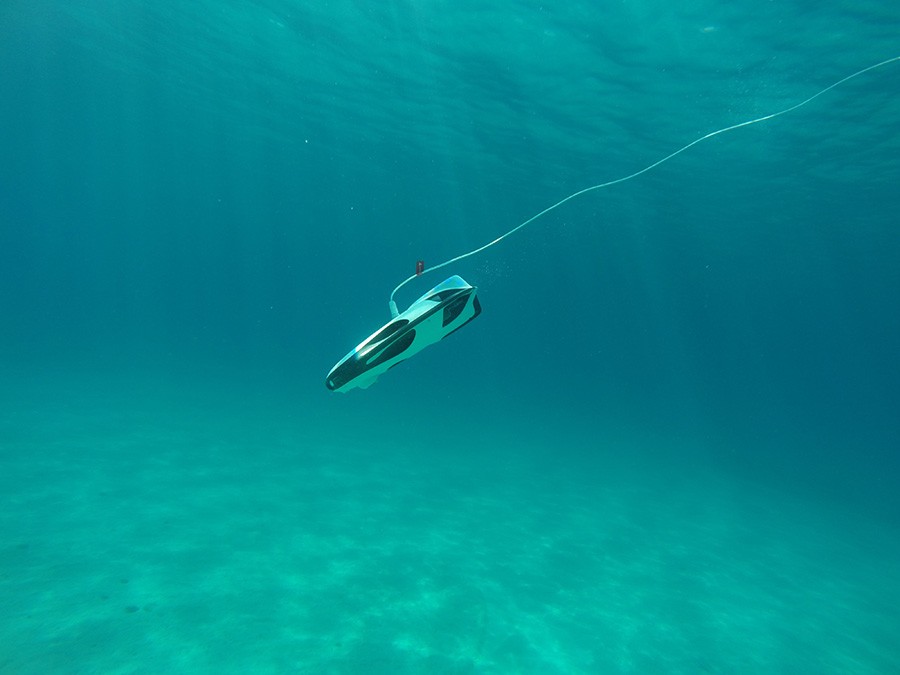
Enter Powervision’s PowerRay Underwater Drone, an intelligent robot. It can capture real-time, high-res images beneath the sea’s surface. It has a wide-angle lens and instrumentation capable of determining temperature, sea depth, and even the presence of fish. Coupled with image processing and machine learning techniques being developed by the group, the drone maps the sea floor, determining its make-up as well as identifying locations where different fish species originate.
The small, lightweight drone can travel up to 1.5m/s and is currently being tested off the coast of Malta near Buġibba. This area has already been mapped manually by divers, which means that, when ready, the drone and human maps can be compared to evaluate the drone’s performance. If the AI algorithm produces accurate results, it will be used to charter unmapped regions—a first from Malta.

But its applications don’t end there. The drone can also be used to monitor the condition of other expensive marine instruments which spend a lot of time underwater. Without having to put on a diving suit, it allows the team to check on deployed water temperature sensors, tide gauges, and acoustic Doppler current profilers. This helps to optimise and plan maintenance, which in turn prolongs the hardware’s lifetime.
The UM team also want to use the technology to detect marine litter. They plan to identify litter ‘hotspots’ in order to raise awareness and organise clean-up campaigns—a valuable initiative to support vital efforts to clean up our oceans.
Author: Kirsty Callan
Player 1: ready to learn
Can digital games form part of the answer to dwindling attention spans in the classroom? Sara Cameron attended the ‘Playful Learning in STEM’ Seminar at the MITA data centre in June to hear entrepreneur Dr Lauri Järvilehto’s thoughts on the matter.
Our attention is constantly bombarded by the likes of mobile games, social media, Netflix, and Google. Adults are having a tough enough time focusing, let alone children sitting at their desks trying to wrap their heads around algebra and particle physics. Textbook lessons are fighting a losing battle with personalised entertainment. But there is light at the end of the tunnel. Dr Lauri Järvilehto, co-founder and chairman of Finnish startup Lighteneer, believes his team might have a solution. Games see kids experience progressive challenges. Children, as players, use diverse problem solving abilities, then receive instant feedback, satisfaction, and a sense of achievement. To ignite that same fire for games in learning, education needs to tap into that world and harness what makes it special. The feat, Järvilehto explains, is finding balance. We need games that contextualise mathematical or scientific concepts, allowing players to master these concepts, all while being engaged and having fun. A tall order.
Gamification has the potential to ease the introduction of subjects that are normally considered complex. It can make them more approachable, allowing students to grasp the basics before undertaking formal learning to further deepen their understanding.
‘Our thinking is that great learning games can work as the first spark for the love of learning in future generations. They can convey the awe and wonder you see shining in the eyes of our scientific experts as they tell us about the wonders of particle physics,’ says Järvilehto, speaking at a seminar called Playful Learning in STEM organised by the Science Centre (Ministry for Education and Employment) in collaboration with Malta Information Technology Agency and the Valletta 2018 Foundation.
But whilst digital learning is becoming all the craze, Järvilehto warns that educators should be wary of jumping on this trendy bandwagon. Technology is not a cure-all; there is no magic wand. Lighteneer aims to develop games that complement, rather than compete with, formal learning. He also believes that, even with an abundance of tech-based tools, an engaging teacher is still the best way to improve education and inspire the next generation. Games should be used as an initial spark to reel students in at the outset. ‘Perhaps kids will soon grow to think about particle physics and atoms as something as cool as collecting Pokémon.’ Game learning can be the key to unlocking students’ potential, offering a more accessible route to developing an understanding of complex topics.
To keep up with a fast-changing digital world, we must acknowledge its challenges and adapt. Games can’t solve this puzzle alone, but used in the right way, they can be a tremendously useful addition to a teacher’s toolbox.
Author: Sara Cameron
Green heat, green power
At face value, renewable energy seems the smartest choice for a cleaner tomorrow. But when green energy cannot be stored, what do we do during scorching summer afternoons and cold winter nights? Cassi Camilleri speaks to Prof. Joseph Cilia and his team to find out more about the innovative solution they are developing.
The movement towards sustainability has been ramping up over decades. Now, it feels like it has reached fever pitch. Headlines are hogged by the latest scary statistic on air, land, or sea pollution. People are rallying, demanding that new measures be implemented to reduce waste and clean up our streets. Despite this call, real advances on these issues always manage to find themselves obstructed by seemingly ‘rational’ arguments.
For one, renewable energy isn’t as reliable and cheap as fossil fuels. Overhauling the status quo is expensive and requires significant effort, both of which make people frown. Solar power depends on the sun, wind power depends on wind, both of which are quite unpredictable. But while this is true, it shouldn’t even be considered an issue. We live in a country on the receiving end of 550,000 GWh of solar energy annually, while we need only 3,484 GWh to cover all energy consumption. Let that sink in.
Of course, I hear your concerns about the quantity of solar panels needed to harvest that energy—Malta is so small and built up. But in reality, only 28% of our island is built up, and just 7% of the remaining land would be required to meet the total energy demand. So yes. There are solutions to our energy woes. And those solutions need to be combined to create the best results.
Thanks to support from Abertax Kemtronics and MCST (Malta Council for Science and Technology), Prof. Joseph Cilia and his team of researchers (Department of Industrial Electrical Power Conversion, University of Malta [UM]) have found that houses with a normal-sized photovoltaic system can supply more than 100% of the total energy they need during summer. During winter, that figure falls to 50%. To manage this drop, energy can be supplied through other sources. Enter the Micro-CHP.
A small combined heat and power (CHP) machine provides seasonal energy in two forms: electrical and thermal. It consists of a standard internal combustion engine coupled with a generator that produces electrical energy. The thermal energy resulting from the engine and exhaust is then recovered using water heat exchangers and reused to heat the house and domestic water.
While similar systems already exist, most are geared towards industrial applications. The rest cost, on average, around €15,000—pricing a large cross-section of society out. The system Cilia and his team have developed makes use of a grid PV system, combined with battery energy storage, a heating and cooling heat pump load, a CHP machine, and LED lighting. It is also an easy-to-install, plug-and-play solution that fits into your current setup, as opposed to a complex installation that would force everything to change with it. By the end of it, the team’s CHP will cost the consumer around €8,000.
Their study of Maltese households showed that in a typical medium-sized household, energy needs vary substantially. The energy fluctuations for a typical Maltese household are usually about 500 kWhr between the summer and winter seasons. In this case, storing this energy in a battery is not feasible. What is feasible is simply making more efficient use of the LPG gas tank that most people already have and use at home. If one wants to be renewable, one can also use ethanol or methanol to operate the CHP, which, if used in combination with a heat pump, can easily reach an efficiency of 150% to 180% in heating mode.
Added to this, the team’s system is unique compared to others on the market. It is connected directly to the main electricity supply, tapping into it whenever the system needs support, while not using mains electricity when enough energy is being produced by the system itself.
The system is scalable due to the plug-and-play concept the system is based on. It can be upgraded as more and more savings are made on electricity bills. ‘The idea is to provide a cost-effective solution that even low-income households can afford,’ says Cilia. This can not only trigger a widespread use of energy generation and storage for domestic use, but also turn consumers into suppliers of their own energy needs. Gone are the days of being dependent on the grid.
Author: Cassi Camilleri
Project A Smart Micro Combined Heat and Power System financed by the Malta Council for Science & Technology, for and on behalf of the Foundation for Science and Technology, through the FUSION: R&I Technology Development Programme.

Sewage works
Water is our number one resource. It not only sustains life, but also supports the economy and its development. And yet, water is taken for granted. Kirsty Callan talks to Marco Cremona, the man behind the revolutionary water treatment solution that promised to reduce Maltese hotels’ water use by 85%.
The new digital divide
Unequal access to technology and the Internet is traditionally termed the ‘digital divide’. Both are expensive, which leaves some people behind. Today the situation has changed, with 98% of minors having home Internet access in Malta. Government targets digitally-deprived students by investing hefty sums to have tech at school. However, there is a new digital divide within formal education, and this time it is not about who uses technology but how they use it.
What is the attitude toward the technology that is being used in class? What is the goal that students are using that technology to accomplish? You can have countless schools on the receiving end of whole shipments of tablets and laptops, but the sad reality is that without an effective strategy, they are unlikely to reap the full benefits of that investment.

If technology is placed within a system that ignores students’ needs and is unresponsive, if not completely resistant, to new teaching and learning methods, the result is completely counterproductive. A teacher’s frustration with students being distracted by their devices is an everyday occurrence, and it needs to be addressed. The question is: Is this a technology-related problem or a more profound issue related to how humans discover and understand knowledge? Are these pedagogical conflicts arising from the presence of technology in class or from an epistemological clash between teachers’ and students’ beliefs about learning and knowledge sharing?
If we define pedagogy as ‘guidance for learning’, we need to provide guidance for a variety of learning methods. By focusing only on the ‘chalk-and-talk’ method of teaching delivery, we may actually limit access to different ways of acquiring knowledge. Besides using technology to enhance teaching, digital tools and resources need to be used to empower students: first to take over the management of their own learning, and second, to pursue different technology-enhanced learning avenues for acquiring, creating, and sharing knowledge. This gives the student better skills in digital and information (critical) literacy, in collaboration, and in networking, hence preparing them for the world of work.
To make this happen, challenges await both teachers and students. Teachers need to welcome new forms of learning, offering guidance and support rather than simply ‘giving students all the information they need to know.’ Students, on the other hand, have to overcome the mental conditioning that links learning directly to teaching so they can stand on their own two feet.
Students and teachers need to work together to adopt a more independent and customised approach to learning, enhanced and transformed through technology.
Author: Dr Philip Bonanno
Entering the Age of the Blockchain of Things
What happens when you put smart washing machines on a blockchain?
In writing this article, Dr Joshua Ellul and Prof. Gordon Pace explain their investigation into how to combine the interconnectedness of all things promised by the Internet of Things with the trust promised by blockchain technologies.Continue reading
Brain Control
The power to control objects with your mind was once a dream held by science fiction fans worldwide. But is this impossible feat now becoming possible? Dr Tracey Camilleri tells Becky Catrin Jones how a team at the University of Malta (UM) is using technology to harness this ability to help people with mobility problems.Continue reading
Escape the (Virtual) Room!

Virtual Reality (VR) has created a whole new realm of experiences. By placing people into varied situations and environments, VR enables them not only to explore, but to challenge themselves and gain skills in ways never thought possible. With applications in medical and psychological treatment, VR is now being used to train surgeons, treat PTSD, and to help people understand what it’s like to be on the autism spectrum. The key to this application is VR’s ability to immerse its users.
Many agree that immersion needs two key ingredients: a sense of presence and interaction with the environment. Interaction comes in three main forms. Selection is about differentiating between items in the environment. Navigation allows travelling from one point to another and observing the environment. Finally, manipulation lets users grab, move and rotate selectable items. In addition to this, VR applications need a setting. Supervised by Dr Vanessa Camilleri and Prof. Alexiei Dingli, I chose to use escape rooms (adventure games where multiple puzzles are solved to leave a room) to experiment with these interaction techniques.
I used escape rooms because they’re highly interactive and naturally immersive systems. And since interaction isn’t a one-size-fits-all scenario, I also applied procedural content generation (PCG) techniques to create the escape rooms themselves.
People selected items using a reticle, a small circle in the middle of the screen which expands or contracts to indicate which objects they could interact with. They navigated the space by looking around through the VR headset and moving their joystick. They manipulated puzzles from a separate screen which I layered on top of the escape room. This allowed them to inspect objects to their heart’s content, while also reducing the amount of clutter in the room.
Since there was no previous work in PCG escape rooms, I had to pave my own way. I used a genetic algorithm, a machine learning algorithm that mimics evolution in biology to select the best solution to a problem, to determine which puzzles and items would be placed in the escape room. I also programmed the game to create the rest of the room, placing floors, ceilings, and everything else that the algorithm didn’t consider. This made the space look like it had been made by an actual person, despite being created through AI.
From the results gathered, most people found that the system allowed them to explore the VR environment in a very natural way. Players said that the room’s generated interaction was consistent, reliable, and fun.
Understanding immersion is critical for VR’s future applications. If we can help people hone these techniques by creating a few games along the way—so be it!
This research was carried out as part of a Bachelor of Artificial Intelligence at the Faculty of ICT, University of Malta
Author: Natalia Mallia
Transcendence through Play
Even though philosophers like Kant and Schiller of the aesthetic tradition never had the opportunity to troll some noobs in Call of Duty or slay a dragon in Skyrim, their views on the concept of play can be critical to our understanding of how the player relates to the game world. Dr Daniel Vella explores the work of aesthetic and existential philosophers. Words by Jasper Schellekens. Continue reading