Look up↑

Earth is just one planet in a solar system that wanders around a galaxy. Each galaxy is unique in its own right, each composed of its special ration of dust, gas, and endless stars. What unites them all is the mysterious dark sky that they float in: the Universe.

A constantly growing expanse of space and time, the Universe’s attractive gravitational force is currently decreasing while its repulsive force is increasing. This repulsive force is referred to as dark energy. It is pushing galaxies apart at an increasing rate, bringing up a flurry of questions. Why is this happening? How does dark energy work? What is the role of magnetism?

To answer these questions and more requires the right tools. Improvements in instrumentation up until now have enabled astronomers to unveil many mysteries, not only in the visible region of our Universe where human eyes are sensitive to electromagnetic waves, but also beyond. This is done through various means. Optical telescopes, such as the famous Hubble Space Telescope, detect the intensity of incoming radiation in the optical band of the spectrum. Fundamentally, all celestial objects emit electromagnetic radiation, among them radio waves.

The observation of cosmic objects in these radio frequencies is defined as radio astronomy. Because radio waves penetrate dust, scientists utilise radio astronomy techniques to explore undetectable areas of space which cannot be seen using visible light by optical telescopes.

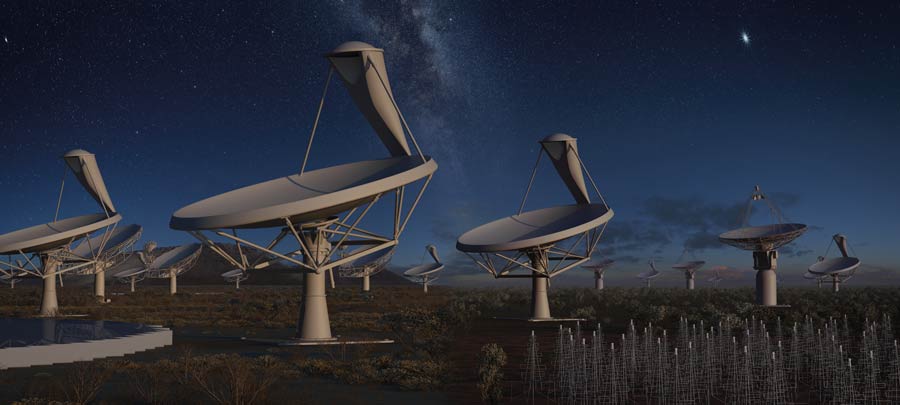
The project is an international effort to build the world’s largest multi radio telescope that will have a total collecting area of approximately one million square metres.

The Square Kilometre Array (SKA) project is the largest project planned for the 21st century. It will see thousands of radio telescopes built in South Africa and Australia. It will enable unparalleled insights into the Universe. The project is an international effort to build the world’s largest multi radio telescope that will have a total collecting area of approximately one million square metres. SKA’s developers are building a system that would operate over a wide range of frequencies, and its size would make it 50 times more sensitive than any other radio instrument. It is set to be able to take images of the sky at up to 10,000 times the speed of current survey radio telescopes.

The University of Malta’s (UoM) contribution to the SKA project is being spearheaded by the Institute of Space Sciences and Astronomy (ISSA). ISSA Founder Prof. Kristian Zarb Adami, Faculty of Science Dean Prof. Charles Sammut, and Iman Farhat are developing an antenna which can be printed like a newspaper and can be rolled out like a carpet.

Unlike conventional antennas which are designed to work optimally at one frequency, the engineering prototype developed at the UoM can sense a large range of frequencies and is capable of running applications such as TV, wireless, Bluetooth, and near-field communications. This was also important because ISSA researchers are trying to detect the first atoms and molecules that were formed at the earliest stages of the Universe. This antenna is also intended to serve as a cost-effective element to cover remote locations for SKA.

The SKA project is scheduled to be built in phases, starting in 2018 and finishing in 2024. Even before the SKA is online, several thousand combined radio telescopes will be collecting and processing data equivalent to 100 times today’s global internet traffic per [unit of time].

The first small scale prototype antenna ISSA built had 256 elements and met SKA’s application and requirements. This was immensely motivating, especially when considering the high standards of this world-wide consortium. The initial success drove home the possibility of further in-depth studies.

ISSA has now embarked on building a large-scale version of the array (funded by the Technology Development Programme of the Malta Council for Science and Technology and Malta Communications Authority). The Malta array demonstrator is an implementation of two antenna arrays. Each array consists of 5,000 elements covering an area of 100 m2. The main aim of this is to test the array in an environment close to its real world conditions. The characterisation of the antenna array radiation pattern is being investigated using a far-field flying source. The system makes use of drones equipped with a transmitter and a dipole antenna that communicates with the array on test. The team is now working on this antenna to ensure a seamless performance.

SKA is a behemoth of a project, involving about 100 organisations across 20 countries. With it, scientists and researchers all over the world will be able to conduct transformational science in astronomical observation, breaking new ground with every step and redefining our understanding of space as we know it.

Key goals include challenging Albert Einstein’s theory of relativity to have a closer look at how the very first stars and galaxies formed moments after the Big Bang. It could also potentially provide an answer to one of the greatest mysteries known to humankind—are we alone in the Universe? SKA-night
THINK BIG: Can Malta produce a Nobel Laureate?

Nobel Medal

by Prof. Godfrey Baldicchino

Iceland (population: 320,000) is proud of writer Halldor Laxness; the even smaller Faroe Islands (pop: 50,000) celebrates its physician and scientist Niels Ryberg Finsen. The combined population of these countries is smaller than Malta’s, yet they have each managed to secure Nobel Laureates: Laxness in Literature in 1955; Finsen in Medicine in 1903. Small size may be a handicap, but—as the Iceland and Faroe examples attest—it is not an insurmountable obstacle. Small size should not prove to be a cheap excuse. So the question is: can Malta produce a Nobel Laureate?

Thinking big can be a powerful motivator. Grand ideas can push publics, enterprises, and governments to achieve the unthinkable. Believe in the impossible, advised the historian Max Weber, and then the possible might just become true. Landing a man on the moon before the end of the decade inspired the US Space Programme in the 1960s. The Live Aid Concerts in 1985 delivered £150 million in famine relief. And the One Laptop Per Child (OLPC) Initiative has equipped 2.5 million children, and counting, across the world.

Malta needs ‘think big’ projects to galvanise the nation. Securing a Nobel Laureate could be one. Developing an underground subway system (and linking Malta to Gozo in the process) could be another. Such projects need not be mutually exclusive. Their trademark would be their ability to engage public opinion, foster national pride, and raise the game to the next level. Naturally, people will continue to talk about politics, the weather, the traffic, the guy or gal next door… but also about these grand accomplishments. Of course, these projects will be controversial; they will have as many sympathisers as dissenters and critics. So? What’s new? That is how it should be.

Securing our political independence was one such dream for the 1960s. Bringing an end to our fortress economy was another aspiration for the 1970s. Joining the European Union was a third. Valletta Capital of Culture for 2018 may be a fourth and is an active project. What’s cooking in the Kitchen of Big and Bold Ideas for Malta for the next few years?

We need to think ahead. Apathy is dangerous, and we need big ideas to keep it at bay.

By the way, St Lucia (population: 150,000) has not one, but two Nobel Laureates: Arthur Lewis for Economics in 1979 and Derek Walcott (born in 1930, still alive at the time of writing) for Literature in 1992. 

Insects taking over

Malta is thought to harbour around 6,000 to 8,000 species of insects. In the last two years almost 200 new records of these fascinating creatures were found around the Maltese Islands, and a new endemic species, unique to Malta, was also described as new to science. Jessica Edwards meets up with Dr David Mifsud to find out more about these amazing findings and why insects really do run the world. Photography by Dr Edward Duca.

Continue reading

1565 – Was it that great?

A historical discovery does not always equal the unearthing of new documents or artefacts. Sometimes it’s about re-evaluating what we already know. Prof. Victor Mallia-Milanes tells Tuovi Mäkipere more.

Continue reading

Let it shine

Malta has a target: by 2020, 10% of the generation of energy should come from the renewables. Luckily, there is a resource which is available almost every third hour a year—sunshine. Dr Ing. Maurice Apap and Ing. Jurgen Bonavia explain how the solar energy can be harvested. Words by Tuovi Mäkipere.

Continue reading

Attacking the silent epidemic of diabetes

 Diabetes prevalence is burgeoning on a global scale. In 2012, 1.5 million people worldwide died as a direct result of the disease, cementing it as an epidemic. By 2030, diabetes is expected to become the world’s seventh leading cause of death. With 12% of the Maltese population suffering from the disease, a research team has come together looking into new methods of detection to stop the disease in its tracks. Words by Yasmine Gatt.

Continue reading

Cultural Regeneration through Urban Spaces and Places

The effects of a European Capital of Culture are felt through both the cultural activities that take place and through the interactions people have with each other as well as the space around them in their everyday lives.

The Valletta 2018 Foundation has been working tirelessly on several projects preparing Valletta for its title as European Capital of Culture in Malta in 2018. More so, it is researching how these projects are changing the lives of people.

These interactions between communities and their surrounding space are key issues being investigated by the Valletta 2018 Evaluation & Monitoring research process. This is a five-year research study examining the impacts of the European Capital of Culture on Malta’s society and economy.

Dr Antoine Zammit, with the Valletta 2018 Foundation, has been studying the relationship between community inclusion and space in cultural infrastructural projects. His research focuses on four specific infrastructural projects taking place in Valletta as part of the European Capital of Culture: The Valletta Design Cluster (il-Biċċerija) and its surrounding neighbourhood; Strait Street; the relocation of MUŻA – Mużew Nazzjonali tal-Arti (Malta’s National Museum of Fine Arts) – to Auberge d’Italie and Pjazza de Valette; and the area surrounding the Valletta Covered Market (is-Suq tal-Belt).

The four projects are in different stages of their implementation, and have been dispersed throughout Valletta in a way that allows them to collide with many of the different districts of the capital. While none lack cultural significance, each project has displayed different strengths in implementation. The Valletta Market and Strait Street Projects have a particularly strong commercial value, while the Valletta Design Cluster is aimed at creative design and encouraging entreprenuership. MUŻA, more overtly than any of the other three projects, is an attempt at traditional forms of cultural engagement and regeneration through the development of a national, community-driven musuem of art. Zammit, together with two M.Arch. (Architecture and Urban Design) students—Daniel Attard and Christopher Azzopardi—carried out extensive studies to gain a deeper understanding of the sites.

“Quality urban design has increasingly become about creating these habitable places. It is ultimately all about the quality of life of residents.”

Attard developed a matrix in order to score the different types of interactions within each site. Split into categories such as ‘aural’, ‘user categories’ and ‘actual use of space,’ the sections help identify emerging patterns and traits from the implementations of the projects. The Biċċerija and Strait Street all score high in the ‘aural’ category, meaning various elements that contributed to noise, or the lack of it, were observed. MUŻA and the Covered Market both qualified for the ‘user categories’ section, meaning that a relatively diverse demographic was observed making use of the place. The Valletta Design Cluster was noted for having a higher level of human interaction take place daily (balcony conversations, loud conversations in general, and so on). Finally, all four sites qualified for the category of ‘actual use of space,’ meaning that people actively show awareness of the space by taking photos, complaining due to lack of public conveniences, construction work, and shops setting up or closing down, among other things.

On the other hand, Azzopardi focused on the spatial quality of the sites by looking at their accessibility and permeability, perception and comfort, and the vitality of the four sites. Of the four, Strait Street, more specifically the intersection with Old Theatre Street, scored highest, followed by MUŻA and the Valletta  Market. The Valletta Design Cluster obtained the lowest score, suggesting that the site in its current state is poorly perceived and somewhat inaccessible. Matching Azzopardi’s findings with statistical data, obtained at a neighbourhood level through the NSO’s evaluation of the available 2011 Census Data, Zammit has determined some relationship (but not statistically significant), between the buildings’ current state of repair and the community’s achievements in literacy, education, and employment.

Museum of the People

Naqsam il-MUŻA is a branch project inspired by MUŻA. Currently in progress, participants in the Naqsam il-MUŻA project were selected from different communities around Malta and taken to see the art collection of the National Museum of Fine Arts. They will then exhibit their choice of artwork from the museum in their localities. It brings the museum to the people, rather than the other way round.

The diversity of the four sites were key to Zammit’s studies. He studied the effect their differing cultural infrastructure had on the cultural regeneration of Valletta. ‘Cultural infrastructure entails those interventions, which generally have some kind of physical implication, in an urban space which tends to enhance and broaden people’s cultural appreciation,’ explains Dr Zammit, ‘but I see it as requiring an added value. In my opinion, art for art’s sake in these cases doesn’t mean anything. Which is why the question which I try to answer in my research is, “what will that infrastructure give back to the community at the end of it all?”’ Other research, similar to Zammit’s, holds that more than just creating spaces, cultural regenerative projects should aim to create places which result from quality urban design. ‘Over the past two years, I started to realise that the real difference is ‘between places that are alive, versus habitable places,’ comments Zammit, who thinks that, ‘quality urban design has increasingly become about creating these habitable places. It is ultimately all about the quality of life of residents.’ This issue of liveability is key to being a European Capital of Culture. Its goals are to create high-quality cultural and artistic activities while improving the quality of life of communities through culture. Zammit’s study highlights many potential issues such as an increase in noise pollution, gentrification resulting from a rise in property values and rental prices, and other potential impacts on Valletta residents. The Valletta 2018 Foundation is discussing these issues in its upcoming conference Cities as Community Spaces in November 2016, which will bring together a number of international speakers to explore how different communities make use of public spaces for creativity, contestation, and interaction. 

For more: valletta2018.org

From Immigrants to Theology

Over 1.82 million migrants entered the EU in 2015 and this has triggered much dialogue across member states. In May 2015, the Archbishop of Malta, H.G. Mons Charles J. Scicluna, after the Vatican announcement of the Year of Mercy, reached out to the academic community to reflect on the immigrant phenomenon. This call set in motion The Mercy Project, which aims to create a set of reflections and recommendations around immigration.

The project has four stages. It first reflected on the issues of mercy and immigration within the Maltese context. During this stage, staff members from various University of Malta (UoM) faculties explored the local situation, reflecting on the terminology used, prevailing concepts and current practices. This was followed by a second stage. Academics held meetings to discuss various viewpoints and realities around migration. Those involved included members from the Faculties of Theology, Arts, Social Wellbeing, Laws, Education, and Health. At the third stage, a symposium on ‘Mercy and the Immigrant’ was held on 6 June 2016. The symposium brought together interested parties and agency representatives to reflect on the issue. This provided a platform for a dialogue between theologians and society. Rev. Dr René Micallef S.J. (Gregorian University in Rome) spoke about the mercy, justice, and policies needed to be considered by Malta and the rest of the EU.

The final forth step is underway. A publication of the project’s position papers is being prepared. This will make available to various sectors of the public some of the philosophical, social, legal, educational, and theological ideas which surfaced during the project’s dialogues and consultations. It will provide concrete recommendations for the University of Malta, State, and the Church. 


Dr Pauline Dimech and Rev. Dr Stefan Attard are the project co-ordinators.