
Let it shine

Malta has a target: by 2020, 10% of the generation of energy should come from the renewables. Luckily, there is a resource which is available almost every third hour a year—sunshine. Dr Ing. Maurice Apap and Ing. Jurgen Bonavia explain how the solar energy can be harvested. Words by Tuovi Mäkipere.
Radio Telescope

Malta now has a radio telescope. This is a great step forward for the University of Malta as it helps speed up research.
The Department of Physics, Faculty of Science and the Institute of Space Sciences & Astronomy (ISSA; both at the University of Malta) have just acquired a 5.3m dual-reflector parabolic dish, as part of a European Regional Development Fund (ERDF) project to extend postgraduate research lab facilities. The radio telescope will now allow students and researchers to study celestial objects such as the sun or the centre of the galaxy through the radio waves they emit.
| Quick Specs |
| Dish diameter: 5.3m
Feed horns: L-Band and K-band Gain: 44 dBi @ 4GHz Observing modes: Continuum and line observation Total weight (including pedestal): 1900 kg Surface accuracy: 0.5mm PC-based automated control unit |
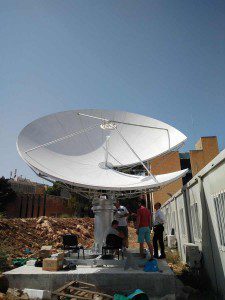
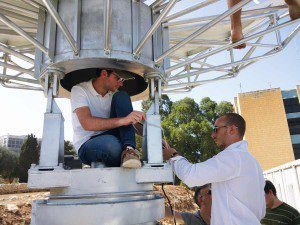 When pointed to a radio-loud celestial object (an object which emits large amounts of radio waves, such as the sun), the telescope will receive radio waves from these sources and convert them to voltage readings in the feed. The converted signal is then transmitted to a digitiser that converts these signals into bits and bytes.
The digitised signals are then processed and broken down into the different frequency counterparts (similar to what a car radio does with the radio waves it receives from its antenna), which allows for continuum observation of the skies above. The telescope provides a test-bed for several research initiatives being undertaken at ISSA.
Some of its specialisations include improving the hardware and software processing back-ends for radio telescopes. The on-site telescope can speed up this sort of research immensely. ISSA is part of the largest radio telescope project in the world: the SKA (Square Kilometre Array).
Using Muscle Activity To Control Machines

Independent living is important to everyone. However, it is a known fact that there are many cases where physical problems prevent people from living without care. To help people regain some independence in their lives there are systems such as Human to Machine Interfaces (HMI). Systems such as these work by using biosignals like Electromyographic (EMG) signals that can be used to control assistive devices. However, some have their drawbacks: prosthetic arms, for instance, are one commonly used device that are at times abandoned due to a lack of dexterity and precision.
The problem is that most of these devices make use of sequential control, where only one function can be articulated at a time— meaning fluid, life-like motions are impossible. Now, most daily activities need simultaneous movement with multiple degrees of freedom. And it is this need that is pushing the creators of these devices to create simultaneous control to mimic real life movements.
Christian Grech (supervised by Dr Tracey Camilleri and co-supervised by Dr Ing. Marvin Bugeja) has developed a system which allows the control of the position of a robotic arm by using the muscle activity of a person. This consists of an HMI which continuously provides the shoulder and elbow joint positions using surface muscle movements. Grech tested the model to develop more freedom, which would lead to fluid movements. He investigated three types of system identification methods (state space models, linear regression models, and neural networks) to develop this relationship between muscle activity and corresponding joint angles. Additionally, seven different movements were tested in real-time using a robotic arm. Grech managed to develop a model that allows prosthetic arms to be used more naturally.
Of course, more research is needed to perfect this device. Ideally it would operate without delay and with minimal user discomfort. The Department of Systems & Control Engineering is carrying out more research to continue to improve the accuracy and robustness of such myoelectric (EMG) controlled devices.
This research was carried out as part of a Bachelor of Engineering degree at the Faculty of Engineering, University of Malta.
l-għ

L-għ is a thoughtful, innovative, and interactive exhibition. The reaction it provokes is from the very base of the senses and is the first final year project exhibition from BFA in Digital Arts degree students organised by the Department of Digital Arts, Faculty of Media and Knowledge Sciences.
The exhibitors chose an intriguing moniker: the most enigmatic and iconic rune in the Maltese alphabet (L-għ). Together they used it as a starting point and explored the thematic elements it connotes. The students tapped into six themes and developed twelve projects.
Despite majoring in animation or graphic design, each artist worked with a subject they discovered and developed over several months. Creativity and variety are abundant, with projects ranging from audio-visual experiments and curatorial work to interactive documentaries and highly thematic visual material. The body of research and thought behind each project sheds recognition on conceptual and creative transformations currently occurring in the practice of art and design. They shift the boundaries of art, design, and media and how they can be used together.
L-għ, the Degree Exhibition of the BFA in Digital Arts (Department of Digital Arts, Faculty of Media and Knowledge Sciences, University of Malta). Artists: Ramon Azzopardi, Matthew Calleja, Caroline Curmi, Darryl Farrugia, Danika Muscat, Angele Pollacco, Lucrezia Rapa, Pascale Spiteri, Michelle Trapani, Siobhan Vassallo, Matthew Vella and Ryan Zammit Pawley.
Thin Coatings For Better Hips

By the year 2030, due to the rise in age-expectancy and accompanying increase in frequency in bone-weakening conditions, total hip replacement surgeries will increase by 174%. One of the most important facets of implant surgery is biocompatibility. Durable implants that are biocompatible with human tissue are needed to prevent rejection and failure. And with this logarithmic expected rise, the need for longer lasting implants will be needed more than ever before.
Currently, metallic biomedical implants are the most common type. These, however, have a limited durability, often requiring surgery to be replaced after a decade. The combined action of wear and corrosion (termed tribocorrosion), brought about by friction during joint movements and the body’s aggressive environment, causes implant failure. A material called biomedical grade 316 LVM stainless steel is commonly used in hip-joint implants. It naturally forms a thin oxide film on its surface that protects the material from the body’s hostile environment. The problem with stainless steels is that despite this natural coat, tribocorrosion processes at the joints still form debris leading to problems for the patient and implant failure. Such failure can cause severe pain and expense when the hip implant needs to be replaced.
Antonino Mazzonello (supervised by Dr Ing. Bertram Mallia and Dr Ing. Joseph Buhagiar), is investigating a new type of coating on hip implants. He is analysing the corrosion-wear performance of a dual-layer coating made up of a Chrome-Nitride (Cr-N) layer followed by a Cobalt-Chrome-Molybdenum-Carbide (Co-Cr-Mo-C) layer deposited on top of low-temperature carburised stainless steel (the coatings are made by Prof. Peter Dearnely [Boride Services Ltd.]. This treatment is owned and carried out by Bodycote Plc. The top layer reduces friction while the bottom layer toughens the coating, reducing its removal. When the dual-layered stainless steel is compared to the untreated steel, the treated material is more resistant to wear and corrosion.
This new dual-coated material promises to be an ideal candidate for hip joint implants. Apart from being harder and more resistant, its low friction means that less effort would be required to move the joint. The encouraging results mean that in the near future this technology could be implemented in clinics. Mallia points out that ‘such multi-layered coatings may offer a giant step in increased durability for a relatively small additional expense.’
This research is being performed as part of a Master’s degree in Mechanical Engineering, which Antonino Mazzonello is reading at the Faculty of Engineering, University of Malta. The research is supported by an Endeavour Scholarship. This scholarship is part-financed by the European Union; European Social Fund under Operational Programme II (ESF) 2014-2020, “Investigating in human capital to create more opportunities and promote the wellbeing of society”.
by Antonino Mazzonello
What Do You Need to Setup An Indie Gaming Community?

Joseph Aldape met indie game developer Rami Ismail to chat about indie gaming communities.
Simple and Powerful: Start-Ups

Yasmine Gatt meets Dr David Darmanin, Founder and CEO of hotjar, who talks about how upcoming entrepreneurs can maximise the use of the virtual word to their advantage
Continue readingRobots in the Classroom

Reuben Ferrante, a University of Malta Engineering graduate and founder of eeRoot, has developed a small robot called eeMod. eeMods are built from only two modules stacked on top of each other. The bottom module is a ‘sensor hub’ that can sense the environment around it. It does so through connections (wifi, bluetooth, USB, microSD card slot), several sensors (gyroscope, accelerometer, light sensors), and a bit more wizardry. The second module is the controller, or brain. Its programmable controller is entirely compatible with the Arduino platform—a standard used worldwide. A set of wheels let’s the eeMod zip around.
Because the robot’s brain is empty by default, it can be hooked up to a computer to upload data. eeMods understand complex instructions and can utilise their senses to act accordingly. Users can start programming by using a very simple Arduino compatible drag and drop interface, and later make the transition to writing their own code. Having all that technology in one sleek package is one of the their unique selling points. Although eeMods were originally designed to streamline the scientific workflow in robotics, it is receiving a lot of attention from educational institutions. The robot’s simplicity allows it to be uses in schools giving children early insight into robotics. Ferrante has received multiple requests to provide a syllabus paired to the eeMods and tailored to Malta’s educational system.
Sphero is another miniature classroom robot, but looks very different from an eeMod. The company SPRK provides a near indestructible ball that can move around via various motors at its core. Recently the developers made it possible to programme Sphero through a smartphone app. For some quick fun the ball can also be remote controlled using the same app. It can move across all kinds of surfaces, and even through water—the perfect classroom bot.
The robots approach education from different angles and target different age groups. eeMods are the perfect device to delve into the technology behind robotics and learn programming algorithms early, while Sphero is a nice toy to play around with, enabling even technophobe people to experience the miracle that robots are.
With an increasing presence in everyday life robots are here to stay, in one form or the other. Allowing children to get familiar with the technology early helps teach lifelong skills and inspire them for the rest of their life.
For more information visit the official eeRoots website.
This article first appeared in ‘Sounds of Science’ in the Times of Malta, May 22 2016.
Science, art, academia: Star Trek

The Star Trek academic symposium will be held at the Faculty of ICT, University of Malta, on 15 and 16 July 2016. This event will be a platform for both academics from various disciplines as well as Star Trek fans to meet and explore the intersection between the humanities and the sciences. There will be inspirational presentations from national and international speakers, with the programme tailored to attract a wide audience. Contributors will be encouraged to explore contemporary issues in medicine, science, and technology as well as philosophical, psychological, and sociological issues connected with the science fiction entertainment franchise Star Trek.
A similar symposium was held in 2014 and which proved to be a worldwide first that successfully drew participation from many international scholars including American philosopher Jason Eberl, UK-based neonatologist and ethicist Neena Modi.
As a result of its success, this second event that marks the 50th anniversary from the launch of Star Trek: The Original Series is being organised. The event will be held under the auspices of the Humanities, Medicine and Sciences Programme (HUMS), a University of Malta programme set up to explore and encourage the interfaces between the humanities, medicine, and sciences. The Science Fiction Symposium will appeal to scientists and fans of science fiction alike..
For more information, visit the website.