Barely two weeks of the coronavirus lockdown measures had passed before people started posting images of cleaner waters and purified air over industrial zones; nature was healing in our absence. Some of them proved to be hoaxes, but others helped us imagine a better world. Martina Borg spoke to some of Malta’s leading researchers and environmentalists to make sense of the feel-good news.
During my final year of studies, I was meant to focus on exams and clinical placements. COVID-19 has upended everything. I felt that volunteering will be my way to keep busy and continue contributing to the general public.
It started with a high school project. ‘Every year, the school needed students to [adopt] a beehive. Eventually I fell in love with bees – like everyone does,’ Dr Daniele Alberoni (University of Bologna) remembers the beginnings of a journey that later became his research, his business, and his lifestyle. He shared these thoughts with THINK when he visited the University of Malta in December 2019. Having become a beekeeper at the age of 16, the Italian scientist is working to develop new remedies against common bee illnesses.
Fruit flies (Drosophila melanogaster) have helped scientists discover innumerable secrets about humanity. Over 1,000 types of these flies are living at the University of Malta’s (UM) Motor Neuron Disease (MND) Laboratory. Each type or ‘stock’ is unique, and UM researchers have generated the majority of stocks through genetic engineering over the last 11 years. Flies need constant care, fly food needs to be freshly prepared, and stocks must be monitored to avoid overpopulation and sudden death. The COVID-19 pandemic has forced universities worldwide to close campuses, leaving researchers to work and teach from home. But research activities, especially the care of living organisms, have to continue even in the face of a shutdown.
‘Man-flu’ memes and the celebration of women’s endurance hide the reality that the medical world routinely downplays women’s pain and disease. Miriam Calleja takes a closer look.
We often hear that women are more tolerant to pain than men. Many are also proud of it. However, in the famous game-changing paper titled ‘The Girl Who Cried Pain: A Bias Against Women In The Treatment Of Pain’ the authors Diane E. Hoffman and Anita J. Tarzian found that contrary to popular belief, women report more severe levels of pain, more frequent pain, and pain that lasts longer than men’s. Three Maltese women found out the hard way that confiding in medical practitioners does not always lead to help.
Culture and gender frame our behaviour around pain perception. Boys were, and some still are, told not to express pain by crying or showing emotion. Girls were told to calm down and not make a fuss. Pain meant weakness. Our language lacks the vocabulary to adequately describe pain. In ‘On Being Ill’, Virginia Woolf writes: ‘English which can express the thoughts of Hamlet and the tragedy of Lear, has no words for the shiver and the headache… The merest schoolgirl, when she falls in love, has Shakespeare and Keats to speak for her; but let the sufferer try to describe a pain in his head to a doctor and language at once runs dry.’
Gendering pain
By analysing a number of studies, Hoffman and Tarzian found that women are ‘more likely to be treated less aggressively in their initial encounters with the healthcare system until they prove that they are as sick as male patients.’ This is a phenomenon known as the Yentl Syndrome. In other words, doctors may brush female pain off as fabricated or exaggerated. This can impact diagnosis, disease progression, and treatment plans —delaying care and fueling mistrust.
Prescribing uterus removal when a woman was ‘rebellious’ may seem like ancient history, but that bias has not fully retreated. Until the early 1990s, women were mostly excluded from clinical research studies and trials in medicine. What we knew about the body, about disease, and about medicine was based on men. Drugs that didn’t work on men, but might have worked on women, were discarded. With incomplete data, the medical world may have lost opportunities to improve women’s health. Have today’s healthcare professionals been trained to counter this gender bias?
Another doctor later referred Karen for an MRI, and the tumour was detected — a life or death analysis.
Antonia* doubts that. As a teenager she developed digestion problems and nausea every time she ate. When she complained, her family doctor downplayed the problem and suggested that she should just stop eating for a couple weeks. After this shocking response she ignored the issue for a long time, suffering in silence. Another doctor chalked it down to ‘growing pains’ and did not recommend a colonoscopy, even though Antonia asked for it.
Having received no satisfying response from her visits to medical professions, Antonia decided to do her own research, discovering that her symptoms matched the description of a condition called Crohn’s. Because of her constant discomfort and pain Antonia had no choice but to persist until she was granted testing and the correct treatment after years of suffering. This means that two doctors would have left her inflamed digestive system untreated, risking further damage.
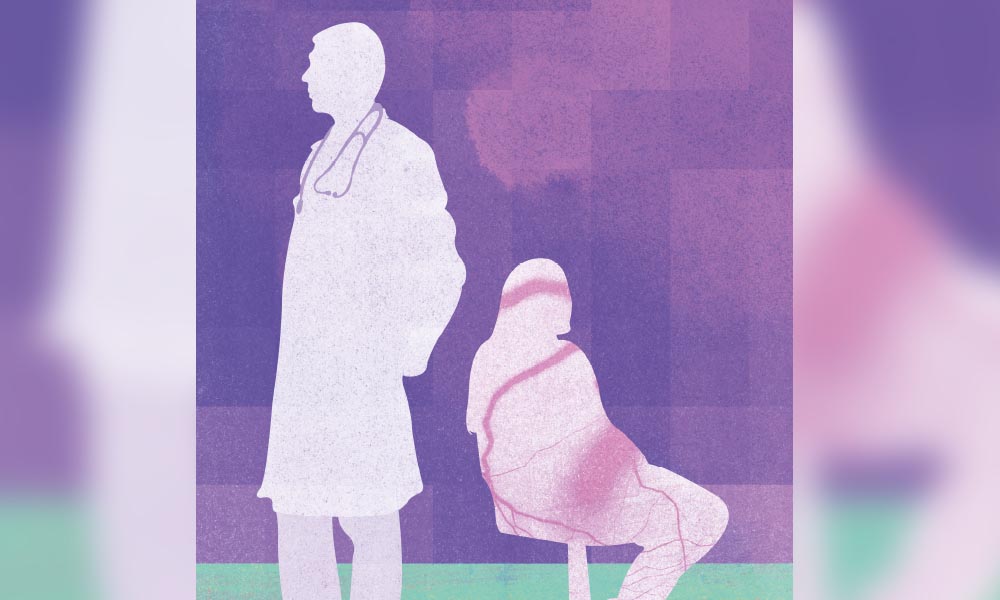
Illustration by Gabriel Izzo
‘It is just a phase’
Women are often told that their ailments are due to stress or other emotional factors. A little rest would solve the problem; it is just a ‘phase’. Some doctors would call a woman insisting on referral for further testing a hypochondriac, even in the presence of positive clinical tests (see e.g. Samulowitz et al. 2018 study and numerous articles in the New York Times, The Atlantic and elsewhere). Thankfully, there are enough doctors who look beyond textbook-like symptoms. They make it a point to listen and investigate as much as necessary. Yet the burden of finding a practitioner ready to listen lies with the patient.
Karen visited her gynaecologist complaining of headaches and substantial weight gain. Test results revealed a high prolactin level, which is normally produced during pregnancy or right after giving birth. Yet when Karen asked to be referred for an MRI to investigate for tumours in the pituitary gland, the doctor refused, telling her that she was ‘making a fuss’. Another doctor later referred Karen for an MRI, and the tumour was detected — a life or death analysis.
Some doctors would call a woman insisting on referral for further testing a hypochondriac, even in the presence of positive clinical tests.
Gynaecologists feature often when discussing gender bias. Without systematic training to counter biases, women are left to ‘shop around’ for a gynae that doesn’t shame them or belittle their wishes. This is surprising for a profession specialising in women’s health.
Reproductive issues open another can of worms. Some women who decide not to have children are treated as though they don’t know what they’re doing. Their doctors imply that the patient will inevitably change their mind, or try to guilt the patient into considering the feelings of a hypothetical man they might meet.
You would think that commitment to bear biological children would be respected, but women who undergo IVF are often treated with insensitivity too. Sandra* and her husband had a harrowing story to tell me. Sandra’s gynaecologist decided to immediately hurry her to IVF after the first visit about their concerns at not being able to conceive. The gynaecologist was rarely present for her many appointments at hospital, leaving Sandra to be passed from one doctor to another, internally examined by various doctors without explanation or prior request for consent. With the exception of one doctor, none of them introduced themselves. All along she tried to ask questions, but was kept in the dark about the situation, going along with the doctors’ instructions but losing trust. The outcome of the first procedure was unsuccessful, and because of how traumatising all this felt, the couple decided not to try again.
Unlearning the bias
Pain is subjective and difficult to measure. An individual’s tolerance to pain is affected by various factors, and pain perception may change with time and experience. Pain causes distress, which makes it difficult to measure objectively. So how can overworked doctors make the best possible assessment?
In her thesis titled ‘The Chronic Pain Management Service: Awareness and Perceptions Among Healthcare Professionals’ (University of Malta, 2008), Maria Campbell studied pain perception in other healthcare professions in Malta back in 2008, finding out that outdated attitudes have not been challenged. She writes, ‘Incomplete knowledge, outdated attitudes, myths, and misconceptions about pain and its management contribute to unsafe, inadequate, and inappropriate pain management.’ Medical practitioners wanted to be more up-to-date: ‘The need for information in the form of leaflets, seminars, and continuing education was echoed in the overall answers (90%) of the close-ended question and in the statements declared by participants.’ But before this training becomes systemic, the radical act of listening to women is a good place to start.
* Name has been changed
Further reading:
Fassler, J. ‘How Doctors Take Women’s Pain Less Seriously’. The Atlantic. October 2015.
Hoffman D.E., Tarzian, A.J. ‘The Girl Who Cried Pain: A Bias Against Women In The Treatment Of Pain’. Journal of Law, Medicine & Ethics, Vol. 29, pp. 13-27, 2001.
Campbell, M. ‘The Chronic Pain Management Service: Awareness and Perceptions Among Healthcare Professionals.’ University of Malta. June 2008.
Lack of clarity amplifies the challenge to come to terms with a disease or disorder. During my research into genetic diseases, I met a Maltese family seeking to understand their condition. Several family members had been diagnosed with hereditary ataxia, a disease that results in some loss of control of normal bodily movements. They had no information about the variation in their DNA that caused the disease.
The relationships between ants and other organisms can be just as complex as the subterranean networks they tunnel. Thomas Cassar takes a closer look at how these insects farm, steal, and co-habit.
Some ants’ tendency to ‘farm’ aphids (plant sap-sucking insects) for their sweet honeydew is decades-old knowledge. Cynics use this phenomenon to downplay the achievements of humans: look, an animal the size of a sesame seed had mastered agriculture long before human beings.
But aphids aren’t alone in this world of ant-coexistence. There’s a specialised group of animals which ignore the opinion of disgruntled roommates worldwide, seeking out the company of others. These are the myrmecophiles, literally ‘ant-lovers’. Such a phrase may conjure up an image of a great expert, maybe someone like the American biologist E. O. Wilson, pouring over an anthill (that would be a myrmecologist). Myrmecophile is an organism that just can’t live without ants.
The Ant Nest Ecosystem
Ants’ nests are prime real estate for the enterprising and the brave. If you can somehow get on good terms with your ant hostesses, you’re guaranteed a temperature-regulated shelter free of predators. And if there’s one thing all living things agree upon, it’s that you don’t say ‘no’ to a free bed and meal. But there’s always an adaptive fee to pay.
Thomas Cassar
There are chambers for the brood, guards, the queen, and for food storage. The nest’s surroundings can yield rich pickings, too — the foraging routes, for instance. But if you’re tiny, good at holding on for dear life, or look like a nightmare straight out of Ridley Scott’s Alien, then the bodies of ants can be your home.
Many mites — tiny arachnids — feed on ants as parasites. The highly specialised mite Macrocheles rettenmeyeri just can’t resist a sip of army ant blood, and to get its meal it latches onto the ant’s last foot segment. But army ants can’t do their job with a bad foot; they form protective clusters by hooking each other’s claws together. So the mite earns its keep by converting its whole body into an extra ant’s foot. When the ant needs to use its claws as gripping hooks, the mite’s legs bend to serve the same purpose.
Antennophorus mites are another kind of ‘considerate’ parasite. Taking up positions on either side of the ant’s head or abdomen, they create a balanced load. Although it would be better for the ant if these thieves of regurgitated food weren’t there at all, this balancing act somewhat reduces the problem.
Patting someone’s head for a snack might not be recommended in human society, but for ants, sharing regurgitated food after a few antennae-taps is a way to communicate and strengthen social bonds among nest-mates. It’s also nutrition on tap for intruders who know how to say the magic word. So apart from lapping up food as it is passed from one ant to another, Antennophorus stroke the ant’s antennae with their legs in a way which mimics the touch signals from other ants requesting food — and hey presto, the host presents a globule of food, glorious food.
The trails of foraging ants can also offer an easy meal. One species which takes advantage is the Amphotis beetle. It waits for ants heavily laden with food, and like a highwayman of the undergrowth, gets the ant to regurgitate food by drumming on its head with its antennae.
Antennophorus stroke the ant’s antennae with their legs in a way which mimics the touch signals from other ants requesting food — and hey presto, the host presents a globule of food, glorious food.
The myrmecophile VIPs have adapted to gain exclusive access to the most precious confines of any nest: the brood chamber. Here, ants tend to their larvae day and night, guarding them fiercely, and feeding them generously. To live a luxurious life here, you need to get under the radar. The ingenious larvae of beetles have learnt to not only mimic the food-begging behavior of the ants’ own larvae, but they mask their intrusive presence by releasing a pheromone which triggers brood-tending behaviour. The beetle has mastered these mechanisms so well that its larvae end up getting a bigger helping of food than the young ants themselves.
You scratch my thorax, and I’ll scratch yours
Many myrmecophilous relationships are truly reciprocal. Some caterpillars of blue butterflies (Lycaenidae) seek out ants’ care and protection in exchange for a concentrated sugar solution secreted by a gland on their back. In some treehopper species, which exchange honeydew for protection, females abandon their young early on to the care of their farmers, being able to produce more clutches of eggs in the meantime.
The benefits of reciprocity can be so great that they may change the way ants live their lives and build their nests. Malaysian herdsmen ants (Dolichoderus cuspidatus) have no permanent nests, instead constructing shelters out of their own living bodies to protect their livestock — honeydew-producing mealybugs. When the mealybugs’ plants run dry and all seems lost, the ants pull up their socks and efficiently transport the mealybugs to fresher pastures. The discovery of this behaviour in 1985 was the first known case of non-human nomadic herding.
To live a luxurious life here, you need to get under the radar.
One need not travel to far-flung forests to appreciate the world of ants. Prof. David Mifsud (Institute of Earth Systems, University of Malta) recently worked on a study which brought the total known ant species in the Maltese Islands up to 70, a world with its own cast of characters. There are clean-up crews of blind, white woodlice scavenging the nests of harvester ants. Golden nicoletiidae silverfish zoom around, feeding on debris and stealing the odd morsel of regurgitated food and getting away with it, because the silverfish have learned to copy their hosts’ nest’s unique identifying odour. A sub-endemic, 4mm-long cricket (Myrmecophilus baronii) lives with carpenter ants, its wings lost in the course of evolution, along with much of its eyesight. A ground beetle (Siagona europaea) uses the secretions of its ant prey to make itself less detectable as it hunts.
From an ant’s perspective, living with other insects rather than eating them may ensure that precious resources are always in stock — much the same reason why humans went from hunter-gatherers to farmers. For the myrmecophile, there is one good reason amongst many for moving in with ants. By providing the ants with a useful resource, you avoid becoming their breakfast, lunch, or dinner. If you can’t beat them, join them.
Further reading:
Mifsud D. & Lapeva-Gjonova, A. (2019). ‘Additions to the ant fauna (Hymenoptera: Formicidae) of the Maltese Islands.’ ARPHA Conference Abstracts 2: e46475.
Talarico, F., Bonacci, T., Brandmayr, P., Dalpozzo, R., De Nino, A., Giglio, A., Tagarelli, A. & Zetto Brandmayr, T. (2009). ’Avoiding ant detection in Siagona europaea Dejean 1826 (Coleoptera Carabidae): an evolutionary step towards true myrmecophily.’ Ethology Ecology & Evolution, 21(1), 45–61. doi: 10.1080/08927014.2009.9522510.
Von Beeren, C., Schulz, S., Hashim, R., & Witte, V. (2011). ’Acquisition of chemical recognition cues facilitates integration into ant societies.’ BMC Ecology, 11(1), 30. doi: 10.1186/1472-6785-11-30.
From feasts to body image issues, eating is more than just staying alive. It makes us feel good and holds communities together. Nutrition and health bloggerMarisabelle Bonnici interviews researcher Dr Analisse Cassar and delves into the science of our attachment to food.
Fibromyalgia is a chronic disability which manifests with aches all over the body and profound fatigue, including headaches, sleeping problems, and difficulty concentrating. Miriam Calleja talks to people who try to make the most of their lives while being held back by this condition.
Can bacteria grow in space? How do cells respond to radiation? Geneticist Prof. Joseph Borg realised that to find out, he must make some friends outside his discipline.