Etna



Noel: I recently saw William Lustig’s Maniac (1980) and Franck Khalfoun’s 2012 remake back-to-back. The latter is rather faithful to the original’s spirit. Frank Zito (played by Joe Spinell [1980] and Elijah Wood [2012]) is more of a textbook psychopath, and more brutal in Khalfoun’s film; but still remains faithful to its source.
Krista: I thought the first’s ‘rawness’ was more brutal. The second had a polished style despite the first person perspective. The 1980 film was grittier.

N: True. The remake looks slicker. For instance, the murder scenes are meticulously choreographed, operatic even. Lustig’s film is truer to life, scarier too, because in his lucid moments the killer acts normal.
K: The first person perspective didn’t convince me. Eventually I even forgot about it till it suddenly jumped to the fore again. It was inconsistent and uneasy without being very unsettling. It reminded me of Peeping Tom (1960), which made better use of the first person perspective.
N: Agree, but it didn’t distract me.
K: I hoped it would be more ‘distracting’. It would have been preferable if the first person perspective had been more defamiliarising, puncturing the viewer’s comfort zone — rather than just being ‘naturalised’.
N: The subjective point of view didn’t help me to get closer to the killer. I only saw this technique being used effectively in Enter the Void (2009). I find it a bit distracting because it can turn into a weird game (Spot the reflection in the mirror!). That said, in Maniac they were well aware of this and tried to have fun with it. The moments when the film veers away from the first person perspective, it sort of clicks into another gear.
K: Good point about the first person perspective being the default here, and the veering away from it becoming a ‘moment’ in itself. It calls to mind Bret Easton Ellis’ book American Psycho (1991).
N: I liked the fact that the remake created a deeper relationship between Frank and the mannequins. They are more than just a manifestation of his childhood trauma — a dysfunctional, promiscuous mother. The restoration of the mannequins is a genuine labour of love which underscores the affection that he nurtures towards the photographer (Anna, played by Nora Arnezeder). She is a mediocre artist unable to hold her camera properly. Frank is the real deal, getting his hands dirty.

K: That’s a well-noted criticism of the photographer. In the first movie, I couldn’t really ‘judge’ whether she was a good artist or not — there wasn’t a focus on her art, instead they showed the world she moves around in, which made me think she was a budding artist. In the second one she’s portrayed as an underwhelming artist. She tries to use the mannequins to underpin her art and to somehow appropriate his by projecting an image of her face onto their blank heads.
N: Besides Anna, two other victims in Khalfoun’s film are a dancer and an agent. In both murders the director abandons the first person perspective, suggesting that either Frank is seeing his actions as a form of art, or that we, the audience, should see Frank himself as a work of art.
K: Yes, perhaps even perverting the sublime into the brutally grotesque. Yet ‘getting his hands dirty’ is counterpoised by the film’s stylishness.
N: So which is better?
K: Both films ultimately do different things. This is down to stylistic differences, enjoyably the remake doesn’t try to ‘replace’ Lustig’s film.
N: Totally agree. They’re like brothers sharing one (hell of a disturbed)
mother, similar yet so different. •
https://www.youtube.com/watch?v=4umIfrP_vMk




This myth is HUGE! Urban legend says that drinking kills cells, some even say: ‘three beers kill 10,000 brain cells.’ Thankfully, they are wrong.
In microbiology labs, a 70% alcohol 30% water mix is used to clean surfaces pretty efficiently. It seems our neurons are made of sturdier stuff.
Alcohol does affect brain cells. Everyone knows that and it isn’t pretty. Alcohol can damage dendrites, which are delicate neural extensions that usually convey signals to other neurons. Damaging them prevents information travelling from one neuron to another — a problem. Luckily, the damage isn’t permanent.

 Way back in 2007, a dedicated group of six people put together a formula-style race car in just six months to compete in a prestigious international competition called FSAE. Since then no other team has participated. Students were always interested to build a racing car but found it too hard to actually carry out — the underlying logistics were simply too much.
In December 2012, a group of motivated university students founded the University of Malta Racing (UoMR) team. Their mission statement: ‘To encourage and facilitate students of the University of Malta to unite together as a team in the planning, design and construction of a Formula-style race car and to participate in the Formula SAE, or similar competitions.” They were brought together by a love of cars, engines, speed and a competitive spirit.
 The 2007 team placed 17th out of 20 teams. The new team has stiff competition and huge challenges to overcome for the upcoming competition in July 2014. Foreign universities compete every year and build a database of knowledge and experience which students use to continue improving their cars. For the UoM to compete eff
ectively with top-class international universities, there must be a strong framework which supports and encourages students from every faculty, especially the Faculty of Engineering. To overcome this challenge the team extensively researched the parts, materials needed and procedure to build a competitive vehicle. The PR and Finance team of the UoMR also drew up a sponsorship proposal, which was used to attract sponsors and collaborators. Without them the project would not be possible.
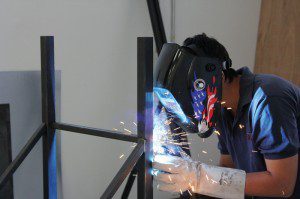
The team is currently working on the car’s design. At the same time they are fabricating some parts and structures inside their workshop at University. They are looking for financial or in kind assistance from driving enthusiasts and organisations. •
For more information on UoMR and contact details visit: uomracing.com. The University of Malta’s research trust, RIDT, fully supports the UoM racing team initiative. The trust aims to sustain and grow the UoM’s research activity. Please consider making a contribution at www.ridt.eu


Malta has three UNESCO world heritage sites which need constant conservation. Generally, it is better to preserve the original building material than replace it. The conservation method called consolidation can glue deteriorating stone material to the underlying healthy stone maintaining it, but few consolidants have been tested on local Globigerina limestone. Sophie Briffa (supervised by Daniel Vella) tested a new set of consolidants which are stronger than other compounds but affected the colour of the stone. She applied five different conditions on the stone. The first three were novel treatments. They were based on a hybrid silane (tetraethylorthosilicate (TEOS) and 3-(glycidoxypropyl)trimethoxysilane (GPTMS)) but one had nanoparticles, one had modified nanoparticles, and the other lacked them. The fourth was a simple laboratory-prepared TEOS silane. The fifth was untreated limestone samples for comparison.
The treatments successfully penetrated the stone’s surface. Microscopy coupled with other techniques including mercury intrusion porosimetry carried out in Cadiz, Spain, confirmed this infiltration and the stone’s physical qualities: strength, drilling resistance, and so on. Half of the treated stones underwent accelerated weathering. The consolidants with nanoparticles or modified nanoparticles were stronger than the other treatments. They also maintained the original surface colour and improved the stones’ ability to absorb water. On the other hand, they were less resistant to salt crystallisation that can damage the stone making it brittle.
The best consolidant for Maltese stone has not yet been found. Ideally, it should have a good penetration and good weathering properties that preserve the stone’s appearance. It should allow ‘breathability’ and be reversible. Current stone consolidation techniques are irreversible since they permanently introduce new material into the stone. These are only acceptable since consolidation is a last attempt to save the stone before complete replacement.
French writer Victor Hugo summed up the importance of this research when he said, ‘Whatever may be the future of architecture, in whatever manner our young architects may one day solve the question of their art, let us, while waiting for new monuments, preserve the ancient monuments. Let us… inspire the nation with a love for national architecture’.
This research was performed as part of an M.Sc. in Mechanical Engineering at the Faculty of Engineering. The research was funded by the Strategic Educational Pathways Scholarship (Malta).