

Words by Dr Claude Bajada
Research is kept behind the closed doors of academic publishers. This creates a problem to access the information for scientific, social, and economic growth.
In a perfect world, results from this research would be accessible to everyone since most research is funded by governments and public institutions. It is not.
Research results are not read by the public for two reasons. First, articles are targeted to the expert reader and are very complex to understand. Public communicators are needed to interpret findings and convey them to the public. Second, the business model of academic publishers places a steep paywall to access articles.
A solution is open access. These articles can be read at no cost. But someone must foot the bill. This is one of the topics that was discussed at the 19th International Conference on Electronic Publishing (ElPub) held at St. James Cavalier in Valletta. It was organised by the University of Malta.
Publishing houses have already started to change their business model to ensure that a certain percentage of their articles are freely available to researchers and to the public. Wim van der Stelt (vice president, Springer) explained that open access publications are increasingly demanded by the academic community. Research that is funded by the public will be accessible to the public. He believes that ‘it is the future’ of publishing.
Countries like the United Kingdom lead the way in this area. In fact research councils in the UK require that publicly funded research is freely accessible to the general public.
Mark Poulton, a librarian at the University of Malta, tells Think that Malta is following suite. ‘The University Library is working on an institutional policy for open access.’ says Poulton. ‘With this in place, all work done at the University of Malta will be freely accessible to anyone who is interested.’ The library has already set up an institutional repository. It contains articles from Maltese academics that have been published with an open access licence. ‘They are freely available to everyone’ explains Poulton.
It is hard to imagine why this topic would be controversial. The answer is money. People are divided in opinion as to who should bear the brunt of having to pay for publication?
Authors are required to pay high premiums to publish their articles under an open access licence. This is not a problem if they come from a wealthy institution, but what if they do not? Some academics also express concerns that high premiums for open access may entice certain journals to publish articles based on payment rather than academic quality.
Van der Stelt says that, ‘while rogue journals do exist, due to the highly competitive nature of academic publications reputable publishers have no incentive to accept low quality work’.
Watch this space for an upcoming podcast discussing the controversies of open access…
Thanks to Prof. Milena Dobreva who organised the conference
UPDATE: There will be a debate about access to information at Science in the City Malta on 25 September, 7pm at Palazzo Ferreria. Join us and have your say!



Yes, hypothetically we can be transformed into brain loving zombies. A scary answer to a scary question.However, before going out to buy a chainsaw to cut those zombies in half please be aware that a human zombie has never existed.
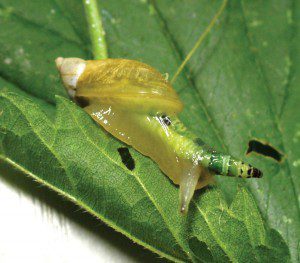
The rest of the animal kingdom isn’t so lucky. Different types of fungi, parasites, and pathogens have altered the life of other organisms and transformed them into zombies. One of the most graphic examples is Leucochloridium paradoxum, a tapeworm which has been observed to infect and take control of snails. After inserting itself into the snail’s body, the tapeworm slowly spreads and concentrates in its eye stalks making these look like tasty green caterpillars. In turn this makes the snail more eye-catching for hungry birds that are an intermediate host for this parasite. If that is not gory enough just wait for the zombie part.
The flatworm makes the snail do its bidding by exposing itself during daylight. By staying on the highest leaves pulsing the eye stalks making them look like tasty morsels ready for the picking by the hungry birds above.
This case is not unique. There are other species which are known to be zombified: ants, flies, crickets, and others. At the time of writing no fungus, parasite, bacteria, or virus has been found to infect and transform humans. Till then there is no need to get your zombie-proof chainsaw and sawn-off shotgun. •

by Matthew Cesareo from the Gadgets team