Aluminium alloys have a low density and are easy to make. These qualities make them popular in the transport industry which can range from cars to planes. A low density makes them perfect to reduce weight in large metal structures. Unfortunately due to poor wear resistance, aluminium alloys can deteriorate quickly which severely limits their applications.
Dr Clayton D’Amato (supervised by Dr John C. Betts and Dr Joseph Buhagiar) modified the surface of an aluminium alloy (called A356) to overcome such limitations by improving wear resistance. D’Amato used a high power industrial CO2 laser to rapidly melt specific regions of the alloy’s surface. He simultaneously introduced additional alloying elements in the melt pool, which mix with the base metal to form new compounds that reinforce the soft aluminium surface. In this way, he formed a strong composite modified surface. Additional experimentation allowed D’Amato to reduce the loss of material due to wear by about 20 times. He optimised the conditions needed to laser process the surface of the aluminium in a uniform and repeatable manner. Adding nickel increased surface hardness 7-fold due to formation of aluminium-nickel compounds. Additional strength was achieved by adding hard ceramics to this aluminium-nickel structure. D’Amato created fine titanium carbide (TiC) particles in a matrix structure (pictured) by alloying a mixture of nickel, titanium and carbon (Ni-Ti-C). Aluminium treated in this way was much stronger.
The exact hardness was related to the mix of alloying elements in the modified surfaces. Hardness improved wear resistance, with large improvements in both surfaces alloyed with nickel and Ni-Ti-C. They lost 20 times less material than normal aluminium preventing severe damage.
Using a high powered laser allows improved wear resistance just where needed. This saves costs and increases versatility. The above technique could be used to manufacture aircraft pump parts, fittings and control parts, and in automotive water-cooled cylinder blocks.
This research was performed as part of a Ph.D. in Engineering within the Faculty of Engineering at the University of Malta. It was partially funded by the Strategic Educational Pathways Scholarship (Malta). This Scholarship is part-financed by the European Union —European Social Fund (ESF) under Operational Programme II—Cohesion Policy 2007–2013, “Empowering People for More Jobs and a Better Quality Of Life”. The laser processing equipment used in this project was financed by the 4th Italian protocol whilst the characterisation equipment was financed by the European Regional Fund (ERDF) through the project “Developing an Interdisciplinary Material Testing and Rapid Prototyping R&D Facility (Ref. no. 012)”.
Would you like to learn about how the cosmos works? Why it relates to our society? In short, how quantum physics can change your life? Then read The Universe Within by Neil Turok.
The laws of mathematics and physics rule our Universe. Neil Turok does not shy away from showing a few equations then devoting pages to what they mean, so you might need to come equipped with some basic mathematical skills.
The Universe Within is yet another astrophysics/quantum physics book talking about our amazing and wonderful Universe. It uses the typical formula of talking about the usual heavyweights like Einstein and Newton amongst others. However, Turok surprises by talking about oft glossed over scientists namely from the Scottish Enlightenment. At the turn of the 18th century, Scotland proved the unlikely source of leading intellectuals such as Adam Smith (who invented capitalism), David Hume (revolutionised philosophical thought), and James Watt (invented the steam engine). Turok also focuses on the achievements of Michael Faraday and James Clerk Maxwell (responsible for finding out the relation between electricity and magnetism, which drives devices from electrical generators to wireless chargers).
Turok loves science. This drive leads to some great moments in the book. He has one of the most beautiful descriptions of the Big Bang, space-time, and Einstein’s E=mc2—you might finally understand them all. He has a nice style if uneven. At times, he falters by being too academic and using overly complicated analogies.
The scientific idea behind the whole book is his explanation to take the Universe into the quantum domain. He sees the Universe as having existed before the Big Bang and that it will exist past the following Big Bang. ‘There was no beginning of time nor will there be an end: the Universe is eternal.’
“He sees the Universe as having existed before the Big Bang and that it will exist past the following Big Bang”
Through this book Neil comes across as an enlightened man. One of his predictions sees the next Einstein arise from Africa. This continent is full of untapped potential and has enough problems to fill all the issues of THINK a few times over. To solve them you need scientists and skilled people. With this in mind he helped set up the African Institute for Mathematical Sciences—a true visionary, who had to flee South Africa due to his parents’ role in trying to bring down British apartheid.
Turok also knows his philosophy. In the beginning, he links Einstein’s thoughts to Hume. Towards the end of the book more philosophical questions arise. This is one of my favourite parts of the book, till he strangely asks: might we be the means for the Universe to gain a consciousness for itself? He also sees quantum physics as a role model for society, and manages to sneak in how quantum computers will evolve with humans making some form of hybrid species.
The author has a good heart. His ideas about the skills today’s children need, how scientists are human, and the meaning of life are beautiful. He also hits the nail on the head when writing, ‘politicians tend to think no further than the next election, scientists no further than the next grant’. This book is worth a read, and if you don’t understand it you’ll definitely look clever having it on your coffee table.
Roderick Micallef has a long family history within the construction industry. He coupled this passion with a fascination with science when reading for an undergraduate degree in Biology and Chemistry (University of Malta). To satisfy both loves, he studied the chemical makeup and physical characteristics of Malta’s Globigerina Limestone.
Micallef (supervised by Dr Daniel Vella and Prof. Alfred Vella) evaluated how fire or heat chemically change limestone. Stone heated between 150˚C and 450˚C developed a red colour. Yellow coloured iron (III) minerals such as goethite (FeOOH) had been dehydrated to red coloured hematite (Fe2O3). If the stone was heated above 450˚C it calcified leading to a white colour. This colour change can help a forensic fire investigator quickly figure out the temperature a stone was exposed to in a fire—an essential clue on the fire’s nature.
While conducting this research, Micallef came across an Italian study that had concluded that different strains of heterotrophic bacteria can consolidate concrete and stone. Locally, Dr Gabrielle Zammit had shown that this process was happening on ancient limestone surfaces (Zammit et al., 2011). These bacteria have the potential to act as bio-consolidants and Micallef wanted to study if they could be used to reinforce the natural properties of local limestone and protect against weathering.
Such a study is crucial in a day and age where the impact of man on our natural environment is becoming central to scientific research. The routine application of conventional chemical consolidants to stone poses an environmental threat through the release of both soluble salt by-products and peeled shallow hard crusts caused by incomplete binding of stone particles. Natural bio-consolidation could prove to be an efficient solution for local application and is especially important since Globigerina Limestone is our only natural resource.
This research is part of an Master of Science in Cross-Disciplinary Science at the Faculty of Science of the University of Malta, supervised by microbiologist Dr Gabrielle Zammit, and chemists Dr Daniel Vella and Prof. Emmanuel Sinagra. The research project is funded by the Master it! Scholarship scheme, which is part-funded by the EU’s European Social Fund under Operational Programme II—Cohesion Policy 2007–2013.
Malta has around 220 beekeepers over just 316 km2. The country’s name is tied to honey that has been prized for its flavour and health benefits. Local researchers are finding out just how unique it is and some of its powerful properties.Continue reading
Growing up on the small island of Gozo, it was inevitable that the sea would exert a powerful influence on me. As a child I never tired of the sea, swimming, cooling off and floating on it in little boats. As I grew older, I came to see the sea as more than just a pretty playground. ‘Where do waves come from?’ ‘What generates sea currents?’ ‘How can I surf a wave?’ Were some questions that aroused my curiosity and motivated me to study the oceans, and eventually to choose to study physical oceanography and fluid dynamics.
Before commencing this journey, I read a B.Sc. (Hons) in Mathematics and Physics (University of Malta), graduating in 2008. Afterwards, I read an M.Sc. in Physical Oceanography, pursuing this qualification while working at the International Ocean Institute — Malta Operational Centre (IOI-MOC, University of Malta). One of the most interesting aspects of my research was studying storm surges around the Maltese Islands. The aim was to develop components to forecast variations in sea level around Malta.
In 2011, I was offered a scholarship at the School of Environmental and Industrial Fluid Mechanics (University of Trieste) in Italy. My Ph.D. research focused on the numerical modelling (Large Eddy Simulation) of coastal areas, in particular, the Barcelona harbour in Spain and the Bay of Taranto in Italy. My objective was to simulate the turbulent water mixing in the ports in order to understand the sea currents and circulation within the bays and thereby to quantify the water renewal within the basins.
Trieste, characterised by the bracing air of the famous Bora wind and by its splendid views of the Adriatic Sea, hosts many world renowned institutions and international organisations. Living in such a ‘city of science’ has allowed me to meet many celebrated scientists at seminars, workshops, and scientific conferences.
Through video conferencing I deliver a weekly physics study unit in Fluid Mechanics at the University of Malta. I am pleased that the beautiful blue Mediterranean waters are still motivating other Maltese students.
My interest in the sea has brought me a long way, not only academically but by experiencing new cultures and indulging my love of cycling along the karst (garigue) coastline.
But I remain at heart that same boy with a love of the sea. I look forward to climbing aboard my trusty kayak, revelling in the ebb and thrust of the rolling waves to continue exploring the rugged coastline of my beloved Gozo.
I chose to study Chemistry and Physics simply because they were the subjects I enjoyed most, so I enrolled on a B.Sc. (Hons) degree at the University of Malta without having a clear idea about what I would be doing once the four years are over. I was not the best brain in the class but in 2004 I graduated with a 2:1 grade and it was quite obvious that I needed a plan. A couple of opportunities to embark on a Ph.D. in Britain came along through local contacts and applications on jobs websites. Despite not knowing much about the subject, I decided to go with the Ph.D. at Exeter University because it was about Nuclear Magnetic Resonance, a subject that sits right on the verge of Chemistry and Physics.
Obviously the idea of moving abroad, living away from my parents and starting this amazing new adventure was incredibly exciting. From the start of my Ph.D. things went incredibly well, it was immediately obvious that I was much better at doing research than studying for exams. I started with looking into dynamics in solid materials on the microsecond timescale, which is the less studied type of motion. It bridges the gap between very fast (spin-lattice relaxation motions, nanosecond) and slow (millisecond to second) timescales. I published my first scientific paper a year into my Ph.D., and five more followed by the time I defended my thesis.
Because of the contacts I built during my Ph.D. as soon as I finished I was offered a post at University College London, Institute of Child Health, working as a research fellow in renal imaging. I carry out research at Great Ormond Street Children’s Hospital using novel non-invasive Magnetic Resonance Imaging (MRI) techniques. I work mainly with children requiring a kidney transplant. The aim of my work is to eventually be able to furnish doctors with information about their patients, which is currently either unavailable to them or they can only get through invasive clinical techniques such as biopsies. My work here has produced six peer-reviewed papers and I am currently working on a few more.
The research I carried out during my Ph.D. involved dealing with basic scientific concepts like Quantum Mechanics — that studies sub-atomic phenomena — and I was at liberty to experiment as I saw fit, which I enjoyed. However, despite being much more restrictive, I find clinical research extremely rewarding. Coming face to face with the people benefiting from all your hard work is really priceless.
Just after my Ph.D. I married my husband. We are now very proud parents of a two-year-old son. Any working mum would tell you that raising a family while maintaining a career is not easy, but I believe that if you like your job enough, combing the two is very worthwhile. Obviously research does not wait for anyone, and luckily for me, having colleagues that supported me meant that I was able to carry on publishing while I was on maternity leave.
Research — that would be the simplest way to answer the question above. Really and truly this answer would only apply to a small niche of individuals throughout the world.
It is a big challenge to explain to people what you do with a science university degree. The questions “Int għal tabib?” (Are you aiming to become a doctor?) or “Issa x’issir, spiżjar?” (Will you become a pharmacist?) are usually the responses. The thing is, people have trouble understanding non-vocational careers — if you are not becoming a lawyer, an accountant, a doctor or a priest, the concept of your job prospects is quite difficult to grasp for the average Joe.
In truth, it is not really 100% Joe Public’s fault — research is a tough concept to come to terms with, ask a good portion of Ph.D. students about that. There seems to be a lack of clarity in people’s minds about what goes on behind the scenes. If you boil it down, everything we use in our daily lives from mobile phones to hand warmers are the spoils of research — a laborious process with the ultimate goal of increasing our knowledge and, consequently, the utility of our surroundings.
“People need to stop feeling threatened by big words and abstract concepts they cannot grasp”
So, then, why exactly is it such an alien concept? I think the reason is that research is very slow and sometimes very abstract. Gone are the days when a simple experiment meant a novel, ground-breaking discovery — research nowadays delves into highly advanced topics, building on past knowledge to add a little bit more. I have complained about this to many of my colleagues on several occasions — and it is more complicated when you are studying something like Chemistry and Physics, or worse, Maths and Statistics — people just do not get it!
Research is exciting. The challenge is how to infect others with this enthusiasm without coming off as someone without a hint of a social life (just ask my girlfriend). It is nice to see initiatives like the RIDT and Think magazine trying hard to get the message out there that research is a continuous process with often few short-term gains. It can be surprising when you realise how much is really going on at our University, despite its size and budget.
To befriend the general public researchers still need to do more. The first step is relaying the message in the simplest terms possible — people need to stop feeling threatened by big words and abstract concepts they cannot grasp. There also needs to be increased opportunities for interaction with research — Science in the City is the perfect example. Finally, I think MCST needs to start playing a larger role — it must work closer to University and take a more coordinated role at a national level. Only then can we begin to explain what us researchers do.
Producing Food products, pharmaceuticals, and fine chemicals leads to hazardous waste and poses environmental and health risks. For over 20 years, green chemists have been attempting to transform the chemical industries by designing inherently safer and cleaner processes. Continue reading
There are over 100 billion galaxies in our universe. Each galaxy has billions of stars. Each star could have a planet. Planets can breathe life. Alessio Magrowrites about his experience hunting for E.T. Illustrations by Sonya Hallett
In 1982, 4 years before I was born, the world fell in love with Spielberg’s E.T. the Extra-Terrestrial. Fifteen years later, the movie Contact, an adaptation of Carl Sagan’s novel, hit the big screen. Although at the time I was too young to appreciate the scientific, political, and religious themes I was captivated and it fired my thoughts. I questioned whether we are alone in this vast space. What would happen if E.T. does call? Are we even listening? If so, how? And, is it all a waste of time and precious money? Instead of deflating me, these questions inspired me to start a journey that led me to my collaboration with SETI, the Search for Extra Terrestrial Intelligence. I participated in ongoing efforts to try and find intelligent civilisations on other worlds.
The debate on whether we are alone started ages ago. It was first debated in Thales, Ancient Greece. Only recently has advanced technology allowed us to try and open up communication channels with any existing advanced extraterrestrial civilisations. If we do not try we will never answer this question.
For the past fifty years we have been scanning the skies using large radio telescopes and listening for signals which cannot be generated naturally. The main assumption is that any advanced civilisation will follow a similar technological path as we did. For example, they will stumble upon radio communication as one of the first wireless technologies.
SETI searches are usually in the radio band. Large telescopes continuously scan and monitor vast patches of the sky. Radio emissions from natural sources are generally broadband, encompassing a vast stretch of the electromagnetic spectrum — waves from visible light to microwaves and X-rays — whilst virtually all human radio communication has a very narrow bandwidth, making it easy to distinguish between natural and artificial signals. Most SETI searches therefore focus on searching for narrow band signals of extraterrestrial origin.
Narrow bands are locked down by analysing a telescope’s observing band — the frequency range it can detect. This frequency range is broken down into millions or billions of narrow frequency channels. Every channel is searched at the same time. SETI searches for sharp peaks in these small channels. This requires a large amount of computational resources, such as supercomputing clusters, specialised hardware systems, or through millions of desktop computers. The infamous SETI@home screen-saver extracted computer power from desktops signed up to the programme, which started as the millennium turned.
E.T. civilisations might also transmit signals in powerful broadband pulses. This means that SETI could search for wider signal frequencies. However, they are more difficult to tease apart from natural emissions, so they require more thorough analysis. The problem is that as broadband signals — natural or otherwise — travel through interstellar space they get dispersed, resulting in higher frequencies arriving at the telescope before lower ones, even though they both were emitted at the same time. The amount of dispersion, the dispersion gradient, depends on the distance between the transmitter and receiver. The signal can only be searched after this effect is accounted for by a process called dedispersion. To detect E.T. signs, thousands of gradients have to be processed to try out all possible distances. This process is nearly identical to that used to search for pulsars, which are very dense, rapidly rotating stars emitting a highly energetic beam at its magnetic poles. Pulsars appear like lighthouses on telescopes, with a regular pulse across the entire observation band.
For the past four years I have been developing a specialised system which can perform all this processing in real-time, meaning that any interesting signals will be detected immediately. Researchers now do not need to wait for vast computers to process the data. This reduces the amount of disk space needed to store it all. It also allows observations to be made instantaneously, hence reducing the risk of losing any non-periodic, short duration signals. To tackle the large computational requirements I used Graphics Processing Units (GPUs) — typically unleashed to work on video game graphic simulations — because a single device can perform tasks of at least 10 laptops. This system can be used to study pulsars, search for big explosions across the universe, search for gravitational waves, and for stalking E.T..
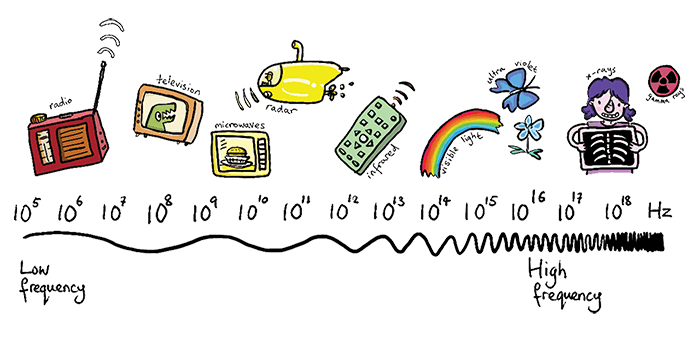
The Electromagnetic Spectrum. Higher frequencies mean higher energies but shorter wavelengths. X-rays and Gamma rays are on the higher end of the spectrum making them so dangerous.
E.T. we love you
Hunting for planets orbiting other stars, known as exoplanets, has recently become a major scientific endeavour. Over 3,500 planet-candidates were found by the Kepler telescope that circles our planet, about 961 are confirmed. Finding so many planets is now leading scientists to believe that the galaxy is chock-full of them. The current estimate: 100 billion in our galaxy, with at least one planet per star. For us E.T. stalkers, this is music to our ears.
Life could be considered inevitable. However, not all planets can harbour life, or at least life as we know it. Humans need liquid water and a protective atmosphere, amongst other things. Life-supporting planets need to be approximately Earth-sized and orbit within its parent star’s habitable zone. This Goldilocks zone is not too far away from the sun, freezing the planet, or too close to it, frying it. These exoplanets are targeted by SETI searches, which perform long duration observations of exoplanets similar to Earth.
“The big question is: where do we look for E.T.? I would prefer rephrasing to: at which frequency do we listen for E.T.?”
By focusing on these planets, SETI is gambling. They are missing huge portions of the sky to focus on areas that could yield empty blanks. SETI could instead perform wide-field surveys which search large chunks of the sky for any interesting signals. Recent development in radio telescope technology allows for the instantaneous observation of the entire sky, making 24/7 SETI monitoring systems possible. Wide-field surveys lack the resolution needed to figure out where a signal would come from, so follow-up observations are required. Anyhow, a one-off signal would never be convincing.
For radio SETI searches, the big question is: where do we look for E.T.? I would prefer rephrasing to: at which frequency do we listen for E.T.? Imagine being stuck in trafficand you are searching for a good radio station without having a specific one in mind. Now imagine having trillions of channels to choose from and only one having good reception. One would probably give up, or go insane. Narrowing down the range of frequencies at which to search is one of the biggest challenges for SETI researchers.
The Universe is full of background noise from naturally occurring phenomena, much like the hiss between radio stations. Searching for artificial signals is like looking for a drop of oil in the Pacific Ocean. Fortunately, there exists a ‘window’ in the radio spectrum with a sharp noise drop, affectionately called the ‘water hole’. SETI researchers search here, reasoning that E.T. would know about this and deliberately broadcast there. Obviously, this is just guesswork and some searches use a much wider frequency range.
Two years ago we decided to perform a SETI survey. Using the Green Bank Telescope in West Virginia (USA), the world’s largest fully steerable radio dish, we scanned the same area the Kepler telescope was observing whilst searching for exoplanets. This area was partitioned into about 90 chunks, each of which was observed for some time. In these areas, we also targeted 86 star systems with Earth-sized planets. We then processed around 3,000 DVDs worth of data to try and find signs of intelligent life. We developed the system ourselves at the University of Malta, but we came out empty handed.
A camera shy E.T.
Should we give up? Is it the right investment in energy and resources? These questions have plagued SETI from the start. Till now there is no sign of E.T., but we have made some amazing discoveries while trying to find out.
Radio waves were discovered and entered into mainstream use in the late 19th century. We would be invisible to other civilisations unless they are up to 100 light years away. Light (such as radio) travels just under 9.5 trillion kilometres per year. Signals from Earth have only travelled 100 light years, broadcasts would take 75,000 years to reach the other side of our galaxy. To compound the problem, technology advances might soon make most radio signals obsolete. Taking our own example, aliens would have a very small time window to detect earthlings. The same reasoning works the other way, E.T. might be using technologies which are too advanced for us to detect. As the author Arthur C. Clarke stated, ‘any sufficiently advanced technology is indistinguishable from magic’.
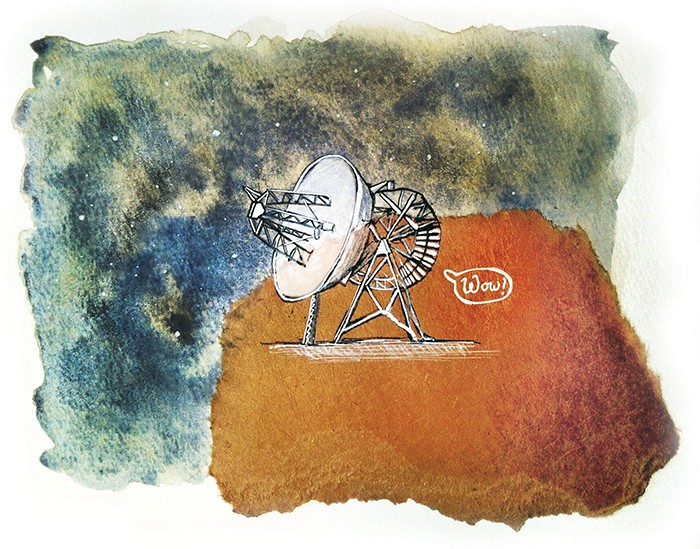
The Wow! signal is a brief, strong radio burst of unknown origin detected by the Big Ear Telescope, SETI search, 1977. If it originated from deep space, it could either be a new astrophysical phenomena or an alien signal.
At the end of the day, it is all a probability game, and it is a tough one to play. Frank Drake and Carl Sagan both tried. They came up with a number of factors that influence the chance of two civilisations communicating. One is that we live in a very old universe, over 13 billion years old, and for communication between civilisations their time windows need to overlap. Another factor is, if we try to detect other technological signatures they might also be obsolete for advanced alien life. Add to these parts, the assumed number of planets in the Universe and the probability of an intelligent species evolving. For each factor, several estimates have been calculated. New astrophysical, planetary, and biological discoveries keep fiddling with the numbers that range from pessimistic to a universe teeming with life.
The problem with a life-bloated galaxy is that we have not found it. Aliens have not contacted us, despite what conspiracy theorists say. There is a fatalistic opinion that intelligent life is destined to destroy itself, while a simpler solution could be that we are just too damned far apart. The Universe is a massive place. Some human tribes have only been discovered in the last century, and by SETI standards they have been living next door the whole time. The Earth is a grain of sand in the cosmic ocean, and we have not even fully explored it yet.
“Signals from Earth have only travelled 100 light years, broadcasts would take 75,000 years to reach the other side of our galaxy”
Still, the lack of alien chatter is troubling. Theorists have come up with countless ideas to explain the lack of evidence for intelligent alien existence. The only way to solve the problem is to keep searching with an open mind. Future radio telescopes, such as the Square Kilometre Array (SKA), will allow us to scan the entire sky continuously. They require advanced systems to tackle the data deluge. I am part of a team working on the SKA and I will do my best to make this array possible. We will be stalking E.T. using our most advanced cameras, and hopefully we will catch him on tape.











 Research — that would be the simplest way to answer the question above. Really and truly this answer would only apply to a small niche of individuals throughout the world.