
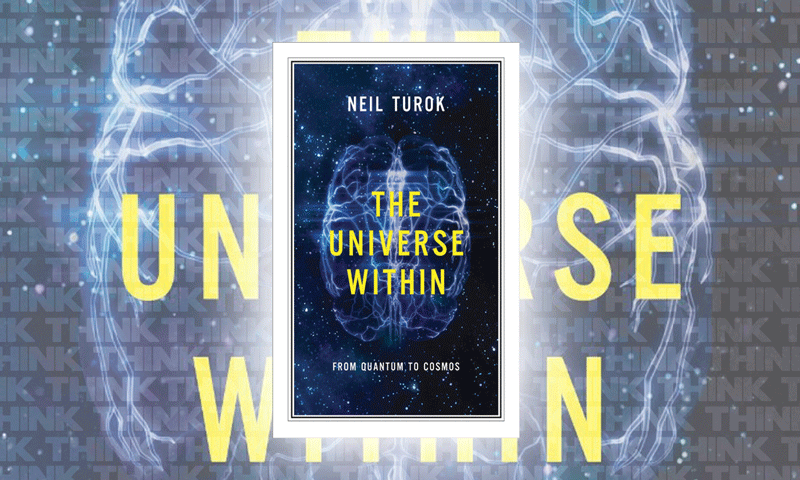

Would you like to learn about how the cosmos works? Why it relates to our society? In short, how quantum physics can change your life? Then read The Universe Within by Neil Turok.
The laws of mathematics and physics rule our Universe. Neil Turok does not shy away from showing a few equations then devoting pages to what they mean, so you might need to come equipped with some basic mathematical skills.
The Universe Within is yet another astrophysics/quantum physics book talking about our amazing and wonderful Universe. It uses the typical formula of talking about the usual heavyweights like Einstein and Newton amongst others. However, Turok surprises by talking about oft glossed over scientists namely from the Scottish Enlightenment. At the turn of the 18th century, Scotland proved the unlikely source of leading intellectuals such as Adam Smith (who invented capitalism), David Hume (revolutionised philosophical thought), and James Watt (invented the steam engine). Turok also focuses on the achievements of Michael Faraday and James Clerk Maxwell (responsible for finding out the relation between electricity and magnetism, which drives devices from electrical generators to wireless chargers).
Turok loves science. This drive leads to some great moments in the book. He has one of the most beautiful descriptions of the Big Bang, space-time, and Einstein’s E=mc2 — you might finally understand them all. He has a nice style if uneven. At times, he falters by being too academic and using overly complicated analogies.
The scientific idea behind the whole book is his explanation to take the Universe into the quantum domain. He sees the Universe as having existed before the Big Bang and that it will exist past the following Big Bang. ‘There was no beginning of time nor will there be an end: the Universe is eternal.’
“He sees the Universe as having existed before the Big Bang and that it will exist past the following Big Bang”
Through this book Neil comes across as an enlightened man. One of his predictions sees the next Einstein arise from Africa. This continent is full of untapped potential and has enough problems to fill all the issues of THINK a few times over. To solve them you need scientists and skilled people. With this in mind he helped set up the African Institute for Mathematical Sciences — a true visionary, who had to flee South Africa due to his parents’ role in trying to bring down British apartheid.
Turok also knows his philosophy. In the beginning, he links Einstein’s thoughts to Hume. Towards the end of the book more philosophical questions arise. This is one of my favourite parts of the book, till he strangely asks: might we be the means for the Universe to gain a consciousness for itself? He also sees quantum physics as a role model for society, and manages to sneak in how quantum computers will evolve with humans making some form of hybrid species.
The author has a good heart. His ideas about the skills today’s children need, how scientists are human, and the meaning of life are beautiful. He also hits the nail on the head when writing, ‘politicians tend to think no further than the next election, scientists no further than the next grant’. This book is worth a read, and if you don’t understand it you’ll definitely look clever having it on your coffee table.




Comments are closed for this article!