Brain to computer interface (BCI) devices can read a person’s thoughts and turn them into commands to move objects. They can give freedom to people suffering from movement impairments. Rosanne Zerafa (supervised by Tracey Camilleri) developed a system that detects a person’s brain patterns while they are thinking of moving a particular part of their body and translates them into commands to move a cursor. The research has the potential to remove considerable lag between thinking of moving an object and it actually moving.
Brain activity can be detected using an electroencephalogram (EEG), which is made up of a cap with electrodes that touch a person’s scalp. The electrical activity captured by the electrodes is then interpreted by a software program to give commands to move a robotic arm, wheelchair, or other assistive device.
Zerafa tested the system on four individuals who were thinking about moving their left or right hand. Different brain patterns from these two tasks could be identified and translated into left or right movement of a cursor on a computer screen.
Taken together, the software could be further developed and tested to improve it for real-world needs such as assisting people with movement difficulties and even gaming.
This research was performed as part of a Bachelor of Engineering (Honours) at the Faculty of Engineering.
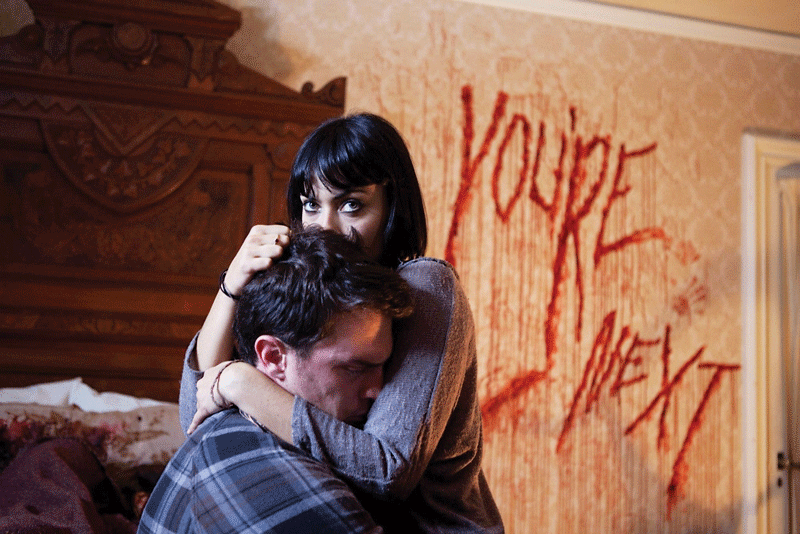
A home-invasion movie with the possible tag-line ‘they got more than they bargained for’. No, it’s not Home Alone—though you may be forgiven for thinking that.
From part of the team that gave us V/H/S, You’re Next bears Adam Wingard’s trademark playful-violent stamp (think Home Alone’s cartoonish violence, with lethal contraptions thrown in). Wingard makes an appearance in both V/H/S and as himself in his segment for The ABCs of Death (‘Q’); though he doesn’t appear in You’re Next, the latter film incorporates a characteristically self-conscious knowing wink, featuring writer Simon Barrett and fellow film-makers Ti West and Joe Swanberg in supporting roles — Ti West’s Tariq introducing himself as a ‘documentary film-maker’, with high ‘intellectual’ (and short-lived) aspirations.
Adam Wingard self-consciously plays with conventions, without quite overturning expectations. The ‘final girl’ slasher convention is here taken a little further, Sharni Vinson’s Erin is not a scream queen fleeing danger, with a dash of luck on her side, she is resourceful and an equal match for the ‘invaders’. The villains’ usual resistance to death is here transferred to a less likely character, in a ‘why won’t you hurry up and die already?’ moment that is brilliantly played up for comic effect.
Little nods to other home-invasion movies frame particular moments: such as an animal-masked figure—simultaneously disconcertingly jarring and ridiculous—sitting on a couch beside a propped-up dead body in an upper-middle class setting, for a quiet Funny Games pause in the action, with an added cartoonish element.
The generally fast-paced action is spaced out with moments of tension, and an effective balance is struck between the danger trying to penetrate into the space of the family/parents’ home, and the danger already ‘within’.
The ‘home’ itself is a newly-acquired house, territory as unfamiliar to the family and guests as it is to the uninvited invaders—not quite lived in, not quite a ‘home’ yet, just as the family-relations are themselves characterised by awkwardness. While lessening the terror that stems from the violation of a warm and safely welcoming homely space, this accentuates the unsettling absence of refuge for the characters, with vulnerable interior–exterior boundaries.
With two striking exceptions, death scenes were disappointingly standard. The premise and set-up of the movie could easily have led to more inventive devices. You’re Next is slasher, home invasion, and murder mystery, all rolled into one; yet, it remains firmly and respectfully within genre conventions. Nothing wrong with this—I’m not about to make any apologies for a genre I have so much affection for. Yet, there is a lingering sense of an opportunity missed—Wingard’s self-awareness and sense of the ridiculous gives a glimpse for greater potential here restrained.
Over the last two decades a relatively new sort of board gaming has emerged which you might not have heard about. ‘Hobby’ or ‘modern’ board gaming is sweeping across the world.
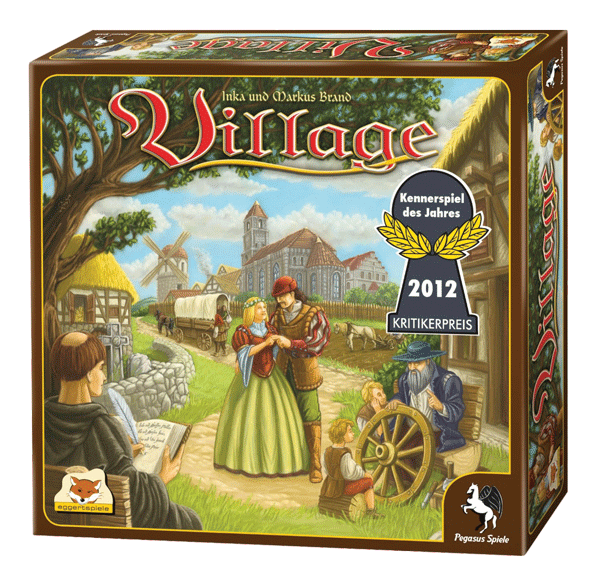
In 1995 The Settlers of Catan by Klaus Teuber changed everything. This is the game that made many Americans realise that there is more to board games than Cluedo and Scrabble. It was family friendly, easy to get into, had a lovely trading mechanic and modular board which changed every time you played it.
Isn’t 1995 late? The ‘Spiel des Jahres’ award (basically the Oscars of Board Games) was founded in 1978. In Germany this genre of board games had been popular long before Settlers of Catan broke the monopoly of Monopoly in the US. Board games go back much further. In 2200 bc, in China, Go had already been invented.
German-style games, or eurogames, are generally regarded as one half of the two over-arching mega-genres in modern board gaming. These sort of games generally feature less luck, a more direct strategy, and less direct player interaction. Winning conditions involve collecting victory points and the design favours symbols over text.
The other half is the American-style, sometimes referred to as ‘Ameritrash’. These are generally the opposite style. War, fighting, killing, rolling piles and piles of dice (therefore luck), and player elimination.
Common themes and styles in American-style games include dungeon crawling (Descent, Claustrophobia), the American Civil War (Battle Cry), and World War II (Memoir 44).
German-style games, on the other hand, tend to have more ‘European’ cultural influences. For example, colonisation of the Americas or medieval farming are common themes (Archipelago, Puerto Rico), as are diplomacy and intrigue at the time of the Inquisition or gaining the King’s favour (Il Vecchio, Caylus).
American-style games sound similar to miniature wargaming and tabletop role-playing games (RPGs), and are definitely inspired by these earlier games. However, board games are different. A board game generally comes in a box which contains everything you need to play with a number of players and most of the time is meant to be played in one sitting. RPGs and wargaming do not follow these rules.
Interestingly, American and German-style games developed in more or less the same period of time in two completely different cultures. This is comparable to the development of the Japanese RPG and the Western RPG in video games.
And today?
Board games are experiencing a golden age. If you had come into the hobby a mere five years ago, the picture was simple. But the worldwide Indie revolution and crowd-funding has also hit board games.
Until a few years ago a few recognisable, high profile game publishers dominated the market. Euro and American style games were easily separated. Now, board games are becoming less and less of a niche hobby. New designers are creating games that combine many different influences from past games. The lines are being blurred. More experimental games and publishers are starting to pop up thanks to crowd-funding, and virtually anyone can publish a game.
In Malta, one of the first locally developed modern boardgames will be published internationally next year— watch this magazine—and others are in development. Exciting times.
David Chircop (and Yannick Massa) topped the Board Game Geek Hotness List for a week and won Best Board Game award at Malta’s first Global Game Jam held on January 24–26, 2014 at the Institute of Digital Games, UoM. See http://maltagamejam.com for next year’s Game Jam or take a course at the Institute http://game.edu.mt to learn how to make your own game. This article forms part of The Gaming Issue.
Robotics is a cornerstone for this century’s innovations. From robot nurses to your own personal assistant, most robots need to know: ‘where is it?’ ‘Where should it go?’ And ‘how to get there?’ Without answers to these questions a robot cannot do much.Continue reading
My career has taken me from industry to research, with a 3-year stint as a business consultant, and EU and local fund evaluator for R&D projects. Now I am back at university managing the consultancy, laboratory services, and training business within the Malta University Consulting Ltd (MUC). The University of Malta (UoM) encourages its staff to engage in activities like these through the MUC. Through this article I hope to encourage UoM staff and outside entities to meet us to talk about their opportunities.
The MUC is one of the subsidiary companies of the UoM that we are revamping. Our new office is located on Campus in the same building as the Knowledge Transfer Office and the Business Incubator TakeOff. Our doors are always open for both academic and technical staff, as well as industry and public entities.
Having carried out research at the UoM and visited foreign research organisations, I have witnessed the UoM develop into a hub of knowledge, resources, and excellence competitive with research institutes abroad. Staff members have expertise in a wide range of areas and can offer technical, educational, business, and scientific advice. Expertise ranges from environment and energy, to sciences, education, engineering, ICT, finance, health sciences, and other areas. The quality of the work is highly professional and competes very well with international levels.
The MUC’s role is to facilitate staff by taking care of the administrative, financial, legal and marketing issues related to networking with industry, allowing them to do what they are best at: deliver the expertise efficiently. Staff and entities are given support to find opportunities and set up teams of experts when projects are multidisciplinary. Projects are managed from their inception to closure — from the preparation of proposals and submission of quotes to chasing deliverables and deadlines. The MUC helps with contract negotiation and legal document preparation for the necessary agreements. It provides insurance coverage and manages the issuing of invoices, and securing and processing payments.
Over the past nine months, with my new role at the MUC, we have been working with a number of local public entities and SMEs (Small to Medium Enterprises) on a number of projects. We have worked on small one-off services that require biological, physical, mechanical, and electrical laboratory tests and larger longer-term projects such as chemical tests with the pharmaceutical industry. Contract research and consultancy projects are generally bigger projects involving teams of experts. We have been involved in projects in the telecommunications, ICT, education, renewable energy, and electronics industries. We also organise Continuous Professional Development (CPD) courses such as digital gaming, Horizon 2020 EU funding, and e-marketing.
We can do much more than we are doing. Our vision is to keep growing slowly but steadily involving other members of staff and other entities. Do contact us—our doors are always open.
E-health uses electronic processes and communications to enhance healthcare. The aim is to improve patient care, reduce costs, and empower patients to work towards maintaining their own well-being.
To work e-health needs a lot of data about patients. This health data is also crucial to discovering new drugs and improving patient care. Using specialised devices and telemedicine, a wide range of conditions can be monitored at home. Smartphones can process the information and transmit it to healthcare professionals and/or patients. Using e-health, conditions can be monitored continuously providing real-time monitoring of the condition and its treatment.
For the full potential of e-health to be realised electronic health records need to be linked to other information, like images and text. This combined knowledge then needs to be distributed through a cloud service, so that a patient or doctor can see it immediately. Genetic profile and socio-economic factors can also be included to provide improved diagnoses and health predictions. In addition, approaches such as data mining offer exciting research opportunities. Data mining can help identify more effective treatments, improve drug safety, reduce risk, and better public health systems. E-health can improve how diseases develop and disabilities are spread throughout different populations.
Assistive technology can be provided through an intelligent healthcare device. These devices include a dispenser that might text you to remind you to take your pills — especially useful for patients with memory problems. If the patient does not take their medication after multiple reminders, the system could automatically alert a family member or carer. This could prove a lifesaver for patients with depression or dementia. Through relatively simple technology, patients can take care of themselves at home, reducing the burden on hospitals.
At the University of Ulster we have been researching e-health solutions for decades. It ranges from cloud computer systems for ‘big’ healthcare data to home-sensor based reminder systems for Alzheimer’s patients. We have also worked with designers to embed sensors into clothing designed to help older people become more active outdoors. Our focus has been to developed new algorithms (computer programmes that do a specific task) to analyse data collected by a system of devices. What we learn from these algorithms can be used to adapt the environment to take better care of the patient. Such feedback is essential to make the technology seamlessly integrate with a patient’s needs and preferences. Feedback could either be through an audio prompt or transmit an alert to a carer indicating that assistance is required. The research opportunities are endless.
In Malta, the University of Malta is well placed to leverage research opportunities for local solutions. Key components are already in place in several faculties, where the focus on Communications and Intelligent Computer Systems is particularly relevant to Malta, with a number of ongoing e-health research projects.
E-health provides business opportunities for the private sector. It can take academic research and use it to develop new technologies, deploy it, or manage it. For example in Northern Ireland there has been a huge interest in developing these business opportunities by creating awareness among investors. This investment can bring improved health and well-being, while supporting economic development. Such developments could be relevant to Malta which is similar to Northern Ireland in having a geographically peripheral location within Europe, an integrated healthcare system, and a technically skilled workforce. Due to its objective of establishing a regional hub for a knowledge-based and ICT-enabled economy, SmartCity Malta could be well placed to bring together the research expertise of the University of Malta and businesses. Together they could advance Malta’s healthcare for everyone.
Prof. Sally McClean is a Professor of Mathematics at the University of Ulster (Belfast, Northern Ireland), and participated in the 2013, Workshop in Information and Communication Technology (WICT) organised by the Faculty of ICT at the University of Malta.