


Technology has made the world a very small place. Using light has transformed communication systems and a web of optical fibres span beneath our streets. This technology is no panacea since light cannot talk to another light beam: currently, ‘translators’ are needed. We want to push forward research into technologies that remove this requirement, addressing both commercial considerations and the underlying mechanisms. Our research is using exotic effects of quantum mechanics to help cut out the middleman and make light talk to light. This would increase speed, make security unbreakable, and improve energy efficiency. Malta’s communication technology would be revolutionised.

In life we are more capable of observing what we easily see. New technologies make it much easier to peek into the nano world to see molecules and atoms. By looking at the very small systems we can understand much larger ones.
Dr Reuben Cauchi (supervised by Prof. Joseph N. Grima, Dept. of Chemistry and Metamaterials Unit) has studied the structural chemistry of particular inorganic crystals (zeolites) through various molecular modelling techniques to learn how nano features result in unusual properties. By using structural chemistry techniques, Cauchi also studied the mechanisms that influenced these unusual properties under different conditions of pressure and temperature. They resulted in some extremely useful properties.
Dr Cauchi observed multiple unusual properties in a single zeolite crystal. Such complex combinations gave birth to the idea that other systems apart from zeolites can have more than one property at the same time. Studying zeolites allowed
the team Cauchi is part of to develop smart systems. These systems can be controlled by changes to stimuli indirectly related to each other, which effect the response to other stimuli.
Zeolites are naturally found crystals and beautiful systems to learn from. Studying such structures may help us think of new ideas and ways for technology improvement. For example, some of Cauchi’s findings are now being used by the Metamaterials Unit to develop smart honeycomb-like systems which can improve heart stent designs or make superior skin grafts.
This research was performed as part of Doctoral Studies at the Faculty of Science at the University of Malta and with the help of Gdansk University of Technology. It is partially funded by the Strategic Educational Pathways Scholarship (Malta). The scholarship is part-financed by the European Union — European Social Fund (ESF) under Operational Programme II — Cohesion Policy 2007–2013, “Empowering People for More Jobs and a Better Quality of Life”. The Metamaterials Unit also acknowledges the funds received from the Malta Council for Science and Technology through their R&I scheme.

 My passion for renewable energies was sparked off during my undergraduate studies in Mechanical Engineering at the University of Malta. Thanks to ERASMUS, I studied at the University of Strathclyde which had a Renewable Energy course that, at the time, was not offered in Malta.
I spent the last year of my bachelor studies designing and testing part of a wind tunnel to simulate atmospheric wind conditions. This test setup allowed for more realistic wind turbine experiments than previous efforts.
Although I wanted to further my career in wind energy, I opted first to broaden my knowledge in the field of renewables by enrolling for the Masters in Sustainable Energy Technology at Delft University of Technology in the Netherlands in August 2010.
Over the first year, I worked on several projects. They included designing a smart grid which was presented at the European Joint Research Centre (JRC). I also helped develop an innovative thermal energy plant that exploits temperature differences between the ocean surface and deep-water (>1km deep) in tropical waters to generate electricity.
Over the second year, I again carried out research in wind energy. At the famed Wind Energy Research Institute of Delft University called DUWIND, I looked into the effect wind turbines can have on each other. When wind turbine blades cut through the wind they can change its direction. This can reduce the efficiency of nearby wind turbines making them produce less energy. My results showed that a turbine’s effect on nearby systems diminishes when the wind distortion it causes is limited either by the wind’s inherent instability or other by properties like its proximity to the ground. By exploiting these wind qualities, a wind farm’s efficiency can be improved by up to 15%.
After my Masters I worked for a year at Eindhoven as a flow and thermal analyst at Segula Technologies Consultancy. I developed new components for a company’s cutting edge lithography machines and for fuel cell system development for BOSAL engineering. Now I have managed to secure a Ph.D. scholarship in wind turbine blade aerodynamics, continuing the work I started in my Masters at DUWIND. This time I am looking into the influence of small flow control devices on the performance of large (10 MW) wind turbines.
Baldacchino was awarded a STEPS scholarship for his Masters studies, which is part-financed by the EU’s European Social Fund under Operational Programme II — Cohesion Policy 2007–2013.


My journey started in 2006, when I started my bachelor in Mechanical Engineering (University of Malta). My passion lay in Materials Engineering, so I focused my undergraduate thesis in this area. I studied ways of improving the corrosion resistance properties of Nitinol, an alloy of Nickel and Titanium. This material is used in many biomedical applications. I built an environment similar to the human body to test the material’s corrosion properties.
After graduating in 2010, I took an M.Sc. in biomedical engineering and specialised in biomaterials (Delft University of Technology, Netherlands). Over this two-year programme as part of my technical internship, I worked at the Orthopaedics Research Department of the Erasmus Medical Centre (Rotterdam). I worked with two other Ph.D. students researching titanium scaffolds for bone defects.
Following my internship, I moved back to Delft and performed another research project again on the alloy Nitinol. We were using it to improve heart stents, tubes used to prop open blood vessels when they are clogged. I created a layer of a ceramic, porous Titanium dioxide, on the surface of Nitinol and then filled the pores with a novel drug that prevents the blockage of blood vessels. Heart stents sometimes fail by getting clogged, the slow release of the drug, which we monitored, would help prevent blockages hence heart attacks at a later date.
But my time in Delft was not yet over. I remained at TU Delft to take up a two-year research position. This time I am researching how natural polymers can be used to make artificial cartilage tissue for patients who need it replaced — a challenging project since I am learning how to set up a new lab for a new subject.
Cuschieri was awarded a STEPS scholarship for her Masters studies, which is part-financed by the EU’s European Social Fund under Operational Programme II — Cohesion Policy 2007–2013.

Theory says yes; practicality says no. Thanks to Einstein time travel is possible. The easiest way is travelling very close to the speed of light. Achieve 99.5% close to light speed means that in 5 years you travel 50 years. Goodbye friends and family you left behind. The harder way is creating a wormhole, a device that can bend space and time, looping it on itself to go into the future or past. The energy required would rival the energy of the stars. Sorry Sci-Fi fans.

The marine environment needs to be conserved because all enjoy it in summer for leisure and fishermen depend on it for their livelihood. Our rocky shores also hold a unique ecology and it must be studied as a whole to understand how a seemingly insignificant crab or limpet can affect other species we might consider more important.
Our natural environment can be likened to a puzzle having thousands of pieces. If one piece is removed or changed, it will result in a different or incomplete picture. Jetties are artificial structures, in an otherwise natural matrix of rocky shore habitat, which add a new piece to the puzzle. They are built at right angles to the shore and are much smoother than natural rock. These differences are expected to change the environment and species living there. Leanne Bonnici (supervised by Dr Joseph A. Borg and Prof. Patrick J. Schembri) studied these jetties to understand how they would affect the big picture.
Bonnici studied three sites on the northeastern coast of the Maltese Islands (Little Armier, White Tower Bay and Għajn Żejtuna). The organisms on jetties in these areas were sampled from the mediolittoral zone — that part of the shore that is regularly submerged and exposed to the air. Sampling showed that the most abundant algae were low-growing green algae (Cladophoropsis sp.), and a red alga (Jania rubens). The algae serve as a source of food and shelter to other species.
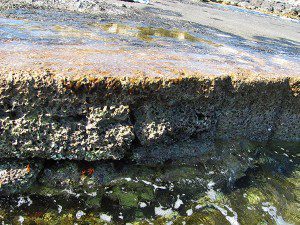
The most common animals were crustaceans, molluscs, and polychaetes. Polychaetes are worms that possess lots of hair-like structures (chaetae). The most common polychaetes were small voracious predators a few millimetres in length. The diverse crustaceans included small cone shaped barnacles (Chthamalus spp.), which spend most of their life attached to rocks. Other abundant crustaceans included minute shrimp-like swimming animals known as amphipods (Hyale sp. and Ampithoe sp.) that are typically found amidst algae. The molluscs recorded included different species of limpets Patella spp., as well as the chiton Acanthochitona sp.; all of these are usually found attached to the substratum, although they do move to graze on algae.
Bonnici found that jetties share some species with rocky shores; however, jetties always had a lower diversity and fewer numbers of individuals living on them. Therefore one can conclude that jetties cannot replace natural rocky shores.
Keeping to the puzzle analogy, if we know how modifying a ‘piece’ of the environment changes the other pieces, it will help maintain the whole picture. This study will help better manage how jetties affect organisms and make the most out of these artificial structures.
This research is part of an M.Sc. in Biology at the Faculty of Science. It was partly funded by the Strategic Educational Pathways Scholarship (Malta), which is part-financed by the European Union – European Social Fund (ESF) under Operational Programme II – Cohesion Policy 2007-2013, “Empowering People for More Jobs and a Better Quality Of Life”.


Whatever you inherit comes from your biological family. Unfortunately, this includes disease. Talking about inherited conditions can make people anxious, making them unwilling to discuss the issue with their relatives. After speaking to a number of people my impression is that it seems taboo to discuss these things. People seem to feel that they will be stigmatised or treated differently because of a genetic condition.
A fear of social stigma hinders beneficial research. Research needs the collaboration of patients, since by investigating their condition researchers can in the long run develop a treatment or therapy. Not only that, but avoiding certain discussions means that relatives who might be at risk of developing the same problem would not be aware of it. If a condition is detected too late there might be very little that can be done.
It is very useful to discuss these matters with your family and speak to your doctor together. By building a medical family tree you can easily see who might inherit what. This way, your relatives will learn more about their health and then seek treatment. For example, a cousin might learn that she has an increased risk of breast cancer and would therefore attend screening sessions to catch the cancer before it spreads. Not knowing that something is there does not make it go away but discussing medical matters with your family could save a relative’s life.
“It is very useful to discuss these matters with your family and speak to your doctor together”
Scientific studies need family medical information. Scientific studies using family trees have already shown how useful this information is in identifying families with a high risk for inheritable cancers, like colon and breast cancer. Other research showed that families can benefit from preventative treatments against cardiovascular diseases like diabetes.
Local research has recently used this technique to find new genes, knowledge that can be developed for new treatments. The researchers were studying the genetic background of the protein which carries oxygen in our blood, haemoglobin. This protein switches from foetal haemoglobin to adult haemoglobin 3–6 months after birth. People with thalassemia have a problem with the adult version. Therefore, by studying local families that naturally cope well with the disease, they discovered the KLF1 gene that compensates for the malfunctioning adult protein by raising foetal haemoglobin levels. This was only possible with the help of family trees.
Speaking to a doctor to prepare a medical family tree (pictured) is done in the strictest confidentiality. You may also create your family medical history on https://familyhistory.hhs.gov/fhh-web/home.action to discuss with your family and doctor. I believe that it is in our best interest, apart from being potentially beneficial to the rest of humankind, to help in the creation of our own family medical trees.
If you have any queries when your physician or consultant asks you to prepare a family tree feel free to discuss them rather than avoiding family trees.


 After repeatedly visiting Asia, I totally disagree with comments occasionally made that China’s industrial success is wholly attributed to its ability to replicate low quality versions of branded products at rock-bottom prices. In China there are many good examples of good quality products and brands being produced such as Audi, Airbus, and Armani. Based on these facts, what Maltese industry and policy makers should focus on is making our industry more competitive by improving the current situation and analyzing products being developed elsewhere.
The Maltese industry is not really dying. Our industry has indeed changed, for example from textiles to pharmaceuticals. Overall, the number of employees has declined. However, this is either due to industry becoming more efficient hence able to produce more with less, or due to the way statistical data is being collected.
Malta’s industrial sector can become more competitive. However, what does it mean to ‘be competitive’? Goods should be produced with shorter delivery periods, better costs and quality compared to competitors. Since we lack raw materials cost is very challenging to compete on. On the other hand, improving quality provides much more opportunity. Quality can be improved by increasing the external quality of the products manufactured, the product’s functionality, the interactions that take place with clients during product development, the quality of support and after sales services, management of operations, and how operators work. Core to adopting this quality-based approach is the need to focus on shifting from just manufacturing products to designing and manufacturing products in Malta.
“Goods should be produced with shorter delivery periods, better costs, and quality compared to competitors”
To design their own products, Maltese manufacturing firms need to set up an internal Research & Development unit. At the same time, industry needs support through government policies and incentives. In their publication ‘Vision 2015’ American consultants clearly specify product design as an enabler to higher value added manufacturing. The Malta Chamber of Commerce, Enterprise & Industry has also recommended starting a Malta Business Research & Innovation Body. These recommendations need urgent implementation to shift Malta’s manufacturing industry towards becoming ‘design driven’.
The UoM’s Faculty of Engineering has been actively contributing towards a design driven approach. Our undergraduate engineers are purposely trained in this design-centric approach. Additionally, some final year student projects focusing on design are sponsored by industry: an excellent win-win mechanism. A number of both mechanical and electrical engineers have also benefited through an evening M.Sc. in Integrated Product Development. The Faculty also collaborates with industry through MCST funded Research & Innovation projects. More financial support to University would help every academic active in research to regularly receive decent research funds.
Considering the above, Malta does not and should not aim to be the next China. On the other hand, Malta should nurture its unique strengths such as a highly educated, flexible English-speaking workforce. We should aim to address weaknesses related to Malta’s manufacturing sector. This requires short-term and long-term commitments from our policy makers. Business leaders can also proactively embrace change by aiming to offer quality and innovative solutions, rather than aiming for higher production rates of existing products. The Maltese industry should support continuous training and collaborate on research activities with University. The UoM can help them become more innovative. Like Airbus, Armani, and Audi, Maltese business leaders should exploit, rather than fear, Asian industry. Some Malta based entities, such as Toly Products Ltd, are already going down these routes and are reaping the rewards of growth during a recession. Clearly others should aim to do the same to keep Malta competitive.