
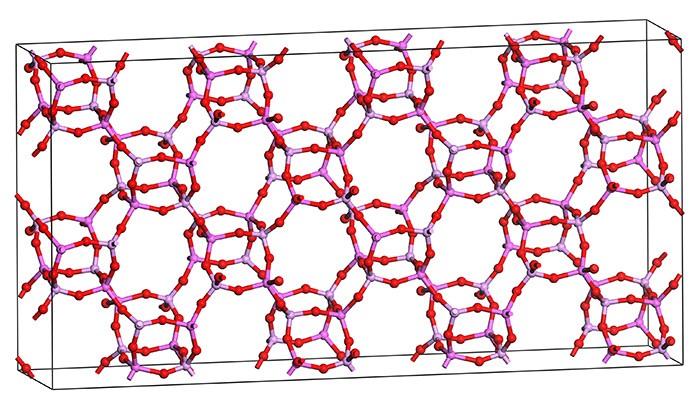
In life we are more capable of observing what we easily see. New technologies make it much easier to peek into the nano world to see molecules and atoms. By looking at the very small systems we can understand much larger ones.
Dr Reuben Cauchi (supervised by Prof. Joseph N. Grima, Dept. of Chemistry and Metamaterials Unit) has studied the structural chemistry of particular inorganic crystals (zeolites) through various molecular modelling techniques to learn how nano features result in unusual properties. By using structural chemistry techniques, Cauchi also studied the mechanisms that influenced these unusual properties under different conditions of pressure and temperature. They resulted in some extremely useful properties.
Dr Cauchi observed multiple unusual properties in a single zeolite crystal. Such complex combinations gave birth to the idea that other systems apart from zeolites can have more than one property at the same time. Studying zeolites allowed
the team Cauchi is part of to develop smart systems. These systems can be controlled by changes to stimuli indirectly related to each other, which effect the response to other stimuli.
Zeolites are naturally found crystals and beautiful systems to learn from. Studying such structures may help us think of new ideas and ways for technology improvement. For example, some of Cauchi’s findings are now being used by the Metamaterials Unit to develop smart honeycomb-like systems which can improve heart stent designs or make superior skin grafts.
This research was performed as part of Doctoral Studies at the Faculty of Science at the University of Malta and with the help of Gdansk University of Technology. It is partially funded by the Strategic Educational Pathways Scholarship (Malta). The scholarship is part-financed by the European Union — European Social Fund (ESF) under Operational Programme II — Cohesion Policy 2007–2013, “Empowering People for More Jobs and a Better Quality of Life”. The Metamaterials Unit also acknowledges the funds received from the Malta Council for Science and Technology through their R&I scheme.




Comments are closed for this article!