
Small islands, big research


In 1994, Czech poet-president Vaclav Havel wrote an article discussing the role of science in helping people understand the world around them. He also noted that in this advance of knowledge, however, something was left behind. ‘We may know immeasurably more about the universe than our ancestors did, and yet it increasingly seems they knew something more essential about it than we do, something that escapes us.’ Almost all traditional cultures looked to the sky for guidance. Cosmology is what gave our ancestors their fundamental sense of where they came from, who they were, and what their role in life was. While arguably incorrect, these ideas created codes of behaviour and bestowed a sense of identity. The cosmology of European prehistoric societies has been studied independently by archaeologists and archaeoastronomers (an interdisciplinary field between archaeology and astronomy). Despite their shared goal of shedding light on our past lives, thoughts, and ideas, the two fields have often failed to merge, mainly due to different approaches. A clear local case is the question of the Maltese megalithic temples.
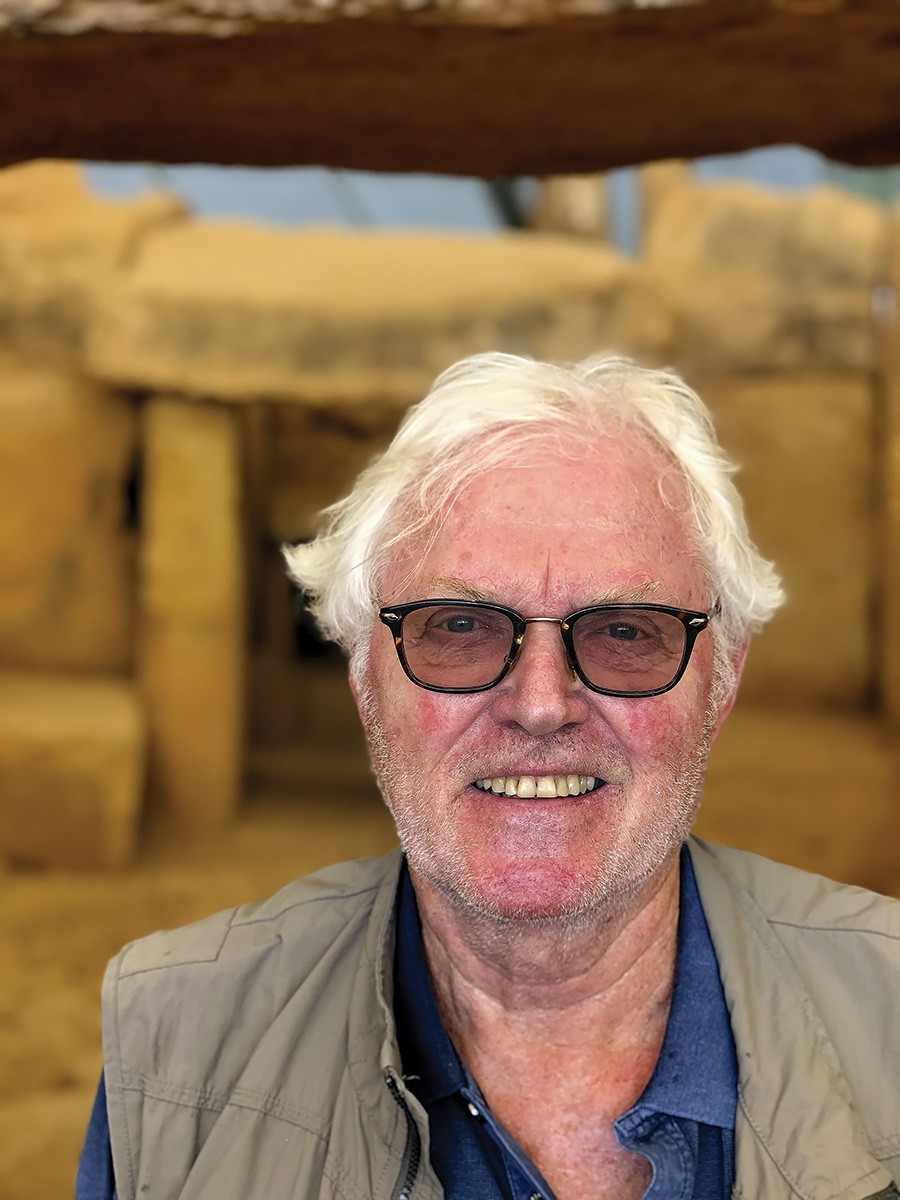
The Mnajdra South Temple on Malta predates both Stonehenge and the Egyptian pyramids. It is the oldest known site in the world that qualifies as a Neolithic device constructed to cover the path of the rising of the sun throughout a whole year. What is unfortunate is that, so far, archaeologists and archaeoastronomers have studied the site largely in isolation.
Whether the temples were built to visualise the effects of the rising sun as seen today is an open question. But with such specific and repetitive patterning, one cannot deny that the sky was an important element in the builders’ understanding of the world—their cosmology.
With some exceptions, archaeologists have largely ignored, excluded, or underrated the importance of the sky in the cultural interpretation of the material record. When studying ancient communities, chronological dating and economic concerns are often given precedence over the immaterial.
But the fault does not lie solely with disinterested archaeologists. Archaeoastronomy has often been too concerned with collecting astronomical and orientation data, neglecting the wider archaeological record, and ignoring the human element in cosmology.
We need to find a common ground. Both sides need to open themselves up to different professional perspectives and convictions and embrace alternative interpretations and possibilities. Bridging the gap between archaeology and archaeoastronomy will allow us to paint a detailed picture of past societies. And maybe it will shed light on that lost knowledge about the universe and our place in it.

Artificial intelligence (AI) has now made its way into the medical world. But it’s not as scary as it sounds. Most forms of AI are simply programs which have been developed to carry out very specific tasks–and they do them very well.
As part of my final-year project, I used AI to develop a program that can diagnose different types of brain haemorrhages. Brain haemorrhages are life-or-death situations where blood vessels in the brain burst and bleed into surrounding tissues, killing brain cells. Speed is key in preventing long-term brain damage, but treatment options depend on the size and location of the haemorrhage. This is when computerised tomography, or CT scans, come in.
Using X-rays, CT scans can image the brain in seconds. Last year, John Napier (another final-year project student) created an AI system to detect brain haemorrhages from CT scans. Building on this, I (under the supervision of Prof. Ing. Carl James Debono, Dr Paul Bezzina, and Dr Francis Zarb) developed a system to take the output from Napier’s system and further analyse the intensity, shape, and texture of haemorrhages to identify them as one of three types.
The AI was trained on 24 pre-classified CT scans. By presenting the scan image to the artificial neural network along with the answer, the system can take on the information and learn. This process trains it to become familiar with the types of haemorrhage. Two different structures of artificial neural network were used with 220 variants each–resulting in 440 variants being used to train and test the model.
Then it was time to test this system. Six scans were given as unknowns and the network successfully classified over 88% of the haemorrhages using only three of the 440 variants.
The purpose of this system is to verify radiologists’ diagnoses. However, we hope to develop it to diagnose haemorrhages, which would help treat patients faster. The system can be adapted to other illnesses–CT scans are commonly used to image the abdomen and chest. The applications, and life-saving potential, are endless.

We’re finally living in a world where environmentalism is a sexy topic. Everywhere you look, it’s vegan-this, plastic-free-that. And it’s wonderful. Public awareness of the impact we are having on our planet is on the rise, and yet, according to Eurostat, Malta still registered the European Union’s highest increase in carbon dioxide emissions from energy use in 2017.Researcher Dr Vincent Caruana (Centre for Environmental Education and Research, University of Malta [UM]), believes the crises we are facing can be summed up in one double challenge: the eradication of poverty and the preservation of the environment. By simplifying the issue, it is turned into a single problem rather than many overwhelming issues, highlighting the interconnectedness of the challenges we face, be they social, economic, or environmental.
Taking Nepal and Bangladesh as examples, both have suffered devastating floods. Some point to large-scale deforestation by logging companies and agricultural businesses, as well as locals using the forests’ resources. Some environmentalists point to the population and blame them, saying that the increasing use of the forest by locals places burdens on the region’s resources, suggesting that their activities are the current major source of environmental problems. But that creates a scenario where the victims of poverty are blamed for trying to alleviate their own poverty. Meanwhile, the reality is that the wealthiest one-fifth of humanity consumes so much more than the rest of the world, leaving the rest hungry.
Who is most to blame for these problems? International institutions such as the United Nations, national governments, transnational corporations, or consumers?
In his classes, Caruana runs his students through a similar thought experiment. Who is most to blame for these problems? International institutions such as the United Nations, national governments, transnational corporations, or consumers? Some argue that it is greedy transnational corporations, out to make a quick buck while ignoring environmental impacts. Some retort, saying that corporations are bound by economy to maximise profits. Others would point their fingers at the consumers who choose to buy from dirty companies instead of the most ethically sourced. ‘Of course, there is no correct answer,’ Caruana states. ‘There is no single solution. We need thousands of solutions working in parallel. Literally. The interconnectedness of it all requires both governments and civil society to commit time and effort.’
Caruana’s doctoral research identifies the influences that lead people to engage in responsible sustainable behaviour and hones in on ways to sensitise and mobilise sustained civic action.
Caruana is quick to note that there are a plethora of barriers—social, economic, and political—which prevent people moving towards sustainability. What surprised him was that more personal barriers, such as frustration, hopelessness, and dealing with disappointments, also pose a problem. ‘This is a significant point, considering that environmental circles are oft en concerned with reaching out towards the unconverted rather than supporting the converted,’ he explains. In other words, we have to continue to motivate those who are already on the right path to ensure they don’t become demoralised.
Looking to understand how people can take control of processes that affect their lives, Caruana conducted four case studies. Among them were an intentional community in Malta and a Fair-Trade network in Egypt. ‘The power of case studies lies in their ability to reframe and critically challenge core beliefs that are now taken for granted, like how a municipality, church organisation, and a trade organisation ought to act,’ he says.
Caruana believes that education on sustainable development (ESD) lies at the heart of it all—and he is not alone. In 2015, representatives from 193 countries gathered in New York to sign off on the 2030 Agenda for Sustainable Development. At the opening ceremony of the summit, Ban Ki-moon referred to the the Agenda outlined as ‘a to-do list for people and planet’. One goal focuses on education, which includes the aim to ‘ensure all learners acquire knowledge and skills needed to promote sustainable development by 2030.’
In Malta, ESD is established as a cross-curricular theme within the National Curriculum Framework. However, ‘in practice, it is still in the process of being concretely translated across schools and within subjects,’ Caruana notes. He also highlights the need for adults to be educated too, so that this cultural shift can truly happen; however, he is quick to follow up the notion with its own weakness. For years, adult ESD has remained ‘locked within ideologies which have caused many of our contemporary environmental problems.’ We need a complete overhaul of our outlook. Increased emphasis on recycling is a positive; however, what would be better is if we could reduce the amount of waste we are creating in the first place. This is but one example. ‘As long as ESD remains stuck within the same thinking that is creating the double challenge, there can be little progress,’ says Caruana.

Back in 2001, Caruana co-founded Malta’s Fair-Trade movement. ‘Faced with the continuous realisation of an unfair world trade system, and seeing first hand through my voluntary work how such a system creates poverty, my friends and I wanted to be proactive and part of a solution,’ he states. ‘The path forward was not chartered for us. We started off passionately, then with each step, we finally arrived to setting up a fair trade shop and an ongoing educational programme. Rather than complain, we have within us the power to create new solutions.’
This philosophy is at the core of what Caruana is doing now. ‘The current model needs to be challenged, and we do have the power within us to create new ways of thinking. We need a shift from thinking in terms of economic growth to growth in wellbeing,’ he says. Referring to the United Nations Conference on Environment and Development in 1992, Caruana says they had it right. ‘A country’s ability to develop more sustainably depends on the capacity of its people and institutions to understand complex environmental choices.’ We need real leaders, not token ones, who inspire, embrace and support citizens in their actions, and create new spaces for dialogue. ‘Both Civil Society Organisations and local institutions can be a positive force towards sustainable solutions at a local level.’
This mission is a beastly mountain. The reality is that there are major hurdles standing in the way of a paradigm shift that would see Malta’s people acting more sustainably. Beyond personal barriers, Caruana’s research reveals the vulnerability of local processes: ‘In Malta, a change in government results in a change in priorities (and support).’ Every five years, the system is shaken by an election that brings with it new agendas and philosophies. ‘Stability in environmental issues and processes is essential,’ he notes. Caruana also points out the fragility of civil societies’ human resources.
The solution, Caruana suggests, is ‘to create stronger links between governments, politicians, organisations, and citizens, both for research and to build a network of adult educators.’ This was highlighted in his Fair Trade case study where success was highly dependent on the level and consistency of engagement at both a local level with producers and with their partners in the west.
It is clear that good leadership is key. To help address this issue, he has created an Erasmus+ project called PEERMENT with the aim of coming up with a new model of mentoring and peer-mentoring for ESD. It involves about 20 education specialists as teacher trainers and senior mentors and about 50 teacher mentees.
‘We have to invest in leadership,’ says Caruana. ‘We need to focus on social learning and empowering institutions and organisations to work together and become innovative co-creators of new ways of thinking. In an ever-changing world, this is a challenge for educators to embrace with passion and urgency.’
Circling back to the double challenge, it is clear that no one project will be able to comprehensively solve the issues we are facing as a global society. But ‘we have to stop waiting for permission,’ says Caruana. ‘The beauty of the emerging paradigm lies in the reality that we don’t need permission to change outmoded mind-sets that no longer serve us.’ And this will be crucial in the road ahead.


In this overwhelming world of apps, chats, commercials, and instant everything, we’re fighting for our attention at every turn. We sometimes barely have time to think about our decisions, often regretting what we did or what we bought a short while later.Resurrected from old Buddhist teachings, mindfulness is being touted as the answer to the varying needs and demands of modern society. New-age ‘gurus’ offer courses that claim to change our life in seconds. To me, this has always sounded like a mission impossible.
Daydreaming poses a challenge for me. Ideally, it should give us the space to absorb new information and figure out potential options for future decisions and behaviour. But most of the time, programming takes over. We mentally analyse events and their effects—we worry—failing to be present.
The ability to create a mindful space in our thoughts can be developed through regular mindfulness meditation. The practice involves a lot of deep breathing, slowing down, observing our passing thoughts, and absorbing our surroundings. There are even apps to help boost our levels of mindfulness.
While this might seem like fluff to some, studies have found clear evidence for the positive effects of such practice. Meditation has been shown to have a positive effect on well-being and emotional regulation. Some research also shines light on its therapeutic benefits for anxiety and depression. Research shows that mindfulness gives us extraordinary insights. Those who practice regularly say that they experience the present reality to a sharper degree, absorbing small details that usually get lost. Imagine, instead of automatically reacting to your surroundings, being able to focus in the moment so that you can actually choose your next step with intention. That is power!
Personally, I found that a month of dedicated practice sharpened my attention. I started noticing small things and gestures that, before, would just pass me by. It drove the amount
of wasted time down significantly. I made better decisions. It wasn’t easy to sit there with all my thoughts, but it definitely trained my mind to overcome challenging tasks.
We can all benefit from regular mindfulness practice. Go on and try it for yourself. Take a deep breath, slow down, and pause. Seize the moment. Be.

What if I told you that I could explain why the sky is blue through dance? All I would need is a fiddle player, a flautist, and a guitarist. By the end of it, we would all be dancing around like particles, hopefully with a better understanding of how the world around us works. This is exactly what neuroscientist and fiddle player Dr Lewis Hou does on a daily basis. Sitting through a boring science class with a teacher blabbing on about how important the information is might be a scene way too familiar for all of us. The science ceilidh (a traditional Scottish dance) aims to combat this misconception that science is all about memorising facts. Bringing people together to better understand and represent the processes within science through interpretative dance and other arts, the ceilidh has been proving a fruitful way of engaging people who would normally not be interested in science or research. ‘For us, that’s a really important guiding principle— reaching beyond those who usually engage,’ says Hou.
It all starts by bringing everyone together in one room. Researchers, musicians, and participants all get together. Researchers kick off the conversation by explaining what their work is and why it is relevant. Hou then helps the rest of the group break the scientific process down into its fundamental steps, be it photosynthesis, cell mitosis, or the lunar eclipse. The next step is translating each of the steps into a dance. And this is where everyone gets involved.
For us, that’s a really important guiding principle— reaching beyond those who usually engage.
Thinking back on how the idea came together, Hou says his first motivation to combine dance and science came when he was playing music and calling ceilidhs, all while attending as many science festivals as he could. ‘I realised there’s a big crossover with the spirit of folk music and dance—it’s all about participation and sharing. Everyone takes part even if they aren’t experts—and that is what we want to achieve in science communication. We want to encourage more people to feel able to participate without being scientists.’
‘Importantly, the nice thing about ceilidh dance is that they might be simple, but it also means that many people can join in and dance,’ emphasises Hou. Back in the studio, aft er having understood the science and its concepts, everyone works together to create the choreography. The science merges with their artistic interpretation. It is no longer something out of reach; it is now owned by everyone in the room.

Water covers 70% of Earth’s surface, but our oceans and seas might as well be alien planets. According to estimates, we’ve only explored about 5% of them so far. Crazy depths and dangerous conditions prevent humans from venturing into the unknown simply because we would be unable to survive. However, these limitations are being overcome. Drone technology can safely explore what lurks beneath the waves, and the Physical Oceanography Research Group from the Department of Geosciences at the University of Malta (UM) are doing just that.
Enter Powervision’s PowerRay Underwater Drone, an intelligent robot. It can capture real-time, high-res images beneath the sea’s surface. It has a wide-angle lens and instrumentation capable of determining temperature, sea depth, and even the presence of fish. Coupled with image processing and machine learning techniques being developed by the group, the drone maps the sea floor, determining its make-up as well as identifying locations where different fish species originate.
The small, lightweight drone can travel up to 1.5m/s and is currently being tested off the coast of Malta near Buġibba. This area has already been mapped manually by divers, which means that, when ready, the drone and human maps can be compared to evaluate the drone’s performance. If the AI algorithm produces accurate results, it will be used to charter unmapped regions—a first from Malta.
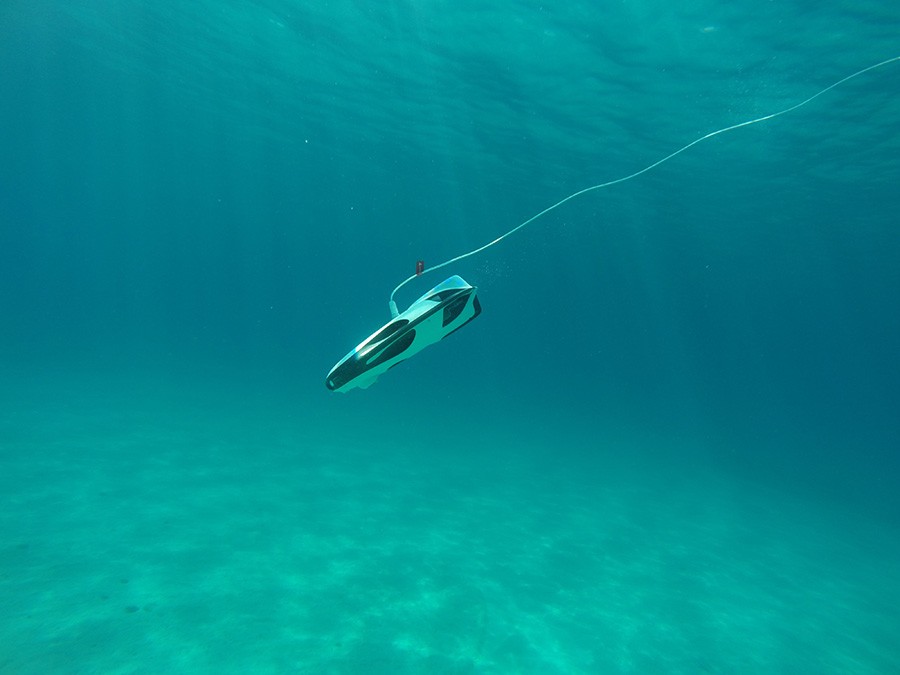
But its applications don’t end there. The drone can also be used to monitor the condition of other expensive marine instruments which spend a lot of time underwater. Without having to put on a diving suit, it allows the team to check on deployed water temperature sensors, tide gauges, and acoustic Doppler current profilers. This helps to optimise and plan maintenance, which in turn prolongs the hardware’s lifetime.
The UM team also want to use the technology to detect marine litter. They plan to identify litter ‘hotspots’ in order to raise awareness and organise clean-up campaigns—a valuable initiative to support vital efforts to clean up our oceans.

‘I’d sell a kidney for that!’ Most of us have been guilty of using this expression when faced with something desirable. But do we fully appreciate the real value of what we are offering before the words escape our lips?
Kidneys are our body’s official waste disposal system, filtering out toxic build-up from our blood, which can poison us if left unchecked. With kidney failure posing such a threat, renal research has become an ongoing global goal.
A team of scientists from the University of Malta is currently honing in on what may cause children to be born with ‘CAKUT’, or Congenital Anomalies of the Kidney and Urinary Tract.
With between three and six cases recorded per 1000 live births worldwide, CAKUT is the most common cause of end-stage kidney disease in children. Since early identification of these anomalies may reduce kidney damage later in life, the LifeCycle Malta Foundation has raised funds for a renal research programme which targets CAKUT and its causes.
‘We know that a number of children are born with a kidney defect, but in many cases, we are not sure why,’ explains the programme’s principal investigator, Dr Valerie Said Conti . ‘There are many factors that can affect the development of the kidney, both genetic and environmental. We are trying to understand those influences so that we can carry out preventative strategies, diagnose issues earlier, and target personal therapeutic interventions.’
A number of children are born with a kidney defect, but in many cases, we are not sure why.
For this team of renal researchers, the first three years of initial research has been the first step in a far longer journey. ‘We hope to contribute our data to the international literature pool,’ continues Prof. Alex Felice, consultant and supervisor on the programme. ‘We will need a massive amount of data to create a robust theory with which to progress. We hope that our findings regarding CAKUT will be useful when we come to the stage of creating new interventions.’
It’s an end-game that has kept the small team focused as they approach the programme’s expected completion date this year. Having had to start literally from scratch, they collected biological samples from patients with a range of kidney diseases, including CAKUT, nephrotic syndrome, and Bartter syndrome. This allowed them to build the renal disease collection at the Malta BioBank, a vital storehouse for scientists.
‘For research projects like this, you see what material is available and you work with it,’ explains Said Conti . ‘A big part of it so far has been sourcing the samples from families attending the clinic with their formal consent for the material to be used in this project. We are hugely grateful to those who accepted to take part in the research. Without them, it would have been impossible.’
This project has set the groundwork for renal research in Malta to continue. ‘Without funding, projects such as this one simply could not exist,’ Said Conti remarks of the €100,000 donation LifeCycle Malta Foundation made to RIDT. ‘It enabled us to employ a full-ti me Research Support Officer, involve other laboratories, attend international meetings to share insights, perform ultrasound tests, and invest in ‘Next Generation DNA Sequencing’, genetic technology that maps out genes, revolutionising our world.’ But there is much more to come.
The Founder of the LifeCycle Malta Foundation, Personal Fitness Consultant Alan Curry, agrees. ‘Renal failure is an ever-increasing problem with figures going up every year, and LifeCycle is the only NGO that is actively supporting renal patients and their families in Malta. Our annual LifeCycle Challenge, which this year is routed from Dubai to Oman, aims to raise €150,000. It’s a huge responsibility, but we are sure that, by funding research programmes such as this, we will significantly improve the lives of kidney patients.’
