
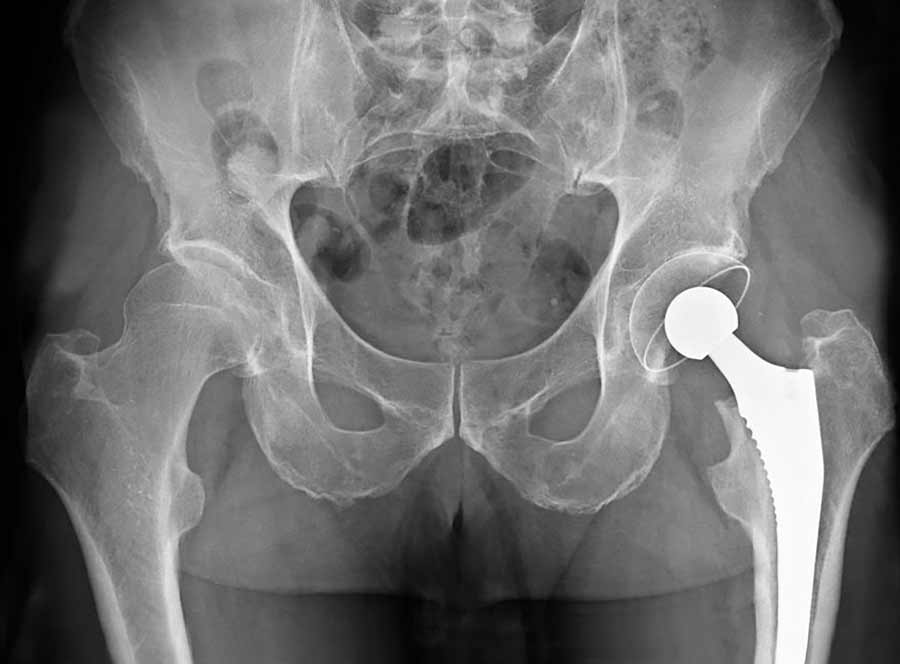
By the year 2030, due to the rise in age-expectancy and accompanying increase in frequency in bone-weakening conditions, total hip replacement surgeries will increase by 174%. One of the most important facets of implant surgery is biocompatibility. Durable implants that are biocompatible with human tissue are needed to prevent rejection and failure. And with this logarithmic expected rise, the need for longer lasting implants will be needed more than ever before.
Currently, metallic biomedical implants are the most common type. These, however, have a limited durability, often requiring surgery to be replaced after a decade. The combined action of wear and corrosion (termed tribocorrosion), brought about by friction during joint movements and the body’s aggressive environment, causes implant failure. A material called biomedical grade 316 LVM stainless steel is commonly used in hip-joint implants. It naturally forms a thin oxide film on its surface that protects the material from the body’s hostile environment. The problem with stainless steels is that despite this natural coat, tribocorrosion processes at the joints still form debris leading to problems for the patient and implant failure. Such failure can cause severe pain and expense when the hip implant needs to be replaced.
Antonino Mazzonello (supervised by Dr Ing. Bertram Mallia and Dr Ing. Joseph Buhagiar), is investigating a new type of coating on hip implants. He is analysing the corrosion-wear performance of a dual-layer coating made up of a Chrome-Nitride (Cr-N) layer followed by a Cobalt-Chrome-Molybdenum-Carbide (Co-Cr-Mo-C) layer deposited on top of low-temperature carburised stainless steel (the coatings are made by Prof. Peter Dearnely [Boride Services Ltd.]. This treatment is owned and carried out by Bodycote Plc. The top layer reduces friction while the bottom layer toughens the coating, reducing its removal. When the dual-layered stainless steel is compared to the untreated steel, the treated material is more resistant to wear and corrosion.
This new dual-coated material promises to be an ideal candidate for hip joint implants. Apart from being harder and more resistant, its low friction means that less effort would be required to move the joint. The encouraging results mean that in the near future this technology could be implemented in clinics. Mallia points out that ‘such multi-layered coatings may offer a giant step in increased durability for a relatively small additional expense.’



Comments are closed for this article!