
Most of us move through life with a quiet certainty that being alive is self-evident. We grow, think, love, worry, plan. We distinguish instinctively between what lives and what does not. A person is alive; a stone is not. A dog is alive; a machine is not. The line feels obvious, until someone asks us to explain it.
That was the provocation at the heart of Life: Balances & Conflicts, a Humanities, Medicine, and Science (HUMS) Platform event held at the University of Malta on 4 February. What might have been a routine interdisciplinary panel instead became something more compelling: a challenge to the assumptions through which we understand life, consciousness, and meaning. Rather than treating life as a stable category, the discussion exposed it as a concept under pressure – biologically, philosophically, socially, and technologically.
Prof. Clare Vassallo, HUMS Coordinator, opened the session by bringing into focus the central claim that no aspect of being human can be understood through one discipline alone. ‘This symposium, like the HUMS Platform itself, begins with the recognition that no single discipline can claim ownership of ‘life’ as a concept. Life refuses to sit neatly within disciplinary borders. It leaks across them all,’ and makes an interdisciplinary approach essential to our understanding. The seminar was presented as ‘an invitation to listen across disciplines, to resist the temptation of easy synthesis, and to remain open to complexity. It asks us to consider not only how our own fields understand life, but also what they might overlook – and what they might learn from others.’
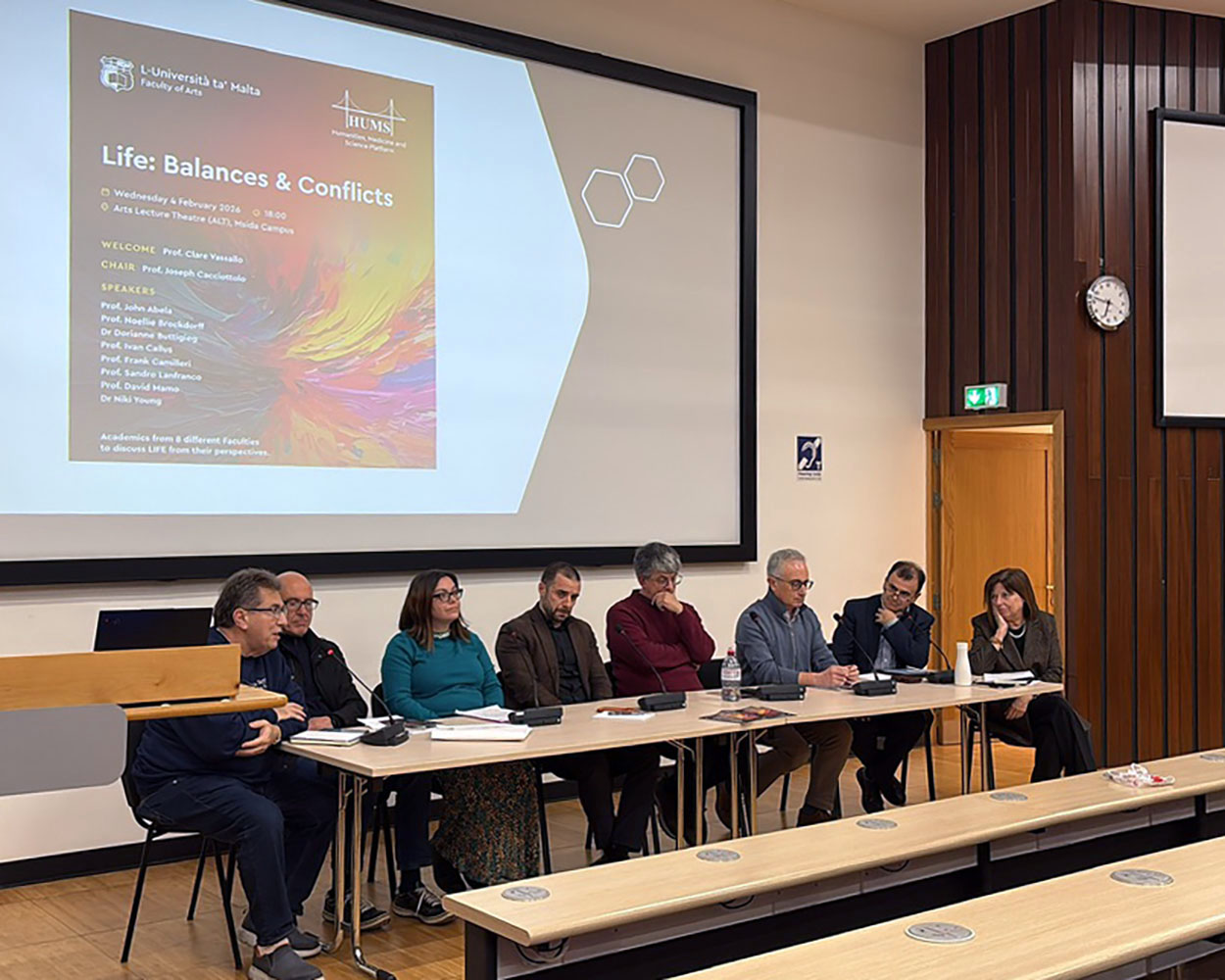
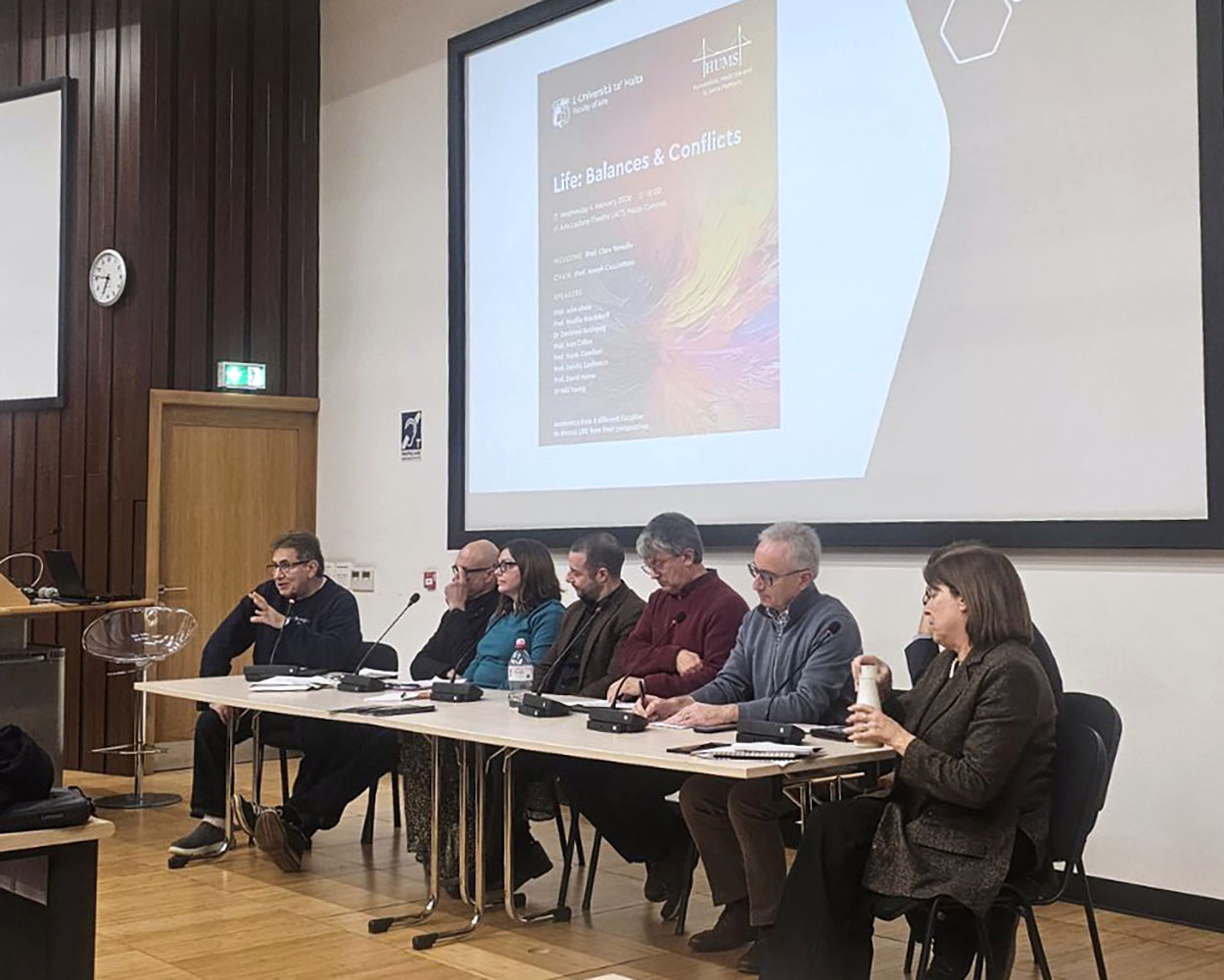
The evening began with a dynamic dialogic tension. Prof. Sandro Lanfranco, from the Department of Biology, presented life in stark material terms, while Dr Niki Young, from the Department of Philosophy, explored how human beings inhabit and interpret that condition.
The most arresting claim of the evening was life not as a soul or spark, but as a rebellion against entropy. In a universe governed by the second law of thermodynamics, where systems tend toward disorder, living organisms are peculiar because they resist that drift, at least for a time. Lanfranco’s account cast life as not some force outside nature, but one of nature’s most improbable achievements: matter managing, however briefly, to hold disorder at bay.
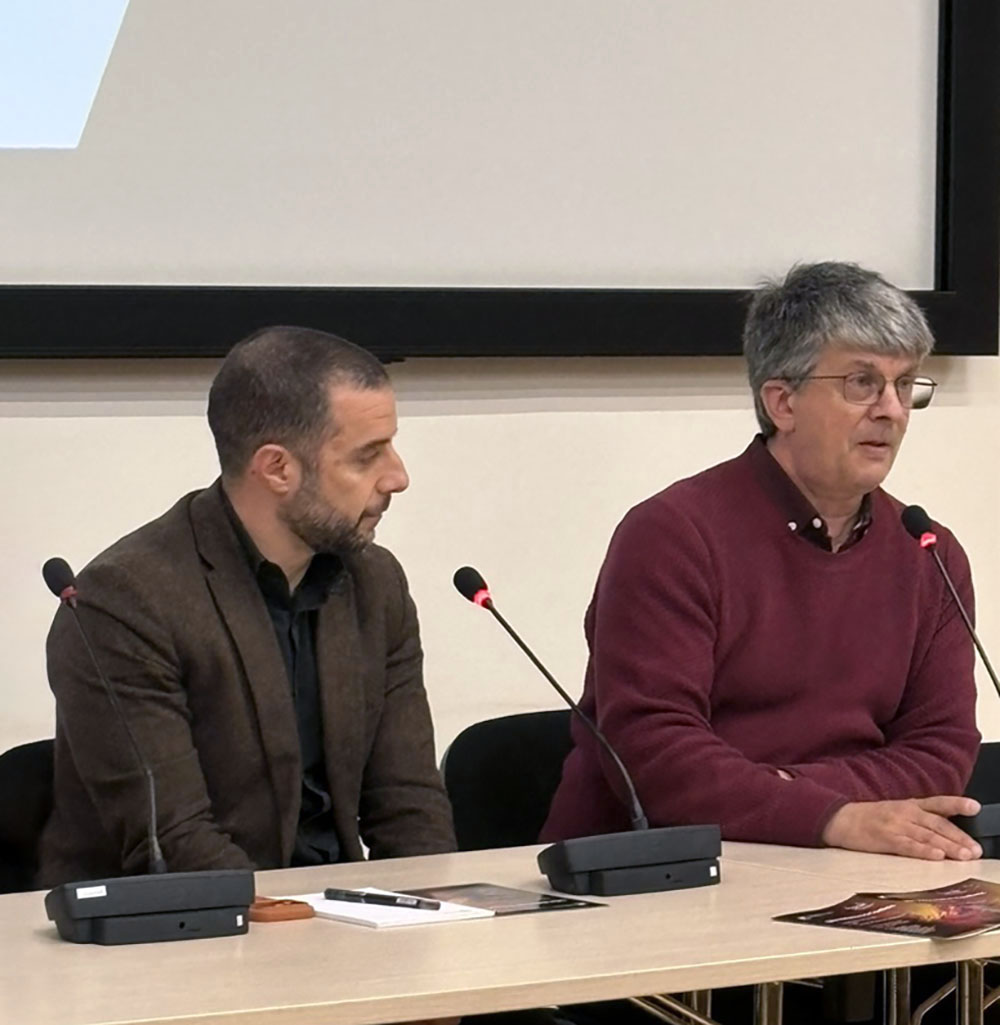
Prof. Sandro Lanfranco in discussion with Dr Niki Young on the nature of life (Photo by Prof. Clare Vassallo)
There is something bracing about this description. It strips away sentiment and returns us to chemistry, energy transfer, and physical law. Yet Lanfranco’s argument did not stop at biology. One of his most provocative suggestions was that human beings may live under an ‘illusion of life’: a subjective sense that our existence is inherently meaningful, even though from a rigorous biological standpoint this sense may function mainly as a mechanism that keeps us going. We wake up, make plans, pursue goals, love others, and tell stories about ourselves. To us, these acts feel full of importance. But perhaps, biologically speaking, feeling is itself part of the illusion.
That suggestion is difficult precisely because it feels like an attack on dignity. If meaning is functional, does that make it false? If our belief in significance helps organisms survive, does that reduce everything noble or beautiful to a trick of evolution? The panel did not force a crude answer. But it did insist on a harder question: what if the meanings we cherish are not separate from biology, but generated through it? That possibility does not necessarily empty life of value so much as relocate it into the reality of living itself.
Lanfranco also challenged the deeply human bias that shapes our understanding of life. We are taught to divide the world cleanly between the living and the non-living, but biology often unsettles that binary. The closer one looks, the more the boundary begins to blur. Rather than a neat distinction, life may be better understood as a continuum.
This is where Young’s contribution became especially important. If Lanfranco laid out the mechanics, Young addressed the interpretive space those mechanics create. If life is the long history of chemical processes resisting entropy, philosophy helps us think through what such a history means once it becomes self-aware. How does chemistry become consciousness? How does survival generate reflection?
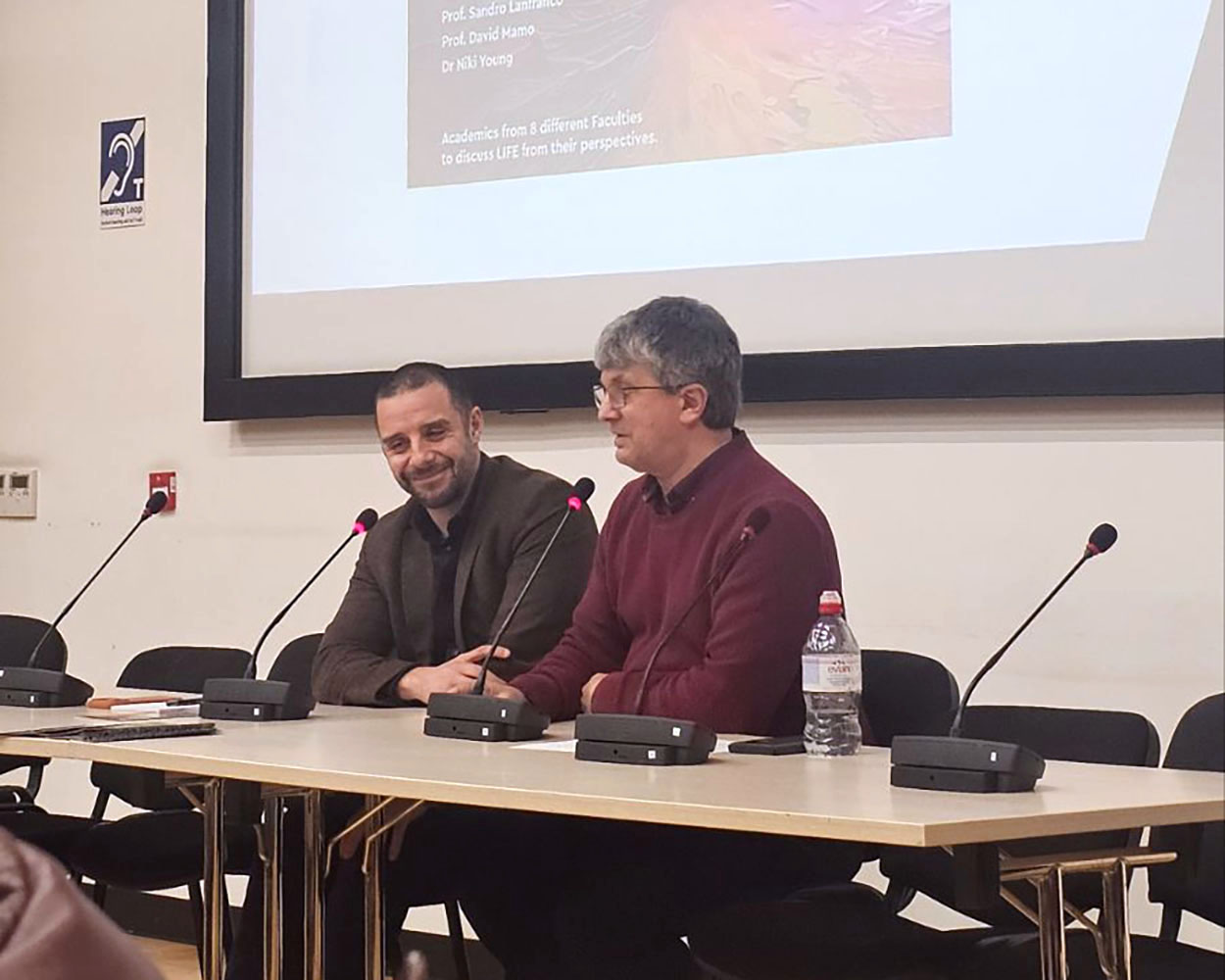
Dr Niki Young and Prof. Sandro Lanfranco exploring the concept of life (Photo by Paola Palii)
Philosophy, in this context, does not compete with science by denying its claims. It lingers where scientific explanation opens onto existential unease. It asks how we are to understand ourselves once we accept that life may be mechanical in origin but irreducibly complex in experience.
As the panel widened, that central tension between mechanism and meaning was refracted through other disciplines.
An important intervention came from Prof. David Mamo (Department of Psychiatry), who noted that biological definitions of life quickly meet exceptions. In medicine, life is often reduced to brain-stem function and vital signs such as breathing and heartbeat, so that one is considered alive – or simply not dead. Yet lived experience complicates this: a person may be biologically alive while feeling emotionally empty or ready for death. Life exceeds medical definition, remaining psychologically and relationally fragile.
From the Department of Pastoral Theology, Liturgy and Canon Law, Dr Dorianne Buttigieg pushed back against a purely chemical picture by highlighting the anthropocentrism that often shapes how we think. Her intervention suggested that life may be defined not only by internal function, but by relationship and exchange. Meaning, on this account, can emerge between beings, through encounter, dependence, and connection.
Prof. Ivan Callus (Department of English) demonstrated how life is not only something we define but something we struggle to articulate. If biology explains living matter and philosophy questions its meaning, literature reveals how life is experienced at its limits – through grief, despair, vitality, memory, and the search for form. In that sense, literature does not offer a competing definition of life so much as expose the emotional and imaginative pressure any definition must bear.
Prof. Frank Camilleri (Department of Theatre Studies) extended this perspective into the social realm by describing life as performance. Human existence, he suggested, is deeply repetitive. We ‘recycle’ what we already know. We inhabit scripts, roles, habits, and inherited forms of behaviour. Much of what we think of as living is enacted through patterns we did not invent. Identity takes shape through repetition and interaction.
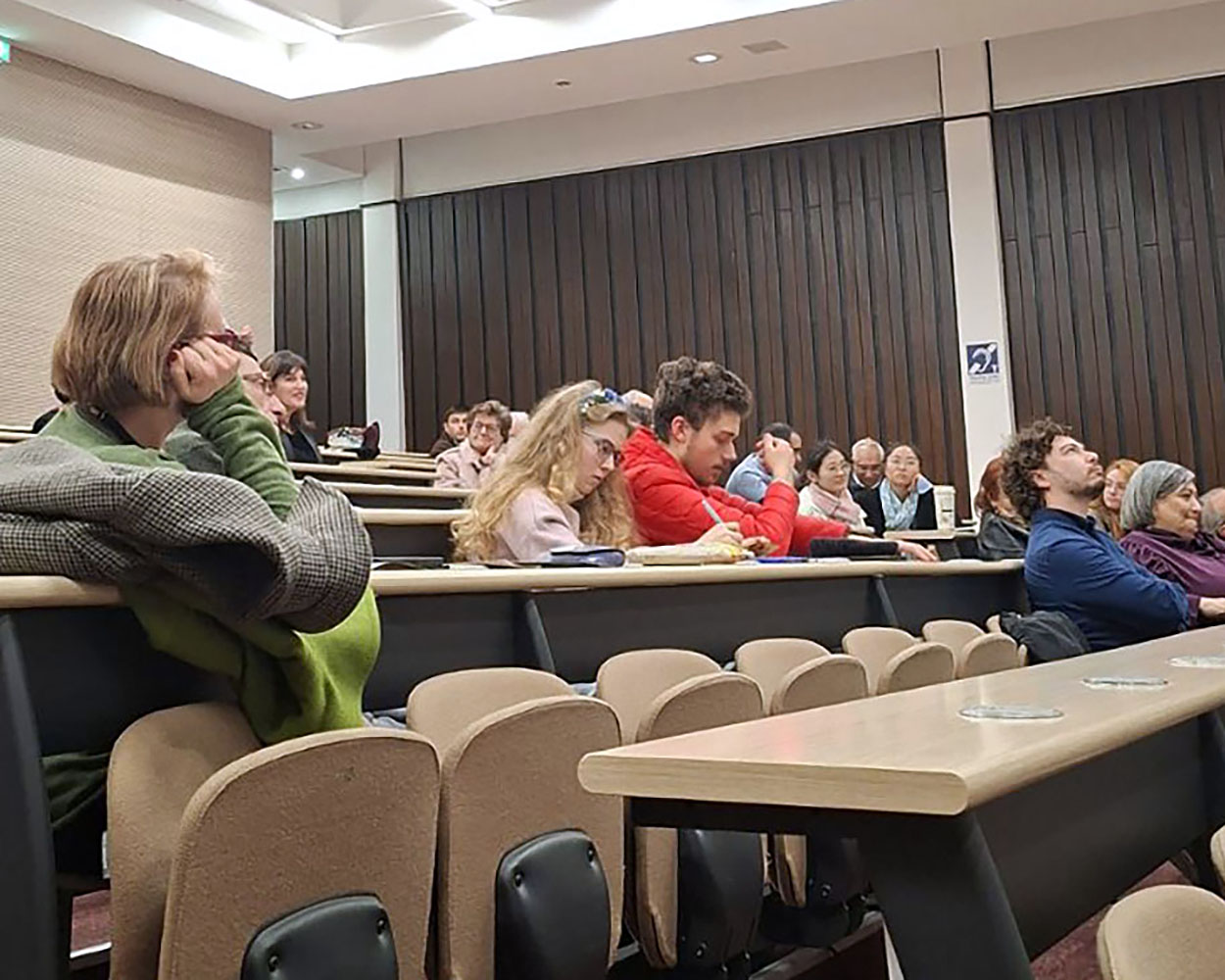
Attendees at the HUMS Platform event entitled Life: Balances & Conflicts (Photo by Paola Palii)
Incoming Pro-Rector Prof. Noellie Brockdorff (Department of Cognitive Science) brought another dimension by focusing on the brain’s predictive capacity. Cognition, she argued, is what gives organisms an advantage in their struggle against entropy. To survive is not only to react, but to anticipate, model the future, assess risks, and stay one step ahead of collapse. In this sense, thought is not separate from biology but one of its most effective strategies.
From there, the leap to artificial intelligence felt inevitable. Prof. John Abela (Department of Information Systems) raised the question directly: if life can be understood in terms of complexity, energy use, prediction, and relationship-building, how secure is the boundary between organism and machine? If a machine can increasingly model, adapt, learn, and simulate relational behaviour, then the line we draw between life and non-life may turn out to be less stable than we once believed.
This is what gave the panel its contemporary urgency. The question of life is no longer only about cells, souls, or systems. It is about the categories we are trying to preserve in an age of artificial cognition. Why do some forms of complexity count as alive while others do not? At what point does our definition of life become a defence of human exceptionalism rather than a description of reality?
The panel refused to resolve these tensions too neatly. It did not offer the audience the comfort of a single framework. Instead, it revealed life as layered and unstable: chemical process, philosophical mystery, relational condition, social performance, predictive intelligence, and technological questions all at once.
Perhaps that is the real value of such a conversation. Not that it tells us what life is once and for all, but that it reminds us how difficult the question should be. We are biased observers of our own existence. We want life to feel singular because we experience it from within. We want meaning to be guaranteed because the alternative feels too precarious. We want the difference between organism and machine to remain clear because ambiguity threatens our sense of uniqueness.
The panel did not offer a definite answer, nor a comforting one. But it offered a vital perspective. Life may not be a fixed essence we can pin down, but an ongoing negotiation. To live is not simply to exist. It is to participate in that tension, to resist collapse, to form relations, to interpret experience, and, perhaps above all, to keep asking what any of it means.
For in the end, life may be defined less by certainty than by the restless intelligence with which it confronts its own fragility.


Comments are closed for this article!