
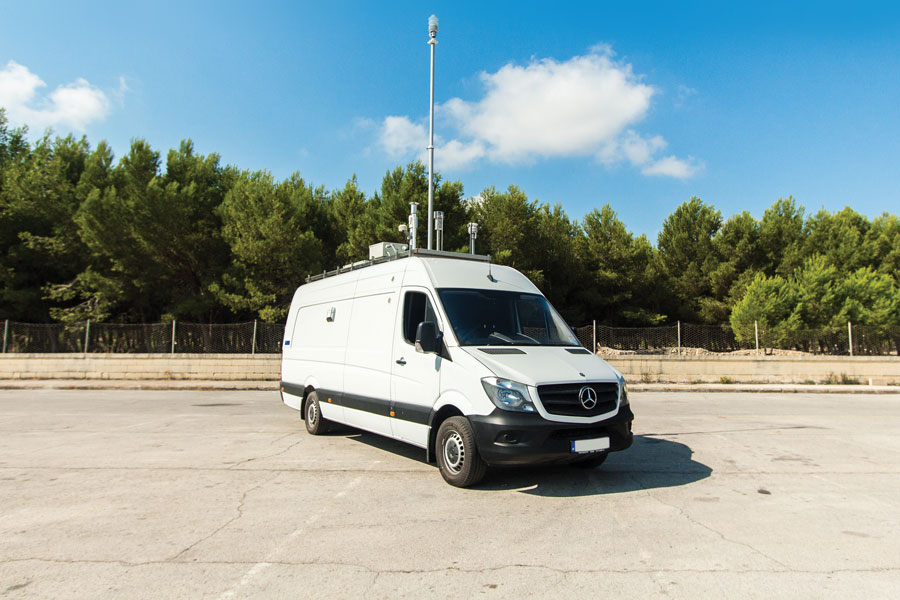
The Mobile Air Quality Laboratory (MAQL) is the first of its kind on the Maltese Islands. Run by a team of geoscientists at the University of Malta, the MAQL can assess the quality of the air by continuously monitoring particulate and gaseous air toxics.
The particulates it can detect vary in size. The finer particles (PM1 and PM2.5) are usually the most dangerous respirable fraction but the instrumentation can also measure coarser sized particles (PM4 and PM10). The suite of gaseous pollutants that can be checked are sulfur dioxide, oxides of nitrogen, carbon monoxide, ozone, Volatile Organic Compounds (VOCs), organic and elemental carbon, and radon.
| Mobile Air Quality Laboratory (MAQL) |
Quick Specs:
|
The MAQL is able to compare the air in indoor and outdoor spaces while recording meteorological conditions onsite. The comparison helps scientists understand from where the pollution originates. Is there so much pollution in our environs because of all the cars outside our window? Or is it because of the new sofa the family next door just bought? Or perhaps it is a result of the redecoration the building down the road recently underwent. Such data is vital for scientists to be able to figure out the root of a problem, to create a model of personal exposure to the pollutants, and to develop safer measures for the general public.
The MAQL facility will help scientists develop a clearer picture of the indoor air quality across the Maltese Islands. It will help other scientists interpret older data, and enable them to design new studies. Medics can match such data with population studies and assess disease rates around Malta. The MAQL can determine the sources of pollution inside buildings with the help of lifestyle and meteorological data, providing enough information for the construction of dwellings which have cleaner and safer air for everyone.




Comments are closed for this article!