
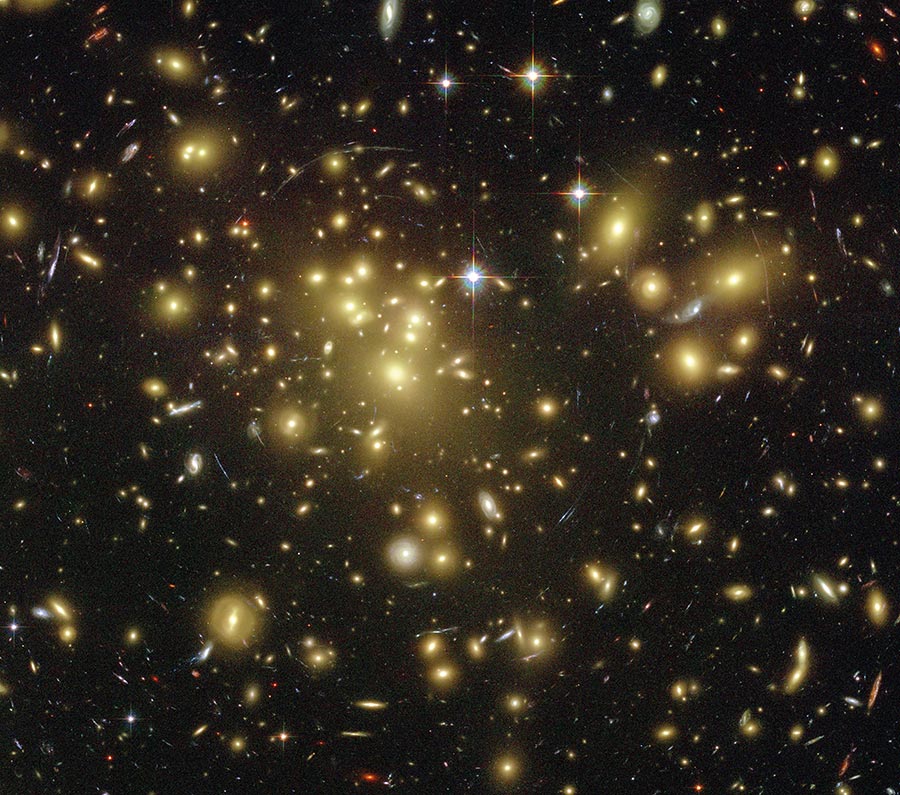
Of the astronomical phenomena, we can witness with our own eyes, a solar eclipse is one of the most spectacular. This phenomenon was used early in the 20th century to prove Einstein’s new theory of gravity. As light passes around a celestial object, its path is bent exactly as predicted by Einstein’s theory.
When researchers compared the amount light that was bent by large clusters of galaxies with the observed mass of the galaxies, they found that there was a discrepancy of over a factor of 1000, giving birth to the phenomenon known today as dark matter.
The distortions of galaxy shapes by large masses, provide astronomers with a tool to construct a dark matter map and its distribution in the universe we observe. Images captured using telescopes are analysed carefully to understand the distortions of galaxies due to the presence of dark matter lenses. However, in practice this is a very arduous task because telescopes suffer both from electronic noise as well as atmospheric distortions, so throughout my PhD, I investigated how the noise present in astronomical images could contribute to the distortion of galaxy images and also introduce errors in our maps of dark.
Under the supervision of Prof Kristian Zarb Adami, I applied Bayesian inference to determine the correct measurements of galaxy shapes. However, since the variations in the shape and size of galaxies due to lensing is very small, the measurement of dark matter is extremely difficult. Only novel statistical methods developed within a consistent Bayesian framework allow us to extract the maximum amount of information in such difficult scenarios.
Unfortunately, the application of the new methods in my Ph.D. have shown results that are similar to those reported by other researchers, with the techniques failing to provide the desired accuracy. Nonetheless research goes on, unravelling more mysteries and questions that still need answers.




Comments are closed for this article!