

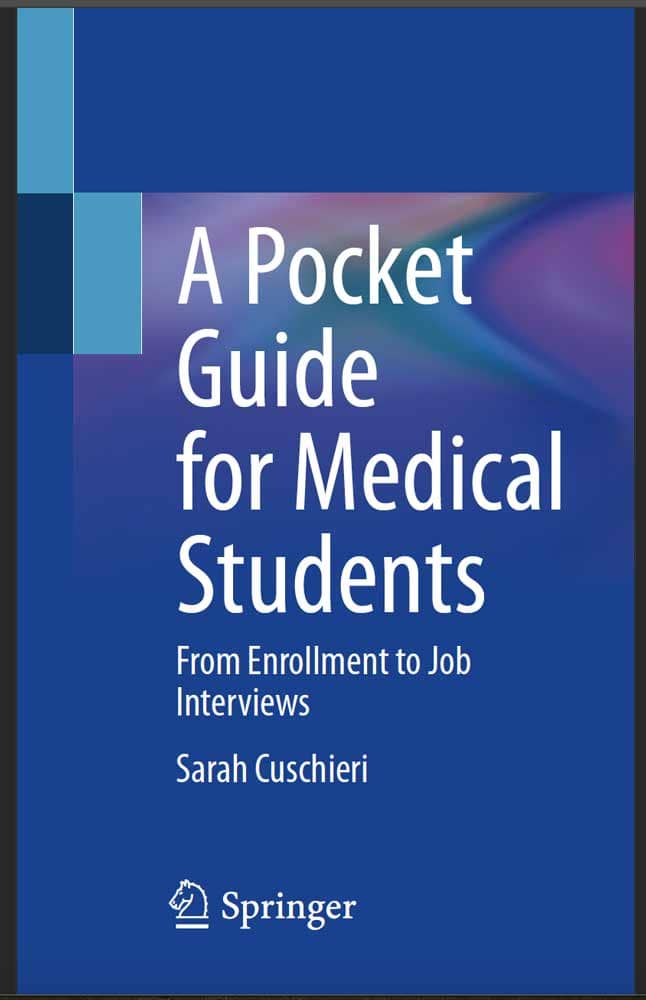
Are you a medical student feeling lost or maybe thinking of embarking on the journey to become a doctor? Struggling to juggle your studies while living a life outside medicine? Remain calm! THINK Magazine sat down with Dr Sarah Cuschieri to discuss her latest book A Pocket Guide for Medical Students, full of tips and tricks on how to survive and thrive during medical school and beyond.
A Pocket Guide for Medical Students: From Enrollment to Job Interviews is an essential handbook written by Dr Sarah Cuschieri, a research and resident academic at the University of Malta. The book is designed to provide medical students with comprehensive information on medical school life, including study techniques, clinical rotations, and career advice. This guide is written in a concise and easy-to-read format, with practical tips that can help students navigate the challenging journey of medical school.
Cuschieri, author of To Do or Not to Do a PhD? and A Roadmap to Successful Scientific Publishing: The Dos, the Don’ts and the Must-Knows, has lectured medical students for the past 10 years. During this time, it became evident that some medical students were struggling during medical school, especially with the preclinical and clinical years. Over time, it became apparent that medical students may have had a limited understanding of the importance of research during their medical school years as well as the importance of having a colourful curriculum vitae. Having herself been a recent medical student and a current academic, Cuschieri understood medical students’ dilemma firsthand. She thought that sharing her experience would be fruitful and decided to put pen to paper to offer a fresh perspective on the issue.
Unlike most published books aiming to guide medical students through the journey of becoming a doctor, this is a guidebook that provides a personal and multifaceted experience as a past medical student, a graduated doctor, and an academic. A Pocket Guide for Medical Students is addressed to future and enrolled medical students as well as freshly graduated doctors, with the main aim to help them get to grips with the what, the how, and the why of the distinct phases of medical education (as well as how to ‘survive’ them!). Additionally, the book sheds light on various aspects which medical students should be aware of, including some ‘hidden issues’ that no one will tell you unless they have passed through the experience themselves. A unique feature, it enables readers to understand that they are not alone, as others have experienced their exact same fears and desires.
The book is divided into ten chapters, each covering a specific aspect of medical school, starting with what students can do to prepare for medical school and ending in what medical students should expect from higher medical training and beyond. A Pocket Guide to Medical School is an outstanding resource for medical students. The book is concise, easy-to-read, and packed with practical tips and advice. Cuschieri’s writing style is engaging and approachable, making the book accessible to students at all levels of their medical education. She uses real-world examples to illustrate key concepts. The book also includes helpful diagrams and charts to clarify complex topics. Moreover, the book focuses on practical advice. It’s filled with tips and strategies that can help students navigate the many challenges of medical school, such as time management, study techniques, and managing test anxiety. Cuschieri provides clear and actionable advice that can help students succeed.
Cuschieri shared that her latest book was very close to her heart, as she was writing it to aid an audience that she interacts with on a daily basis. Yet this book is not only suitable for students studying at the University of Malta, but also the global medical student audience, as the challenges and dilemmas faced by medical students during their medical school years are shared across the world. While some aspects might be slightly different from one medical school to another, overall, everyone is in the same boat, making her book applicable to the global medical student cohort.
Overall, A Pocket Guide to Medical School is an excellent resource for medical students. The book covers all aspects of medical school life, from preparing for medical school to applying for residency. Cuschieri provides practical advice that can help students navigate the challenges of medical school. This book is highly recommended for any student considering a career in medicine, as well as for those already in medical school. Students wishing to obtain a copy can order the printed version of the book here or obtain it as an e-book.




Comments are closed for this article!