
Independent living is important to everyone. However, it is a known fact that there are many cases where physical problems prevent people from living without care. To help people regain some independence in their lives there are systems such as Human to Machine Interfaces (HMI). Systems such as these work by using biosignals like Electromyographic (EMG) signals that can be used to control assistive devices. However, some have their drawbacks: prosthetic arms, for instance, are one commonly used device that are at times abandoned due to a lack of dexterity and precision.
The problem is that most of these devices make use of sequential control, where only one function can be articulated at a time— meaning fluid, life-like motions are impossible. Now, most daily activities need simultaneous movement with multiple degrees of freedom. And it is this need that is pushing the creators of these devices to create simultaneous control to mimic real life movements.
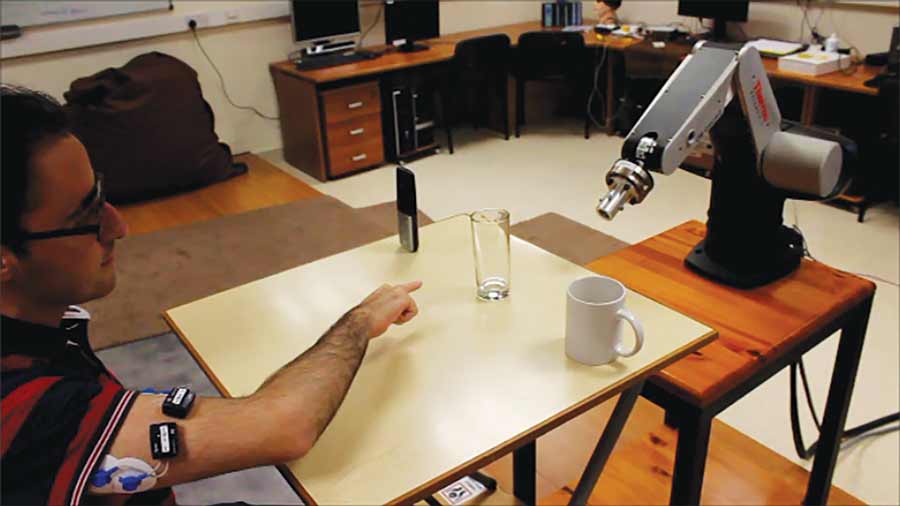
Christian Grech (supervised by Dr Tracey Camilleri and co-supervised by Dr Ing. Marvin Bugeja) has developed a system which allows the control of the position of a robotic arm by using the muscle activity of a person. This consists of an HMI which continuously provides the shoulder and elbow joint positions using surface muscle movements. Grech tested the model to develop more freedom, which would lead to fluid movements. He investigated three types of system identification methods (state space models, linear regression models, and neural networks) to develop this relationship between muscle activity and corresponding joint angles. Additionally, seven different movements were tested in real-time using a robotic arm. Grech managed to develop a model that allows prosthetic arms to be used more naturally.
Of course, more research is needed to perfect this device. Ideally it would operate without delay and with minimal user discomfort. The Department of Systems & Control Engineering is carrying out more research to continue to improve the accuracy and robustness of such myoelectric (EMG) controlled devices.




Comments are closed for this article!