
 My passion for renewable energies was sparked off during my undergraduate studies in Mechanical Engineering at the University of Malta. Thanks to ERASMUS, I studied at the University of Strathclyde which had a Renewable Energy course that, at the time, was not offered in Malta.
I spent the last year of my bachelor studies designing and testing part of a wind tunnel to simulate atmospheric wind conditions. This test setup allowed for more realistic wind turbine experiments than previous efforts.
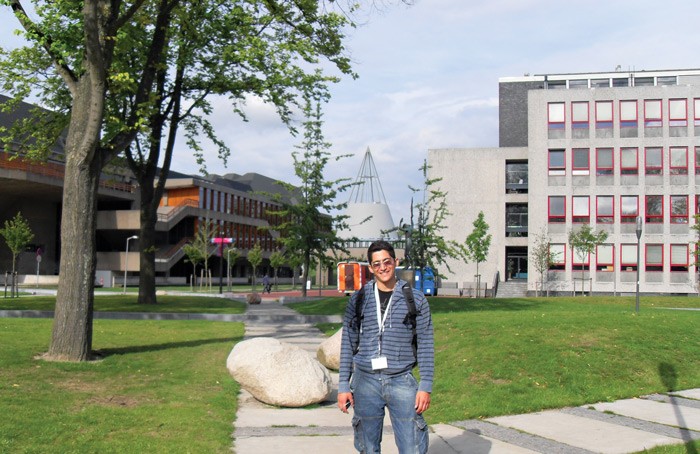
Although I wanted to further my career in wind energy, I opted first to broaden my knowledge in the field of renewables by enrolling for the Masters in Sustainable Energy Technology at Delft University of Technology in the Netherlands in August 2010.
Over the first year, I worked on several projects. They included designing a smart grid which was presented at the European Joint Research Centre (JRC). I also helped develop an innovative thermal energy plant that exploits temperature differences between the ocean surface and deep-water (>1km deep) in tropical waters to generate electricity.
Over the second year, I again carried out research in wind energy. At the famed Wind Energy Research Institute of Delft University called DUWIND, I looked into the effect wind turbines can have on each other. When wind turbine blades cut through the wind they can change its direction. This can reduce the efficiency of nearby wind turbines making them produce less energy. My results showed that a turbine’s effect on nearby systems diminishes when the wind distortion it causes is limited either by the wind’s inherent instability or other by properties like its proximity to the ground. By exploiting these wind qualities, a wind farm’s efficiency can be improved by up to 15%.
After my Masters I worked for a year at Eindhoven as a flow and thermal analyst at Segula Technologies Consultancy. I developed new components for a company’s cutting edge lithography machines and for fuel cell system development for BOSAL engineering. Now I have managed to secure a Ph.D. scholarship in wind turbine blade aerodynamics, continuing the work I started in my Masters at DUWIND. This time I am looking into the influence of small flow control devices on the performance of large (10 MW) wind turbines.
Baldacchino was awarded a STEPS scholarship for his Masters studies, which is part-financed by the EU’s European Social Fund under Operational Programme II — Cohesion Policy 2007–2013.


Comments are closed for this article!