
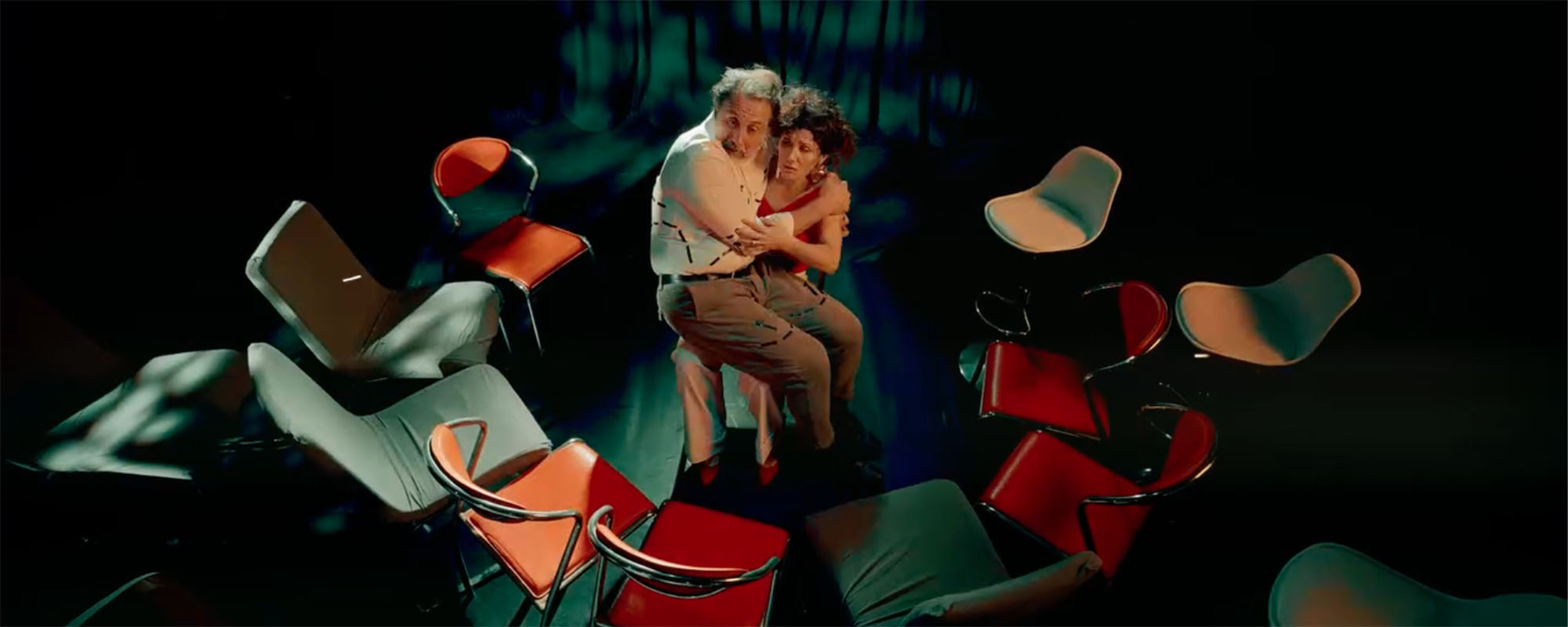
Is-Siġġijiet is not just about chairs. It is also about nothingness and meaninglessness, miscommunication and isolation – that type when you look back and realise you never amounted to much. It’s a stark irrelevance that gnaws at you and makes you desperate to hold onto whatever significance you can and say ‘yes, it wasn’t all for nothing’. It’s not a comforting thought, but the script does well in hiding that with its quips and gags.
A story’s title often lets you in on what it’s about. While there is no shortage of chairs in Is-Siġġijiet, Ix-Xiħ (Mikhail Basmadjian) and Ix-Xiħa’s (Antonella Axisa) masterful performance made me realise that chairs weren’t all that the play had to offer. Is-Siġġijiet, directed by Lee-N Abela, is a contemporary adaptation of Eugène Ionesco’s classic 1950s play Les Chaises, translated from French to Maltese by Dr Claudine Borg, Head of UM’s Department of Translation, Terminology and Interpreting Studies. As this is an absurdist play, Abela has amplified this quality, utilising mind-numbing spectacle to communicate something uncomfortably real – the kind of irrelevance that most of us are fated to. It therefore doesn’t matter what supposed substance the play may hold as anything the two protagonists try to do or say is void, trivial, and flat-out unimportant. No one could care less. Borg retains this quality of the play in her translation, and hence the theme staring one down the barrel (of the stage) is of false importance. The tragedy is then further cemented in the social dynamics presented – being deluded into thinking that one can reach something which they had no business ever reaching for to begin with.
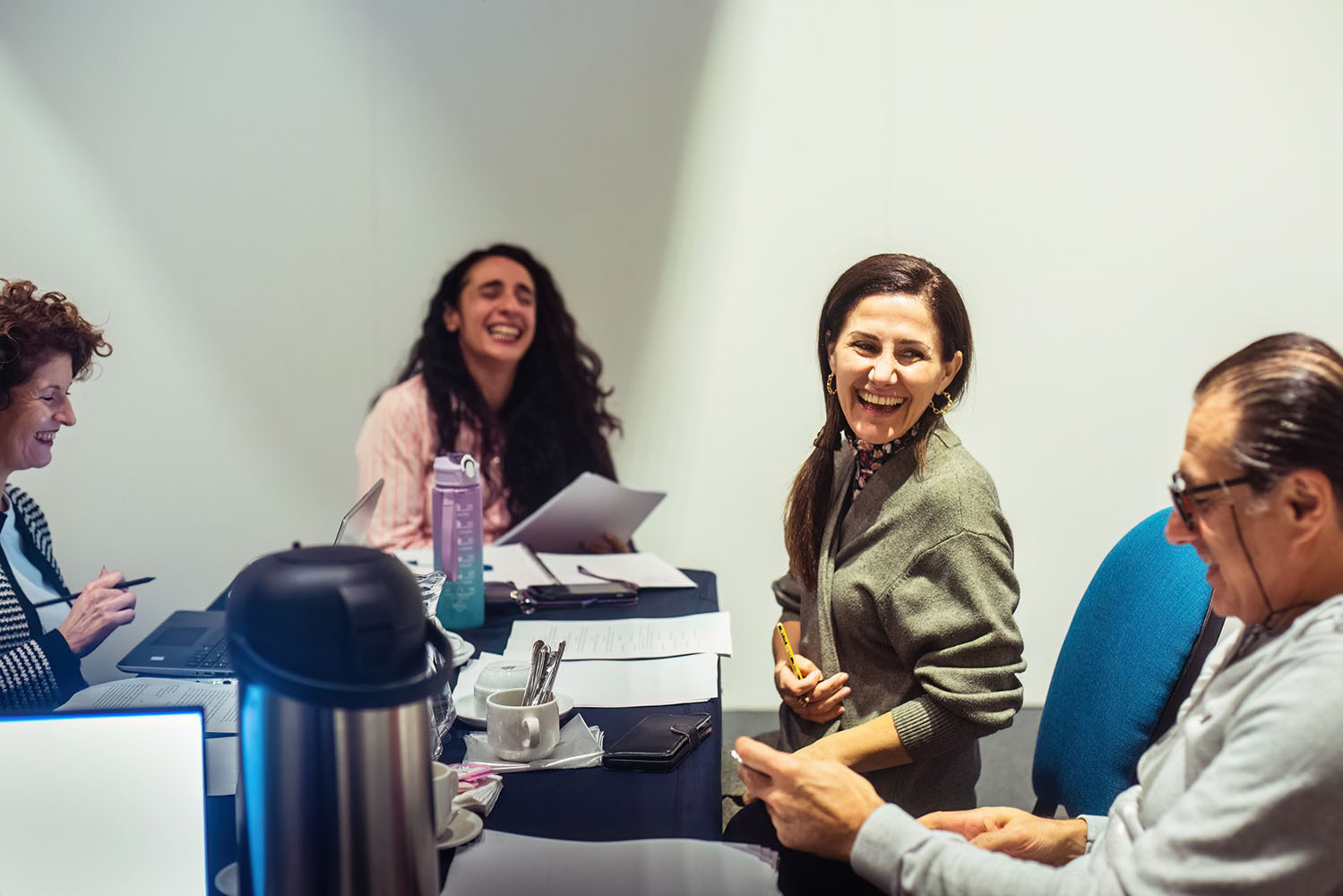
As it stands, through Abela’s direction, the play serves as an open mockery of the couple, Ix-Xiħ and Ix-Xiħa. They’re two nobodies who go about hopping and hooting like two monkeys trying to grab at whatever sense of approval they can garner before they fade into obscurity. What makes this ridiculous site tragic, though, is that it plays towards many of our inner insecurities – the horrid thought that, God forbid, I should end up like that, forgotten, unimportant. As Borg describes it, ‘they want to achieve something which they have never been able to throughout their whole life’, which, in framing their motivation this way, attributes to their absurd efforts a sense of relatability. The effect is quite sobering, so that while the two go about arranging chairs, greeting phantom guests, and occasionally making sexual remarks or hallucinating, we can understand. And if we can understand, then we can empathise.
The Anti-Shakespeare
Is-Siġġijiet struck me as anti-Shakespeare for two reasons. Firstly, performances of Shakespeare are often associated with an expectation of repetition. Crafting a faithful representation of the play – almost entirely unchanged from the source material – was not something Abela had in mind for Is-Siġġijiet. Why produce a performance that has probably already been done by someone somewhere else? And would an exact replica even resonate with our audience? Who do I want to communicate with? The people of Ionesco’s time? Or the people of the here and now? These were important questions Abela had when deciding how to go about directing the play. For Abela, the play was to communicate with the people of now, with whom we identify and have relationships. This is perhaps most apparent through the reversal of the roles of Ionesco’s ‘la vieille’ and ‘le vieux’, with Ix-Xiħa arguably having more agency than Ix-Xiħ.
Secondly, the play seems anti-Shakespeare in its approach to developing tragedy. In tragedies like Othello and Hamlet, legacies and status are brought to ruin. Othello’s reputation is tarnished for acting rashly and committing murder due to ‘being wrought, | Perplexed in the extreme’, while Hamlet’s entire dynasty meets with death. However, despite the ruin, there is always something tangible that remains, even if it isn’t something outright comforting. In Othello, a smudge taints the Moor’s reputation, but also Iago’s. The memory will be remembered to ensure the latter’s punishment. In Hamlet, Fortinbras takes over Elsinore, thereby continuing a form of leadership for the people of Denmark.
In contrast, Is-Siġġijiet does not provide the comfort of suggesting that something persists or even remains. The efforts of Ix-Xiħ and Ix-Xiħa are rendered null as the very idea of them deteriorates surely and steadily. Their very memory arguably becomes as mangled and formless as the chairs placed as the play progresses. These props devolve from eccentric seats to abominable creations, such as chairs with no seats, chairs with curling rods emerging from where one should sit, and little ‘baby’ stools which could have been assigned by either of the couple to some big, burly guest, or even to a complete school bus worth of children. With regard to these last details, I’m not entirely sure as to who sat where. The details get a bit too complex by the play’s end.
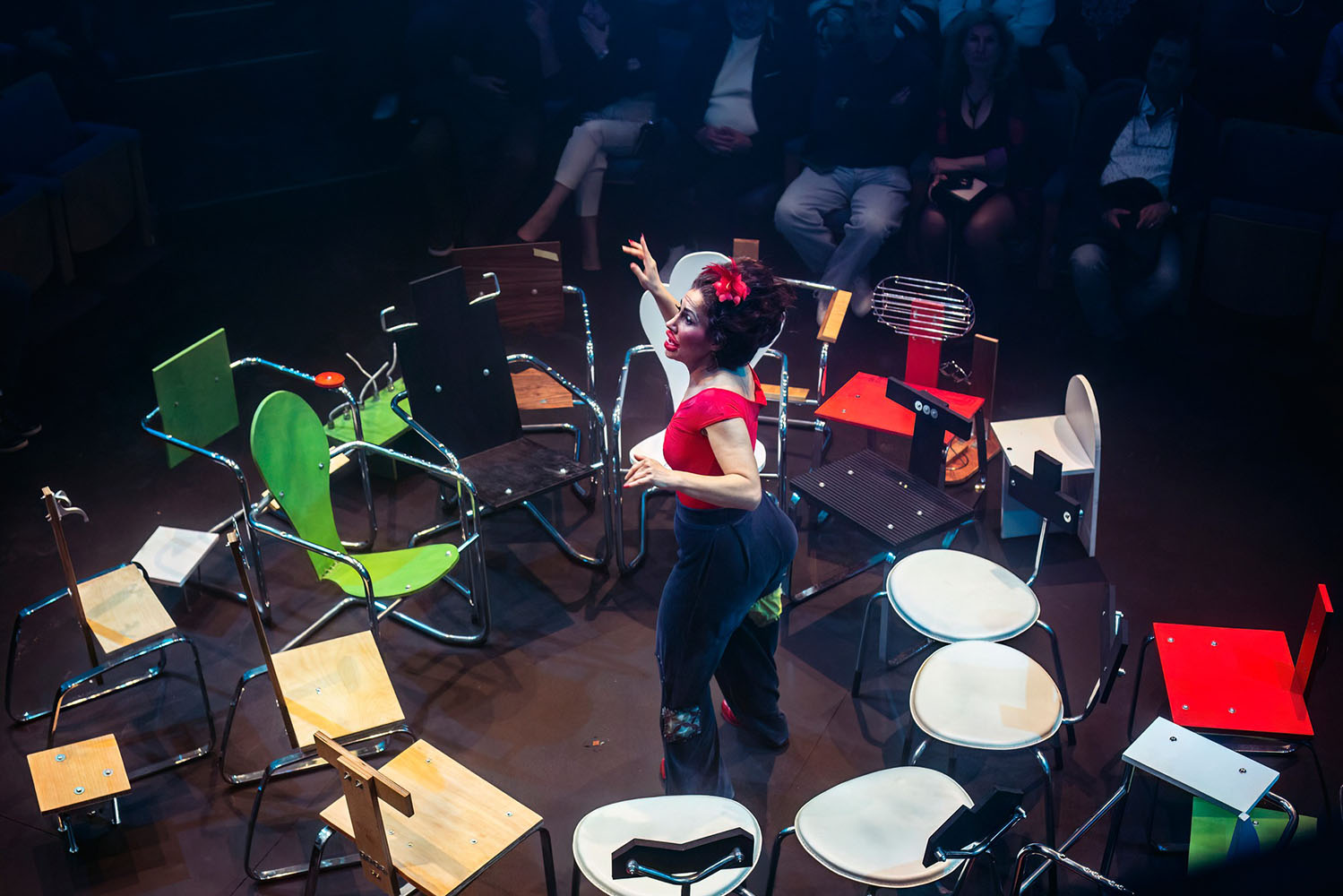
(Photo credit: Elisa von Brockdorff)
The Translatory Efforts in Adapting the Play
This formlessness suggested by the play’s end reaches its most ironic culmination through Arthur Dumas’s exemplary depiction of the Orator. Abela in fact describes this character as ‘the epitome of the absurd’ and for good reason. Just as Ionesco originally rendered the character mute, Is-Siġġijiet retains this element as the Orator delivers the memory of both Ix-Xiħ and Ix-Xiħa through mumbles, grumbles and a dire breathlessness. Even when he attempts to write, his writing signifies nothing. It’s fitting that struggle with which he labours himself, hunching and gesticulating to a phantom audience on ghastly ‘torture’ furniture. It insults the memory of the couple and perhaps reveals exactly how important these two were to all their so-called friends and guests. The situation is both banal and yet impressively profound – the right level of the absurd without it spiralling into obscurity.
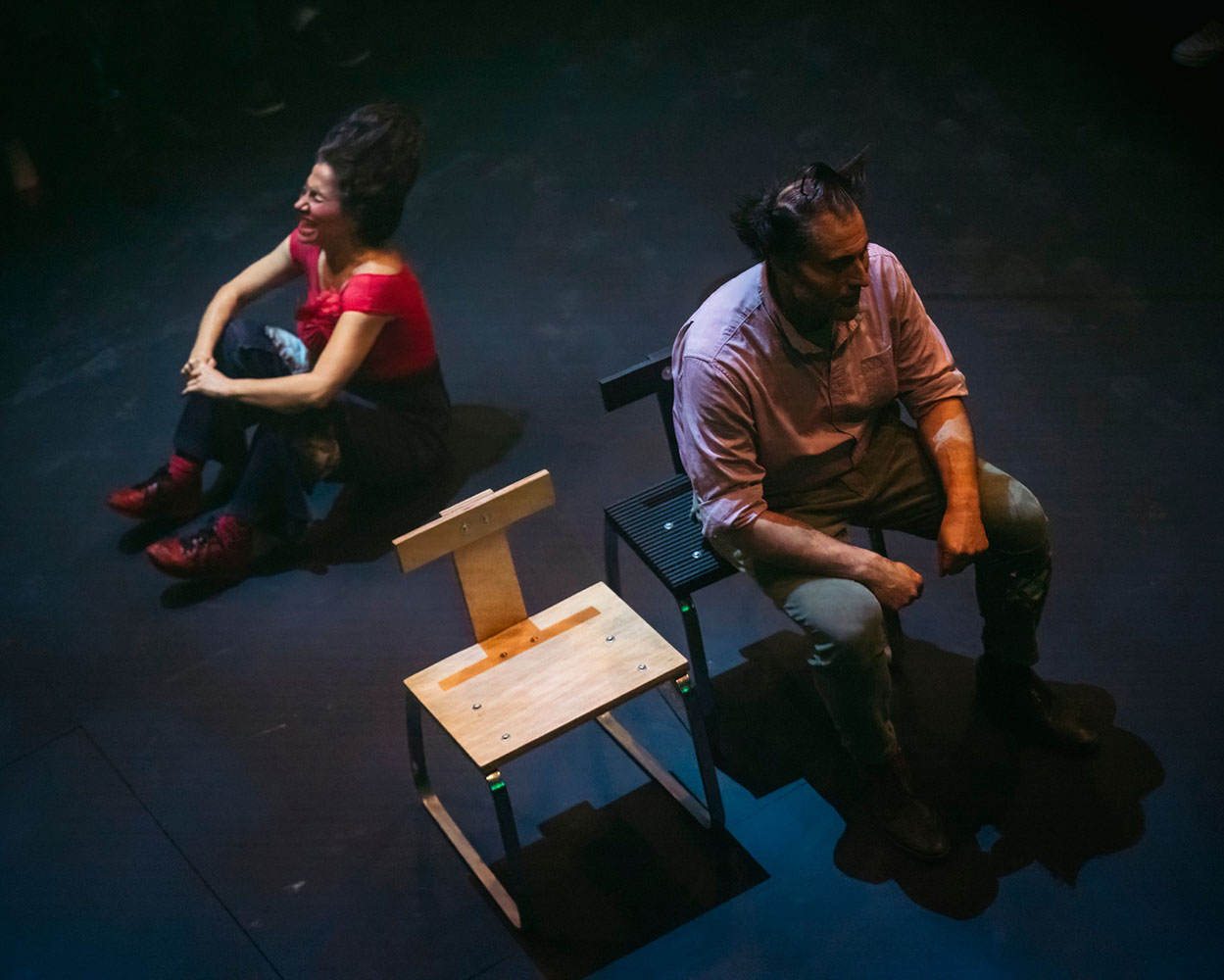
The absurd is therefore not just the focal point of the play but also the focal point of Borg’s translation. Translation is not simply the process of changing words from one language to another. It is more so about retention – the retaining of mood, effects, feelings, anything really that makes Les Chaises Les Chaises. Borg ensures that each word chosen for Is-Siġġijiet retains the intended effects by Ionesco when he had originally penned the French script. The question hence is not whether ‘this word means the same as this word’, but rather if the word chosen to replace that in the original work conveys the right message. Attention is hence paid to even the most minute qualities of a word, from its spelling right down to how it sounds. In fact, Borg states that ‘particular importance to sound’ was given during translation, and for good reason. Is-Siġġijiet is not simply a textual translation, but one intended to be performed in a theatrical context. Fittingly, Abela says that ‘the script serves as our soundboard’, allowing the production team to check what works and what doesn’t during production. The beauty of it is that, as Borg says, ‘we’re dealing with the absurd, so I can play around with it’, thereby allowing her greater freedom with her word choice, inevitably aiding in the retention of Ionesco’s intended effects.
Should one be interested in exploring the techniques and theory of translation, UM’s Department of Translation, Terminology and Interpreting Studies offers a master’s degree in Translation and Terminology Studies. With a choice of three streams from which to tailor one’s course experience, the stream in literary translation would be most relevant should one be interested in tackling projects similar to Is-Siġġijiet in their own future careers. It is undoubtedly clear that the demand for translators in Malta only stands to increase, considering both Is-Siġġijiet’s success and the well-deserved turnout at Spazju Kreattiv.
Is-Siġġijiet, performed between 11–20 April 2025, was a Spazju Kreattiv commission as part of the season programme, with support from the French Embassy in Malta. To learn more about the performance, Audrey Rose Mizzi spoke with Dr Claudine Borg and Lee-N Abela about Is-Siġġijiet on The Spazju Kreattiv Podcast. Listen to the episode here.



Comments are closed for this article!