

Mars themes had a renaissance this year. No less than three games set on Mars were released at the Essen Game Fair in October 2016. While not everyone cares for the red planet, it cannot be denied that it has spawned many interesting games, particularly with game mechanics.
At Essen, Terraforming Mars was the talk of the town. When I visited their stand to see what all the fuss was about, I was unimpressed by the unappealing art and graphic design, and left the booth without a copy. I bought a copy when only one was left due to the fear of missing out. The fair was full of people carrying a copy of this game.
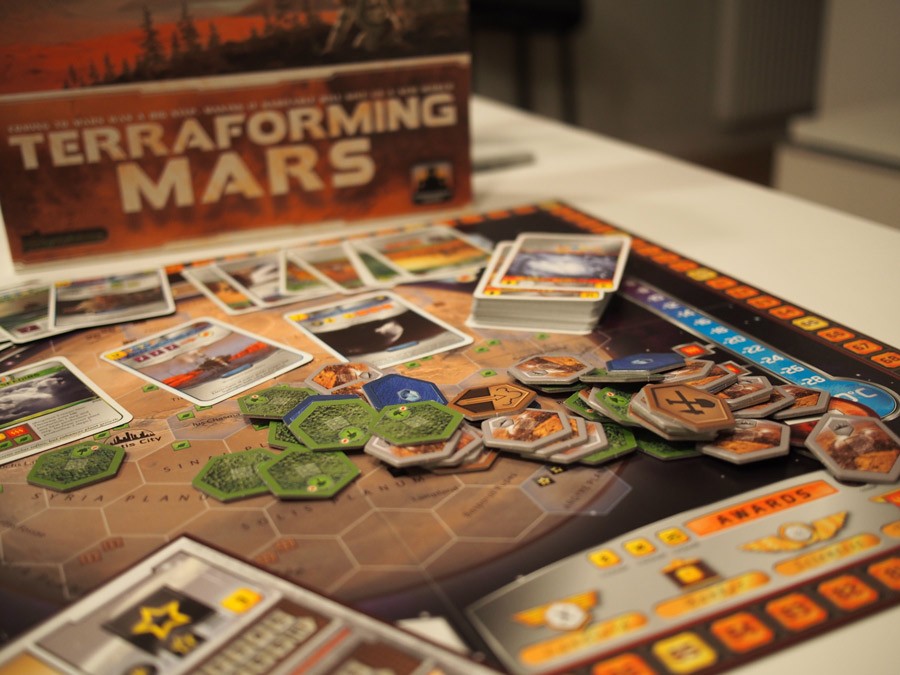
Terraforming Mars is not a pretty game. Its sense of graphic design oozes ‘amateur’ or ‘1990s’. It feels like a relative or friend was hired to keep costs down. The situation became increasingly giggle worthy after realising that most card images are credited to the ‘Fryxelius’ surname, which appears very often in the credit list.
So how is the game played? A player heads a corporation trying to make the planet’s environment habitable. The game ends when the temperature, the landscape, and oxygen levels have reached levels amenable for life. At this point, the corporation that has built the most respect and cash wins. It becomes the market leader in humanity’s next chapter.
The game centres around project cards. These all require cash, or megacredits, to invest in. There are hundreds of these cards, and many are unique. The crux of the game lies in carefully investing in those projects that best benefit the player’s corporation. Each of these cards does something different on Mars, affecting the planet’s state, or terraform rating. This rating identifies how valuable a contributor your corporation is in making Mars a better place for everyone.
These game mechanics give Terraforming Mars one of the most exquisite and intricate game engines in recent memory. The game is vastly different every time it is played. It all depends on which projects come up during the game. It takes a bit too long to play, but is satisfying till the very end.
Terraforming Mars satisfies the classic idiom ‘don’t judge a book by its cover’, so cave in to peer pressure and buy it!




Comments are closed for this article!