
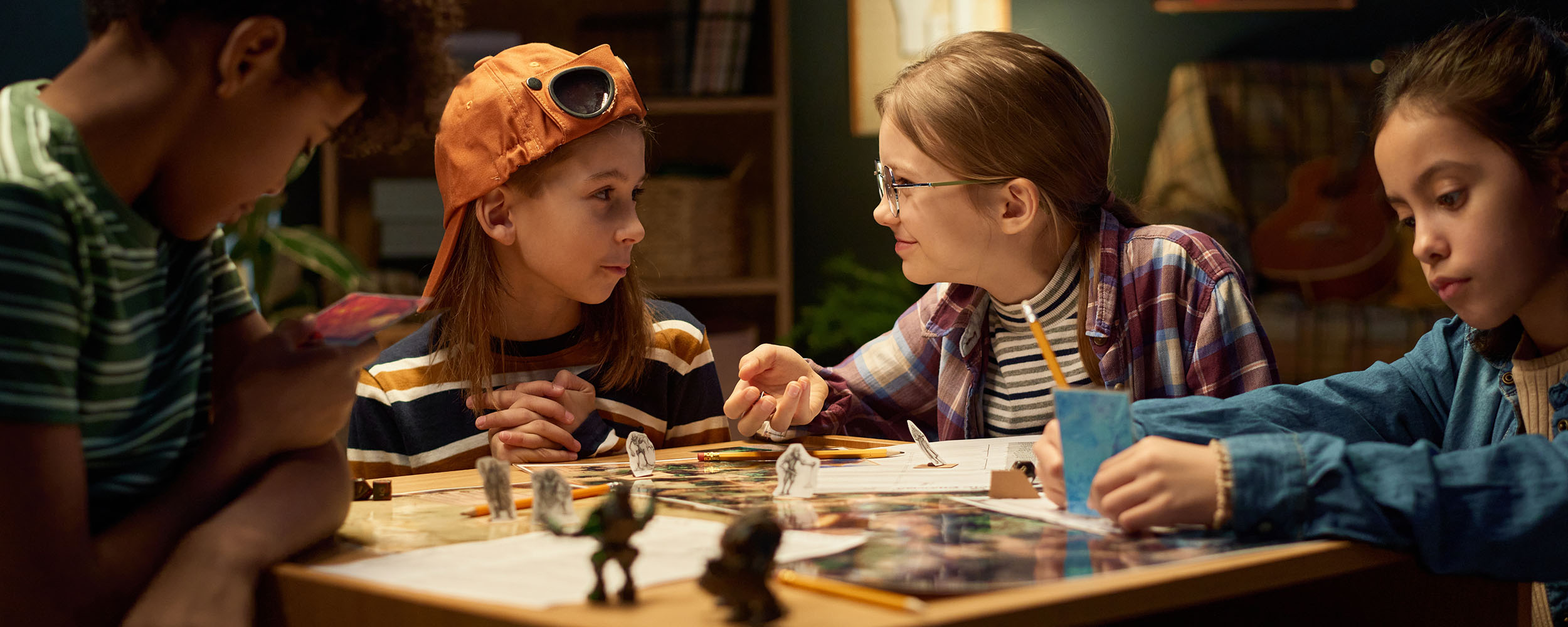
Board games have, for a long time, been overshadowed by the rise of digital entertainment. In an age of constant feedback loops and the fraying of social connective tissue, Prof. Gordon Calleja, designer, author, and academic at UM’s Institute of Digital Games, unravels why modern board games can play an essential role in developing our imagination and strengthening social connections, in a time when such connections might be slowly fading.

The board game scene in Malta and abroad, despite its rich potential for imagination and depth, remained largely a niche hobby for a long time – that is, until recent years. Modern board games are experiencing an unexpected boom, which not even designers and publishers can fully explain. This effect, however, has not extended to digital alternatives that dominated the scene for a while. Prof. Gordon Calleja from UM’s Institute of Digital Games gives insight into this development through his experience having designed and published a wide variety of tactile board games. He has also written extensively about the relevance of board games and the experience of playing and designing them in his In-Game: From Immersion to Incorporation (2011) and his more recent Unboxed: Board Game Experience and Design (2022).
The Journey Begins
Calleja’s journey and deep fascination with board games began in his childhood. He would play Warhammer with his father, who introduced him not only to board games but also to their imaginative potential as he learnt how to design battle systems at a very young age. This passion for structuring imaginative play with rule-based systems, especially through fiction, found its way later into his life as he wrote his PhD on the creation of other worlds, the desire to be out of our bodies, and how virtuality addresses this desire for disembodiment.
With this in mind, we often regard games, both physical and digital, as merely an escape from reality. However, the importance of playing games goes far beyond that. Calleja explains that the imaginative and social essence that playing board games evokes tackles a deep-seated issue that has been circulating ever since the rise of social media. In his words, ‘we miss togetherness’, and so further amplified during the COVID-19 pandemic, the rise of board games may have originated out of a necessity.

Prof. Gordon Calleja (UM’s Institute of Digital Games) is a lecturer of game studies, a game designer, developer and writer at Mighty Boards
(Photo credit: Mighty Boards)
Board Games as a Reaction
Calleja emphasises that imagination, sociality, and play are crucial for our general well-being, but also for our spiritual well-being, bringing about a sense of satisfaction and fulfilment. In Unboxed: Board Game Experience and Design, Calleja clarifies that sociality refers to real-world socialising and not interacting digitally. He argues that these three essential aspects for well-being are deteriorating in our time. This deterioration is a result of the hive-mindedness that social media tends to push, by which we are never given enough time to be bored. A lack of time spent in mental solitude prevents people’s imaginative faculties from roaming free and remaining active, as it is impossible to be imaginative when your thoughts are constantly interrupted.
Quite thought-provokingly, he says that ‘never in human history have we had so many games around us, yet we have been starved of play’. Modern board games seek to address this starvation of play. Subconsciously, people long for togetherness that board games are able to provide, with the added benefit of making people more imaginative – inadvertently addressing these three essential needs.
In this day and age, it is easy to imagine that many are fed up with machines. Albeit video games have broadened the game-playing audience, more often than not, we are playing on our own. Board games offer tactility, and satisfy our deep need for face-to-face communication, acting as a direct reaction to the hyperconnectivity of the digital sphere.


and a reexamination of the concept of immersion
Right: Unboxed: Board Game Experience and Design (2022) – An in-depth exploration of the experience of playing board games
and how game designers shape that experience
Not the Easy Thing I Thought it Would Be
Making a board game that fits all these criteria is not an easy task. After the overwhelming success of Calleja’s game Will Love Tear Us Apart (2013) – an adaptation of Joy Division’s track, a project which inspired his theory-centred approach to game design – he quickly began work on his next project Posthuman (2016). This follow-up game was made with the desire to create a narrative-based strategy game in a post-apocalyptic world that he initially intended to be a video game. After banding together a team of academics – Marvin Zammit, Mark Casha, Fabrizio Calì, and Thom Cuschieri – to form Mighty Box (a small independent video game studio based in Malta) and work on this new game, he suggested making a board game rather than a video game, ‘because that would be easy’, or so he thought at the time.

Delving into this project was nothing short of challenging. Calleja admitted that actually, it was ‘not the easy thing I thought it would be’. The crowdfunding platform Kickstarter was essential to making this project a reality. To make it work, Calleja and his team needed to create a world and introduce it to the communities on Kickstarter to develop a following behind this fictional world. Not to mention the amount of funding that would also go into the art development for the game. After more than a year of work on this project, it eventually gained major traction, becoming the 13th biggest Kickstarter at the time.
Will Love Tear Us Apart? is a free-to-play browser game about relationships on the brink of breaking up. It is inspired by Joy Division’s Love Will Tear Us Apart and follows the song in delivering a dark and frustrating perspective on love. Each verse in the song is represented by a level in the game.
(Photo credit: Might Boards)
The Effectiveness of Affect
A challenge which would eventually also manifest during the development of the board game Vengeance (2017) was that of making a board game cinematic just as a movie like Kill Bill would be. His challenge for this board game was creating a sense of frantic action. He posed the following question to himself: ‘Can I get players to be so invested in a board game that they feel a sense of being wronged by these fictional characters through mechanics?’ To accomplish this level of emotional investment in a board game felt impossible to him, especially coupled with the need to create cinematic fight scenes and a combat system which would strongly engage the player’s imagination.
He would later tackle these challenges and questions during his writing of In-Game: From Immersion to Incorporation, for which he spent six years travelling the world to interview major designers and critics. A book that looked at the theory and established key concepts for board games did not exist, so the whole process was a major undertaking. He had nothing if not the motivation however, as he stated, ‘creativity finds a way out’ and he was determined to propel a more profound understanding and interest in board games.
The effectiveness of the ‘affect’ (emotion) of games became especially apparent in the reviews that Posthuman would receive. Telegraph and other major media outlets regarded this board game as having managed to capture people’s imagination and embody the experience of being in a post-apocalyptic world better than well-renowned board games such as Fallout.

Prioritising Togetherness
Board games have now entered a stage in which their prevalence and importance in the field of creativity are undeniable. Calleja regards how ‘development in board games is like editing in books’, in that a lot of play testing and theoretical work must be done for board games to really tick.
He believes that ‘one of the common mistakes new game designers make is to think up an idea for a board game and never quite get around to making an actual, playable prototype. Another common issue is not thinking about what experience the game is intended to create and thus who it is for.’ The level of thought that goes into a board game must consider the audience at hand. This does not necessarily mean making a board game easy. There are new players who have really enjoyed complex board games and experienced board game players who managed to dislike complexity. Everybody has different tastes, but identifying the imaginative quality of board games is essential to making them stand out.
At the end of the day, board games are meant to bring us together with family and friends in the spirit of play to share an adventure that does not just tell a story, but generates one.


Antonio Grech is a student with UM’s Department of English. This article was prepared in partial fulfilment of Creative Writing 2 under the supervision of Dr Aaron Aquilina.




Comments are closed for this article!