
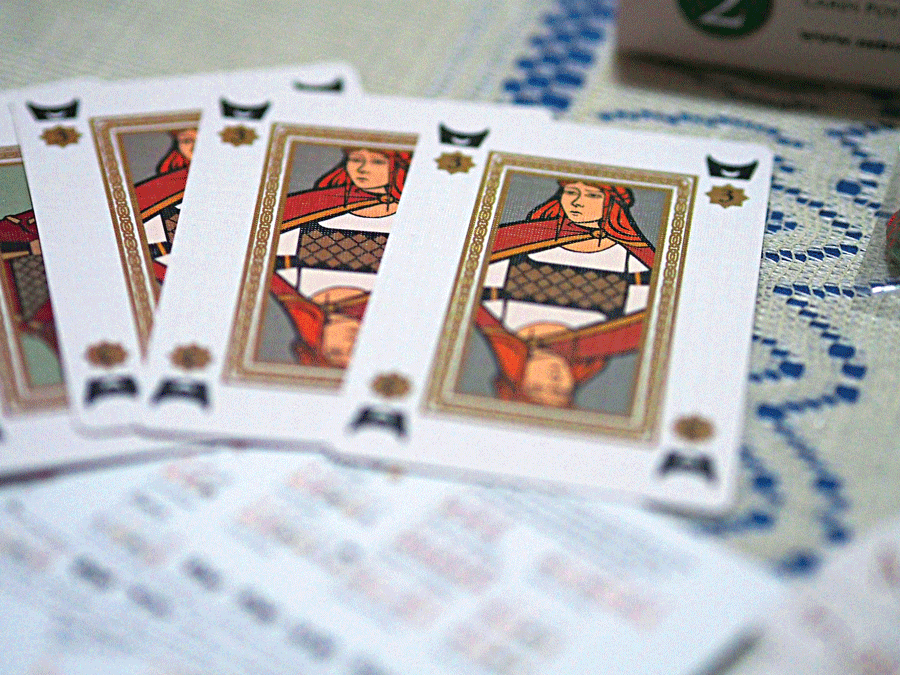

 Haggis is the only game that I rate a round solid 10. I know, it’s probably not good review practice to give your opinion so clearly and obviously at the very beginning, but Haggis is a special game. It’s the only game that I voluntarily own two copies of, just in case something happens to my other one, or the cards just disintegrate after one too many plays. Haggis is that game. The game is strange, because Haggis has no theme. It’s a game of numbers, colours, and emptying your hand of the cards in delightfully strategic moments during gameplay. Quite simply, you need to shed all your cards. Sounds like Uno! Well that’s where the similarities end. Haggis’s design is much more modern, fresher, and not shoved down our throats. Let me put it another way. Uno is a terrible, terrible game. Haggis is my favourite game of all time.
Haggis is in the family of card games called ‘climbing’ games (it has nothing to do with rocks and climbing them). Tichu, another extraordinary card game made specifically for four players is the spiritual predecessor of Haggis. The designer wanted to make a Tichu-like game which plays well with only 2–3 players. The main mechanic of ‘climbing’ games is that the starting player leads with a set of cards reminiscent of poker: so, a pair, a three of a kind, a four of a kind, and so on. The next player needs to play the same set, but of a higher value. So if the previous set was a pair of twos, the next one needs to be either a pair of threes or higher, but the pair always stays. Each of the players takes a turn until nobody can play any higher cards in that set. The player with the highest number takes the points and also the right of choosing which set will be played next.
Climbing gameplay introduces very interesting decisions on which set to play at which point in the game. The balance of trying to maintain control of the game whilst getting the most points is exquisite, and further additions of mechanics like ‘bombs’ and ‘betting on who will win the round’ help bump up the strategy to a whole new level.
Haggis is a great three-player game and an even better two-player game. Haggis wins and wins again on too many levels.



Comments are closed for this article!