
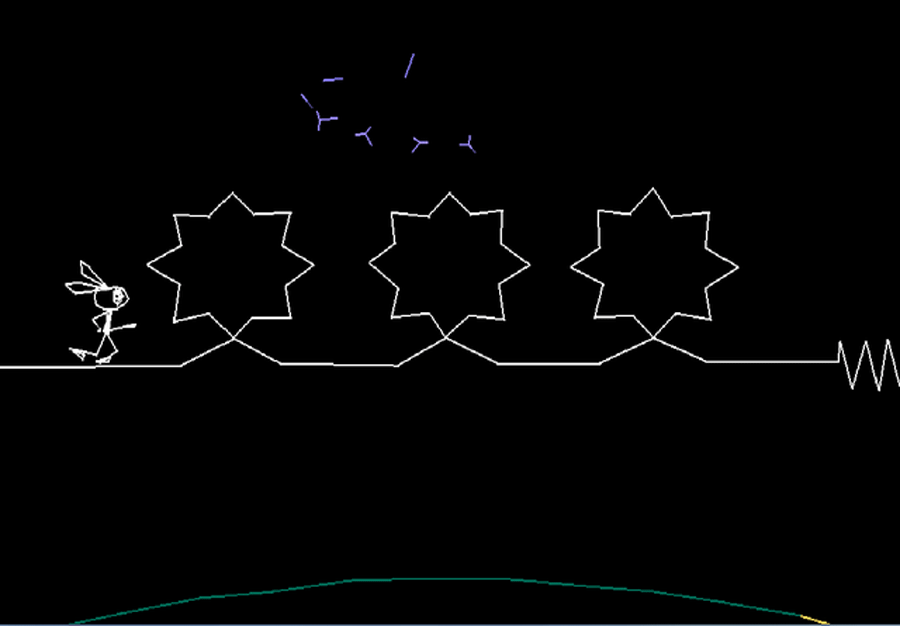

If you’re into music-centric games, you’re in for a treat. Vib-Ribbon, the seminal rhythm game released in 1999 for the original Playstation, is back on contemporary consoles. It’s not a new version, but rather a faithful emulation: an important recognition for a title that was never commercially released in North America, but still made its way into the MoMA (Museum of Modern Art, New York) collection.
The gameplay has remained crucially simple and appealing: push the console buttons on time, and the rabbit heroine will jump, spin, and rotate, all to the rhythm of the incredibily well-fitting ultra-pop songs composed by the Japanese band Laugh and Peace. The soundtrack is heavily manipulated with morphing tempos and bass counterpoints in reaction to the player’s input: the result is exhilarating. The visual style, somewhat reminiscent of the famous animation La Linea, is extremely minimalistic, contributing to the remarkable originality of the game.
It’s a shame that the PS Vita version lacks one of the main features: using any kind of music CD to generate potentially infinite levels. Even so, one of the most creative titles to ever appear on the Sony console is back, ready to surprise a new generation of players.




Comments are closed for this article!