
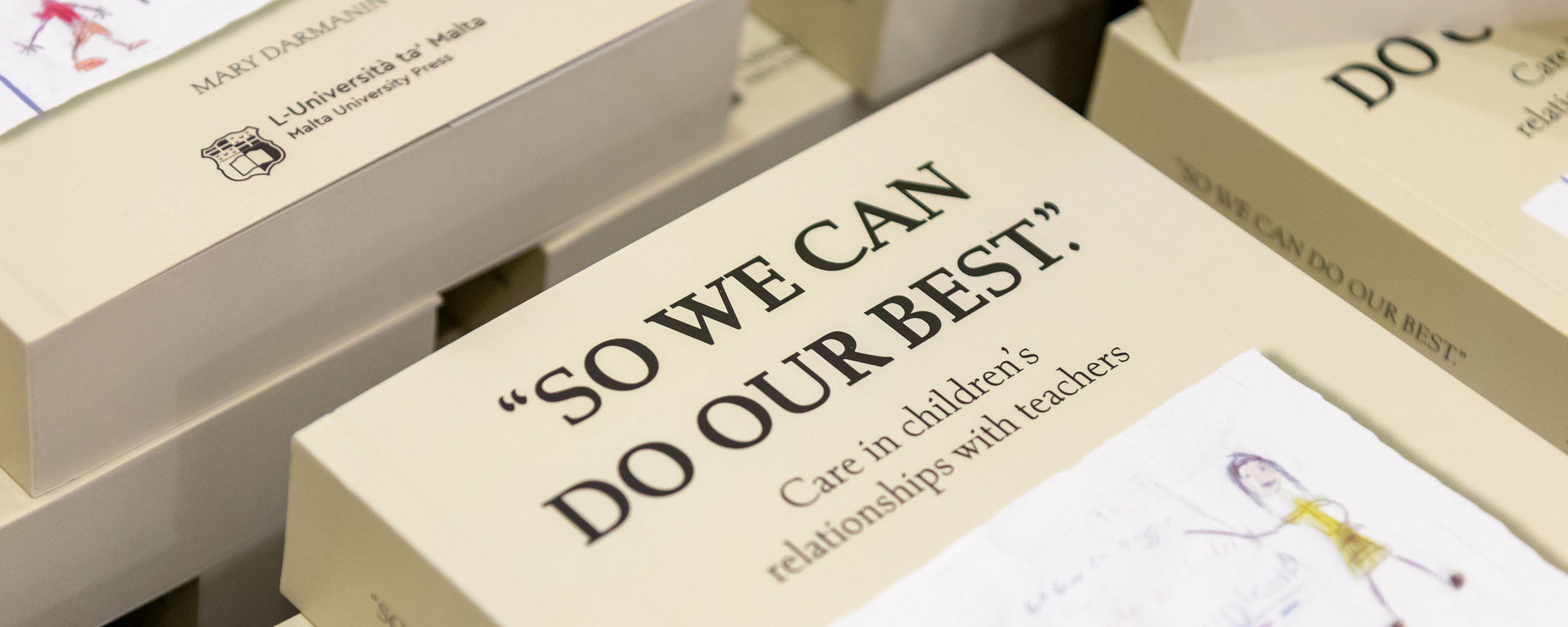
THINK meets with National Book Prize winner, Prof. Mary Darmanin, to discuss Maltese children’s profound understanding of teacher relationships and educational justice.

As a distinguished scholar who has devoted her career to dissecting the intricate dynamics of education policy, the ethnographies of schooling, religious education, and multiculturalism, amongst other sociological studies, Prof. Mary Darmanin’s work has left an indelible mark on Malta’s unique educational landscape. As an academic within the Department of Education Studies at the University of Malta, her work has consistently explored the social and structural factors that shape the experiences of students and educators alike. Her latest publication and winner of the Research Category at the 2025 National Book Prize, So We Can Do Our Best: Care in Children’s Relationships with Teachers (Malta University Press, 2024), now offers a profound and intimate look into the primary school classroom.
So We Can Do Our Best: Care in Children’s Relationships with Teachers – Winner of the 2025 National Book Prize in the Research Category (Photo by James Moffett)
This in-depth study captures the voices (in the Maltese original and in translation) of Maltese children aged 9–11 in state primary schools to illuminate how they perceive their relationships with their teachers and trouble prevailing adult assumptions about what constitutes ‘care’ in an educational setting. The project, Enhancing Student-Teacher Relationships, commenced under the auspices of the National Institute for Childhood, established by the Malta Foundation for the Wellbeing of Society, with the support of President Emeritus Marie-Louise Coleiro Preca. This institutional support facilitated crucial data collection, including funding for research assistants and the considerable cost of transcribing interview data; these interviews underpin the phenomenological understanding of the lived experiences of schooling of Maltese children.

Examining the Classroom Dynamic
Darmanin’s research was born from a recognised gap in the existing literature on student-teacher relationships. Much of the previous scholarship, while valuable, has been primarily quantitative, relying on scales and questionnaires. ‘There is much less work which is based on what happens in the classroom – observational and ethnographic work,’ explains Darmanin. To fill this lacuna, the research team adopted a qualitative approach, rooted in a bioecological framework drawn from the work of American psychologist Urie Bronfenbrenner. This framework focuses on proximal relationships – the ones closest to the child – which in the educational sphere are principally with parents and teachers.
The study was rigorously conducted through extensive ethnographic observation. The researchers spent several months observing six Year 5 classrooms across four different state schools. They spent approximately two weeks in each setting, performing the observational work necessary to understand the contextual factors that shape these crucial interactions. The core of the published work lies in the rich qualitative data – the voices of the children themselves.
One interesting preliminary finding from the quantitative data, which will be explored in a subsequent publication, was the discrepancy between teacher and child appraisals of the relationship. ‘The teacher thinks he’s getting on and the child doesn’t, and the other way around,’ Darmanin notes, highlighting the necessity of listening directly to the children’s perspectives.
Understanding Care
A common tendency is to ‘psychologise’ care, thereby separating it from the core act of teaching. Instead, Darmanin’s work is informed by the care ethics of prominent education philosopher Nel Noddings. In this framework, caring means being attuned to learners’ learning needs.

The children’s accounts made one thing overwhelmingly clear: for children, care is expressed in many ways, but without instructional support, it is missing the unique element that constitutes care in student-teacher relationships. Thus, in the context of the classroom, learning is the key dimension of care. For the Maltese children, a good relationship combines both relational warmth and academic efficacy. As evidenced in the project, without learning, children did not consider that there was care in the relationship. As Darmanin points out: ‘The needs in education are, firstly, the learning needs.’ Poor care, therefore, was tied to any teacher behaviour that diminished the learning environment. This included shouting, which made children afraid to ask for help, poor classroom climate, a teacher’s inability to manage the volume of work, or a lack of instructional support, such as breaking down concepts or offering second and third chances.
A particularly striking insight from this study was the phenomenon of vicarious experience: children were deeply upset by unfairness directed at their peers, even if they themselves were doing well with the teacher. ‘Anything that happens to someone else in the class is experienced vicariously,’ Darmanin notes. ‘They were very aware of what was unfair.’ A teacher who was kind and helpful to most students but not so to another child was not viewed as having a good relationship with the entire class. Another important finding was the children’s profound desire for reciprocity in the relationship. ‘Reciprocity means the teacher is doing something for me; I wish I could do something for her.’ The students did not just want to be recipients of care; they sought opportunities to support their teacher and valued opportunities to remind the teacher of where the class had left off, or to help with tasks. Moreover, they recognised their own academic success as a way of giving back. They would express joy when their teacher was happy with their performance. This two-way connection underscored the depth and relational complexity students sought in the classroom.
Barriers and Policy Challenges
Despite her extensive experience in the sector, engaging with the children’s lived experiences throughout this study deeply influenced Darmanin’s thinking, particularly regarding the impact of structural problems within the education system.


Right: Her Excellency President Emeritus Marie Louise Coleiro Preca (Malta Foundation for the Wellbeing of Society) gave a keynote speak at the book launch of So We Can Do Our Best: Care in Children’s Relationships with Teachers
(Photos by Kristov Scicluna)
In Maltese state schools, the lower band class is often kept smaller but becomes ‘hyper-diverse’ and is the recipient of all new students arriving at different times of the year. This category often includes children with learning difficulties, immigrant status, or those affected by family poverty. Darmanin quotes a particular child’s comments concerning the arrival of a new student: ‘It took five months for him to settle, and I tried to help the teacher, I tried to help him settle.’ This constant flux of disadvantaged, unsettled students overwhelms the teacher, whose task of building stable relationships and providing consistent instructional support becomes nearly impossible. In addition, the children also articulated a need for respect from teachers, noting that shouting, name-calling, or unfairness were signs of a lack of respect. They valued patience as crucial for learning, particularly for those who needed more time to grasp concepts.
A more recent change that the children identified as problematic is the increased use of peripatetic teachers (visiting specialist teachers) in primary schools. The children found it difficult to form the deep attachment necessary for a good relationship when they were meeting too many teachers. They felt they were being treated like secondary school students, and they preferred the holistic bond they had with their main classroom teacher. ‘In the past, in previous generations, the primary school teacher taught everything,’ explains Darmanin, ‘and that led to a very good attachment with the teacher, and the basis of good relationships is attachment.’
A Call for Reflection
Darmanin’s book, So We Can Do Our Best, is primarily geared as an essential read for beginning teachers and those currently in the classroom, informing them how children desire to learn. It establishes that a positive classroom climate is vital, and that the unique bond with a teacher is rooted in effective teaching. Caring should not just be understood as wellbeing, from a psychological perspective, but as ‘caring so that someone can learn’. The book offers concrete takeaways on the need for instructional support, or scaffolding, and the importance of allowing sufficient time for relationships to develop.
At the same time, the book also serves as a critical document for policymakers. Darmanin notes that many current educational policies surprisingly neglect the words ‘learning’ and ‘teaching’. She argues that if policymakers read the children’s accounts, they would gain insight into what can be improved without incurring significant costs. Improved learning hinges on understanding the relational conditions children need to thrive; conditions like a stable class environment, respectful interactions, and effective instructional support can be adjusted quickly and efficiently.
Darmanin’s book is more than a research monograph. It is a testament to the wisdom of children and a vital call to action for educators, policy makers and system designers to align the act of caring with the mission of teaching.

So We Can Do Our Best: Care in Children’s Relationships with Teachers is available from the Malta University Press website and local distributors.



Comments are closed for this article!