
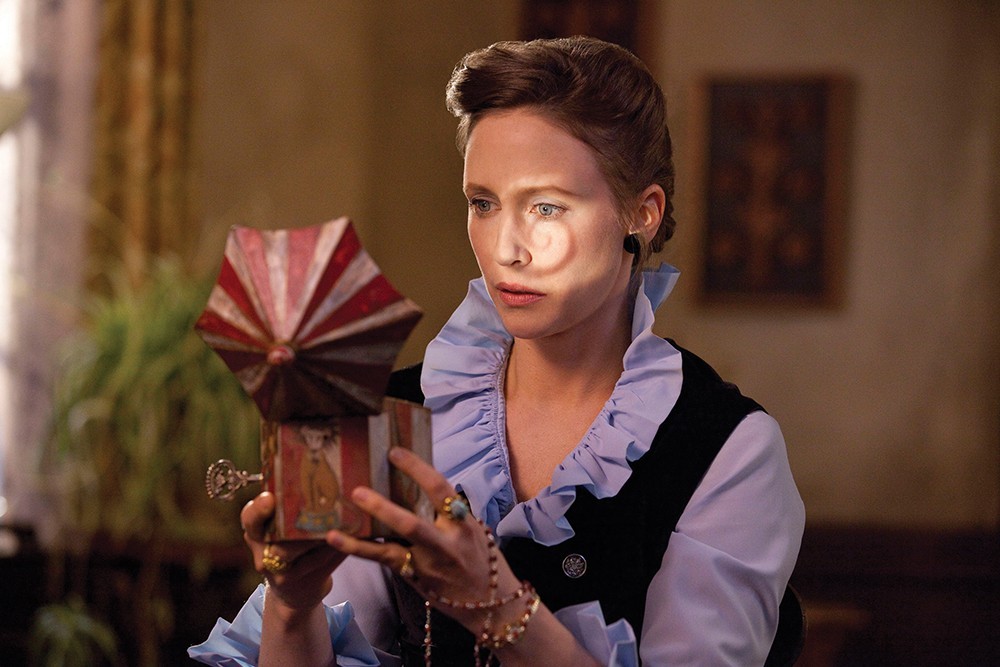

Krista: James Wan’s film is irresponsible for its appalling suggestion that the Salem witch hunt was somehow a justifiable massacre. The dead earnestness of those who ‘inspired’ it makes me shudder. The ‘true story’ malarkey is common in horror taglines but this movie seems more earnest about those credentials by basing its characters on real people.
Noel: You’ve got a point there. Even though the story revolves around female characters, most of them are either ghosts or victims. The true menace is motherhood itself. Even Annabelle the doll exploits maternal instinct to haunt its hosts. The ghost of the witch, despite being after the children, first possesses the mother then tries to make her kill the child.
K: Are you suggesting that the film distorts the maternal instinct?
N: Yes, as far as the witch’s ghost is concerned. That is why it tries to corrupt the other mothers. The males simply orbit.
K: That’s another thing: how seriously does it take itself? There’s the playfulness one associates with a Wan film, especially references to other horror movies, such as The Evil Dead (‘groovy’). Wan is a horro fan who indulges in it for its own sake.
N: I found The Conjuring very dark in tone, compared to Insidious, his previous ghost film. The geeky paranormal researchers play a less central role.
K: How does the motherhood bond in The Conjuring compare to the fatherhood bond in Insidious?
N: The fatherhood bond is tenuous there. The mother is most worried about their haunted son.
K: You are right about the mother being the emotional centre and her level of concern in Insidious. However, the problem originates from the father, who passes on the legacy of astral projection. And it’s the father who rescues the son. I thought the mother-son relationship was more peripheral. She tries to influence events but isn’t a moving force.
N: Off on a tangent: James Wan is such a good filmmaker. He’s confident and knows exactly what he wants to get across without resorting to boo! gimmickry. The scariest bits in the film happen with a static camera and no cuts. Just mise-en-scène — a visually artful way of telling a story. For example, the bedroom scene with the two sisters. One of them points at a ghost that is never seen. Since we’re watching a horror film, we know it’s there. And Wan sustains the scene long enough to get under our skin. Brilliant!
K: That’s true. Though in terms of unexpected shifts, these do occur often. Take that ‘odd’ devil scene in Insidious where it feels like a different horror subgenre. There are these shifts in tone and style in The Conjuring too, but it is more consistent than Insidious overall.
N: Insidious is simply superb up until the ‘ghostbusters’ appear; then it becomes goofy.
K: Though I’d take any Lin Shaye character over the Warrens.
N: I am with you on Wan’s playful approach. Honestly, I’d love to see a ‘mature’ James Wan film through and through. Given the right script, he would make a great film. Krista, could we say that The Conjuring is a second take at Insidious?
K: I agree with what you said when we came out of the cinema — that it refers back to his earlier film. Though I still prefer Insidious, because of those jarring shifts from subtle to unsubtle, which are tricky to pull off, but
somehow work. The Conjuring is certainly more polished, but I cannot quite see it as more ‘mature’ than Insidious, mainly because of its political irresponsibility.


Comments are closed for this article!