

Think meets up with Dr Kris Zarb Adami to have a chat about Malta’s space opportunities. His research covers subjects from searching for extraterrestrial life to new theories of gravity.
How can a small country like Malta have a role in Space?
As an EU member Malta can continue strengthening our existing cooperation agreement with the European Space Agency to full membership. This will automatically give us access to all its projects. By participating in these projects, we will be able to leverage so that research and development for future space missions is carried out in Malta. In Malta we are already contributing to a European Space project, namely EUCLID. This satellite is due to be launched in 2017 and will be the successor to the Hubble Space Telescope. Researchers at the Department of Physics are developing image-processing algorithms that can accurately measure the shapes of the Universe’s furthest galaxies and its expansion.
Moreover, they also collaborate with the University of Bologna to monitor ‘space debris’ and near earth-objects. This is important to ensure the successful navigation of satellites to prevent accidental collisions, which cost millions of euros. Collisions are not as rare as we might think.
What are the benefits of Space research for Malta?
From the invention of disposable diapers to the development of laptops and satellite TV, space research has traditionally been a very strong contributor to everyday technology. For Malta space research can help us monitor our climate and atmospheric pollution, while providing an early warning system for tidal waves.
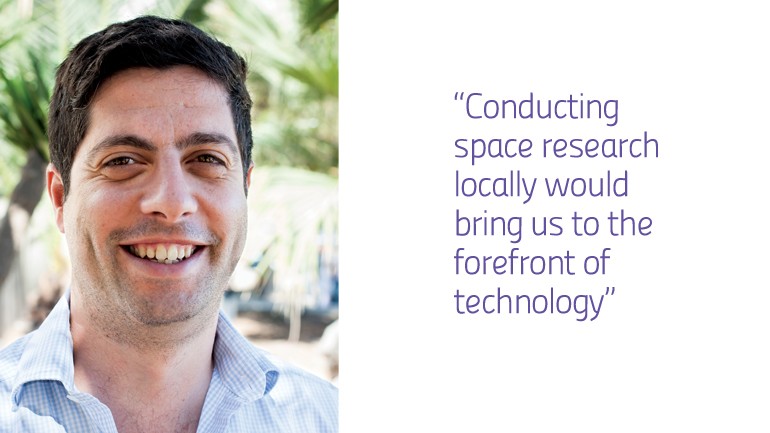
Conducting space research locally would bring us to the forefront of technology: ranging from biotechnology and long-lasting foods for space journeys, to the development of faster and more sensitive communication systems capable of receiving signals from deep space. Malta has just been awarded ERDF funding for new laboratory facilities at University and will contribute significantly to the future of the European Space Programme. In return, Malta will be able to leverage significant funds from this programme and also funds designated to commercialising the technologies. We need more support to get involved in more projects and attract funds to Malta.
What is the future of Space Research?
The next step lies in the development of space vehicles capable of running commercially feasible missions, such as turning the space shuttle into a commercial ‘airliner’ business. Such programmes are beginning to emerge in the US, but Europe lags far behind. Commercial spaceflights will certainly play an important role in future space research. Apart from research into transportation, researchers are trying to figure out how to live on a planet besides our own. How can future generations be able to create food products and live in space?
In Malta I would like University and the whole country to become more involved in space technology and biotech. We could also contribute to landing and docking systems for satellites and shuttles, plus space-traffic control through the University’s expertise in the Engineering Faculty.
Is there anything to lose?
The danger with taking on some new research area is that funding from other streams is spread too thinly. However, if we can manage to leverage extra funding from large Europe-wide space programmes we will be able to launch Malta’s name into space!




Comments are closed for this article!