
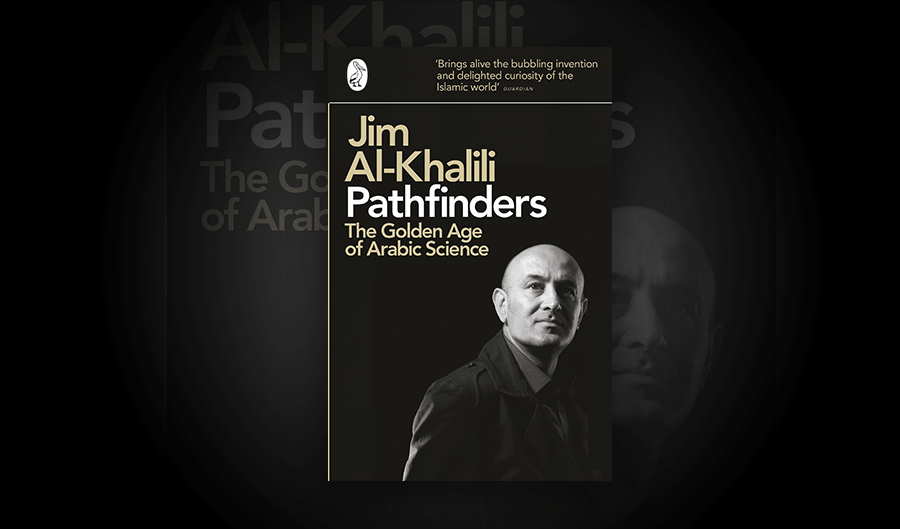

This book was published in 2010 but unfortunately remains one of the few examples of positivity towards Islam coming from the West. British Jim Al-Khalili was born in Iran and he wrote about science during the early days of Islam, also giving a beautiful picture of life before the Islamic revolution of 1979 that forced his family to flee. Al-Khalili is a an accomplished theoretical physicist and broadcast presenter for BBC Horizon, The Big Bang, Tomorrow’s World and Science and Islam (the parallel TV series to this book).
If you love history, you will love this book as Al-Khalili goes into great depth—three whole chapters—to explain the circumstances that led to the golden age of science within Islam. The standard history of science texts usually paints the Islamic Empire (the scientific golden age was mostly from the 8th till 13th century) as being the great saviour of Greek texts having translated the works of Pythagoras, Aristotle, and other Greek scientists that then instigated the Renaissance in Europe when they were translated into Latin and other languages. Al-Khalili shows that these scholars were not mere translators but innovative in Mathematics, Astronomy, Medicine, Chemistry, and other fields. Scholars came from all major faiths.
Al-Khalili takes till Chapter Four to start detailing these scientific achievements. I would have preferred if these came sooner. He reveals facts such as that the zero was not invented by the Arabs but by the Indians, the Arabs simply used it to powerful effect. The Arabs pushed mathematics by leaps and bounds and Al-Khalili uses multiple chapters to outline them all. They invented decimal fractions, part-invented the decimal system, and invented proofs of mathematical equations through induction, using pages of equations to break down the initial equation and prove it absolutely, which is still the gold standard for modern mathematicians.
“He reveals facts such as that the zero was not invented by the Arabs but by the Indians, the Arabs simply used it to powerful effect”
He talks about the polymath al-Razi (854 AD–925 AD). Al-Razi lays claim to classifying substances according to their properties based on experimentation. He used experimentation to select the most hygienic site for Baghdad’s hospital, improved medical ethics and even accepted mentally ill patients (when concurrently the Christian world saw them as devil-possessed), distinguished between curable and incurable disease, clinical trials, and many other advances. His medical textbook al-Kitab al-Hawi fills 23 modern volumes, the largest in the Arab world.
Al-Khalili talks about plenty of other advances and scholars that are sure to surprise readers. The book can be slightly challenging for people to get through. Al-Khalili writes beautifully, clearly, but somewhat academically. If you’re interested in learning about a neglected part of the history of science, this book is for you.
I spoke to Al-Khalili back in 2010 about the TV series related to this book. His final words were that I had to bring his series to Malta. Words relevant then as they are now: a shining light on the possible positivity within Islam interpreted in the right way.


Comments are closed for this article!