
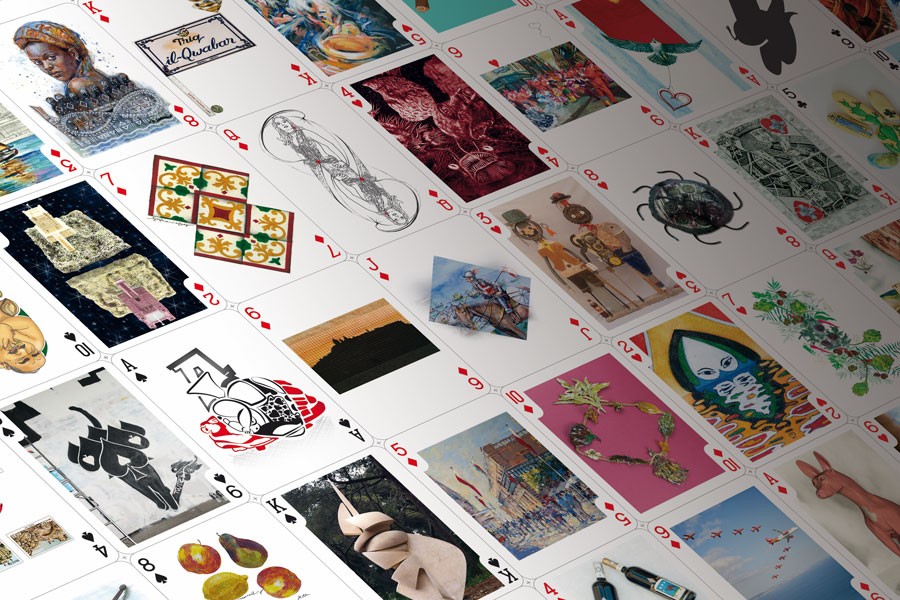
It would be easy to dismiss this nifty card game as a simple tourist souvenir, but a closer look reveals a somewhat deeper meaning than a mere deck of Maltese Playing Cards.
Reviewing this set of cards is outside my immediate comfort zone. I spend so much time thinking about mechanics, group dynamics, table talk, design, and replayability of games, that when presented with something that cannot really be critiqued for any of those game dynamics, I stumble. Truth is, there is no game here. There is a tool for a game, the motives of which aren’t really related to games at all. The ‘game’ part of this product is used more as a vehicle to deliver an ideal, a message, and a story.
At their core, the Malta Playing Cards are just a set of playing cards. Their particular characteristic is that each single card features a unique piece of art from a local artist, and each one has some sort of connection to Maltese history or culture. That in itself is already a great idea but the card makers didn’t stop there: the deck comes with a small booklet called Walkthrough and Compendium. The booklet shows how every single card was thoughtfully and meticulously matched with the artwork. The cards tell a story. They are riddled with connections to one another, one linking to the next like an intricate hyperlinked web. By the time I had reached the the end of the booklet, I felt like I had gone through some sort of hybrid between a curated gallery and guided walkthrough of Maltese culture. One is free to walk wherever they like, and the deeper one digs the more connections are uncovered.
Now, I must retract what I said about this pack of cards not being a game. I was wrong. Few other ‘games’, especially tabletop ones, have so rewarded my curiosity and desire to explore. Of course, the ‘game’ can be read once and then it is over, but then the cards can be reused for any other game you would like to play, and whenever you do, the images on the cards have all now been imbued with meaning. They act as reminders of the little journey you experienced when you went through the deck in one hand, and the booklet in the other, discovering a beautiful story.
One final note, the cards are premium plastic. Not paper, which is awesome. I highly recommend Malta Playing Arts.
See the artworks at Malta Playing Arts: The Exhibition curated by Marika Azzopardi, Palazzo Ferreria, 310, Republic St, Valletta, 18–29 April (Mon–Fri, 0830–1630hrs).



Comments are closed for this article!