
Chemistry is not usually associated with logic gates, sensors, and circuits. However, a new breed of chemist — the molecular engineer — is adding a bit of chemical spice to them. Given the right tools, his/her hands can synthesize anything, from molecules that assemble into large structures to others that can display information about their environment.
Thomas Farrugia (supervised by Dr David Magri), created a molecule that could be toggled between an ON and OFF state using AND Logic. AND logic means that it needs two chemicals to switch state, adding just one chemical makes no difference. The states are easily recognised by shining UV light on the molecule since only the ON state produces blue light.
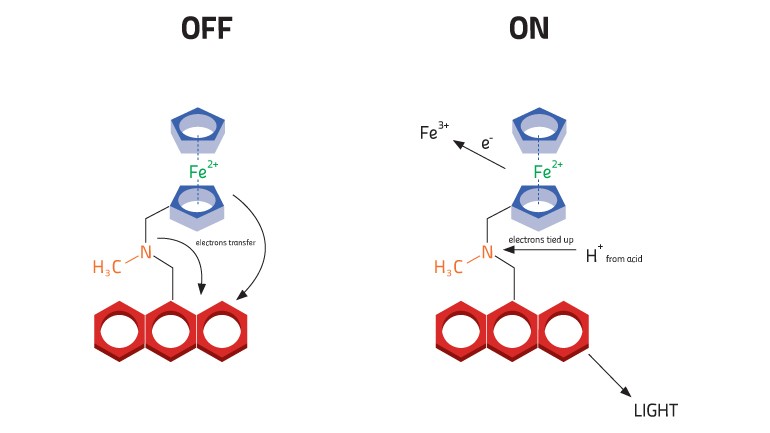
In the OFF state, the movement of electrons from two input sites prevents light being released. Stopping the electron transfer enables light release. The blue light shines when specific chemicals bind to the two input sites. The chemicals use up the electrons being transferred, letting the output of the molecule absorb UV light and shine blue light.
The two chemicals added were an acid and an iron (III) source (like what is found in rust). The acid provides hydrogen ions that bind to the nitrogen atom, whilst the iron (III) ions attack the molecule’s iron (II) atom (pictured as Fe). The molecule displays AND logic since it needs both the acid and iron (III) to turn on light emission.
The molecule was synthesised using a one step reaction and tested to determine the strength of the ON and OFF signals. Testing by fluoresence spectroscopy is essential to determine whether it would make a viable sensor, since the technique compares the strength of the ON and OFF state. The molecule will only work well if there is a large difference between the different states, since a machine needs to detect the change.
This molecule can sense the extent of acidity and iron (III) ions in a solution, and convey that information using light, which is easily measured. The molecule’s design could also be integrated into bigger and more complicated molecules so as to carry out other logical and mathematical operations using chemicals. These molecules are a step towards chemical computers.
This research was performed as part of a B.Sc. (Hons) Chemistry with Materials at the Faculty of Science.




Comments are closed for this article!