
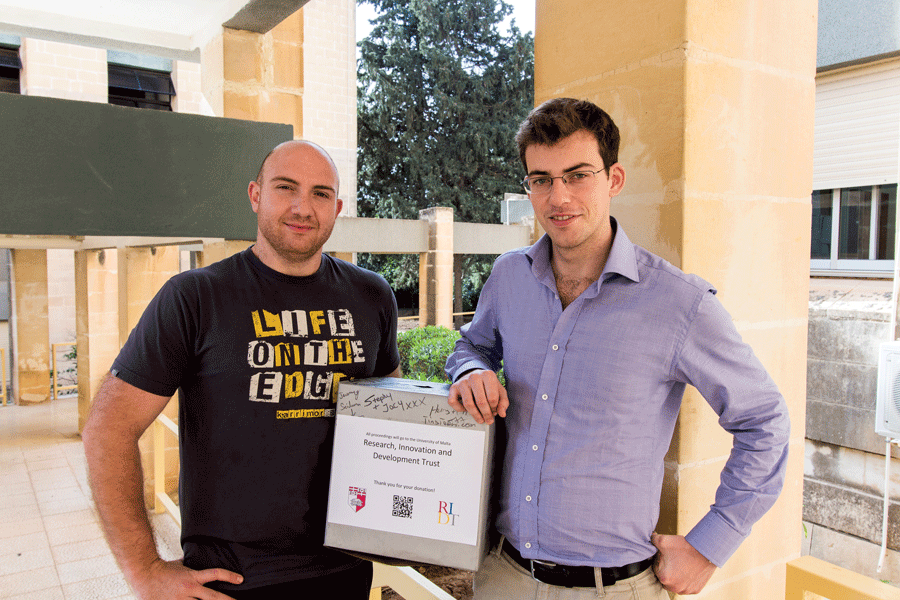
 A changing University greeted me when I returned to Malta four years ago. This culture of change has only snowballed as new institutes, centres, and facilities have opened up, backed by personnel that are pushing its research portfolio. To continue supporting this progress the Research Trust (RIDT) is launching a Staff Contribution Scheme as from January 2015.
The Staff Contribution Scheme allows any University of Malta staff member to donate some of their payroll to research. After filling in a simple one-time form, donations can be started from a minimum of €1 per month, and donations can be stopped at any time through a quick email. Donations are effected before tax, which ensures that all of the donation goes towards research.
A few staff members have already signed up to the scheme. Dr Ing. John Betts (Dean, Faculty of Engineering) talked about how ‘University does not “need” to collect money from staff, but as a member of staff I wanted to support an initiative which is part of a collective effort to promote, help sustain, and enhance research at University.’ Research is the core of any world-class university.
The University of Malta has a solid teaching background with over 11,000 students. It has trained Malta’s leaders with academics, administrators, technocrats, and professionals who have transformed our country from a barren archipelago into a civilised, developed nation. Continuing this socio-economic development needs more funding.
Prof. Charles Sammut (Dean, Faculty of Science) stated that the scheme was ‘an excellent idea which gives University members an opportunity to set an example. Government (and citizens) will take note that we have achieved so much over the past few years that we are confident in investing our own money to support research. Local industry might also appreciate our dedication and hopefully cultivate a culture of investing in research. I hope our voluntary contributions will be matched by others.’
‘No modern-day University can rely exclusively on Government funding’, stated University Rector Prof. Juanito Camilleri. Traditional funding sources will not increase substantially, thus making creative schemes like this one vital to continue expanding research funds. The Rector continued echoing this sense of hope by saying that his donation was ‘because I believe it is a good cause’.
I’m signing up to the scheme myself. Like all others already pledging part of their payroll towards this scheme, we all think that research is vital for Malta. Betts said ‘I am happy to contribute to supporting this, not only by my work, but also by putting my money where my mouth is.’ While Sammut hopes that ‘we can easily double what little money is allocated by government for research at the University of Malta’, supporting what the Rector said previously.
I have faith in the culture change I see around me. The University of Malta is communicating to the public what it is doing, more graduates are furthering their studies, and world-class research groups are being built locally. NGOs and corporate partners are also donating money to research, realising the vital role it plays in achieving their long-term goals.
The Staff Contribution Scheme will not change the world, but every little bit does count and I will be putting my money where my pen is.




Comments are closed for this article!