
 Being in the second year of my banking, finance and management studies, innovation in these sectors is a key part of my curriculum. In banking one can easily see developments with the introduction of banking by telephone, internet and mobile. Similarly with management, recent growth has allowed the sector to grow and develop expertise in management of projects, accounting and supply chains.
Innovation has exponential potential to foster new solutions, initiatives and jobs. Younger graduates need to create new opportunities. For Malta to improve its competitiveness and attract investment we must turn challenges into opportunities. During Ireland’s EU Presidency, in the first half of 2013, the negotiations led by Dublin saw Malta secure €1.128 billion for the 2014-2020 Multi-Annual Financial Framework. The possibilities for Malta are endless. On top of this framework lies the Horizon 2020 Programme, where countries can compete for over €80 billion set aside for innovation. These funds should be used strategically in Malta to improve existing sectors and to find a way to create new markets and jobs. This growth would build Malta’s competitiveness.
“For Malta to improve its competitiveness and attract investment we must turn challenges into opportunities”
SMEs (small and medium sized enterprises) are being greatly encouraged by the EU since they are seen as a route out of the recent economic crisis. The Horizon 2020 programme gives priority to SMEs.
Malta can win more of these funds by looking at what Horizon 2020 aims to achieve, that is leadership in a world of competitive science and to realise innovations leading to societal change. These could be in the areas of biotechnology, clinical research and green technologies. We need systems that change the way we live and think.
In the global economy, it can be hard to be innovative and entrepreneurial as we have grown accustomed to depending on other countries to do our work. Instead of waiting for new technologies and developments to emerge so that we can replicate them, we should encourage the young generation to open new doors that could lead them to success. Thus, inspiring people to think outside the box and to be creative starts from an early age. This train of thought must be cultivated at the heart of the education system where students start to think about jobs and the future.
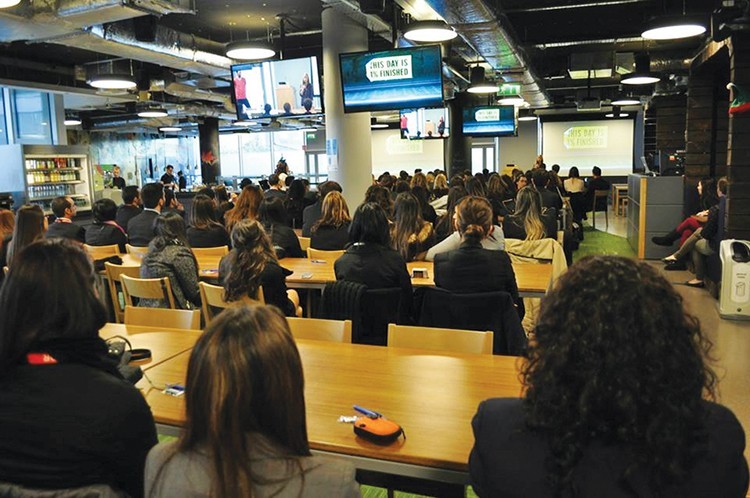
Last December, I had the opportunity to see this when I visited Facebook’s Headquarters in Dublin as part of the ASCS study trip. There is considerable scope for further research into virtual platforms linking social media with innovation in business.
Albert Einstein once said ‘Most people see what is, and never see what can be,’ which is exactly why we need to shift the focus on what can be done, rather than what has already been done.




Comments are closed for this article!