
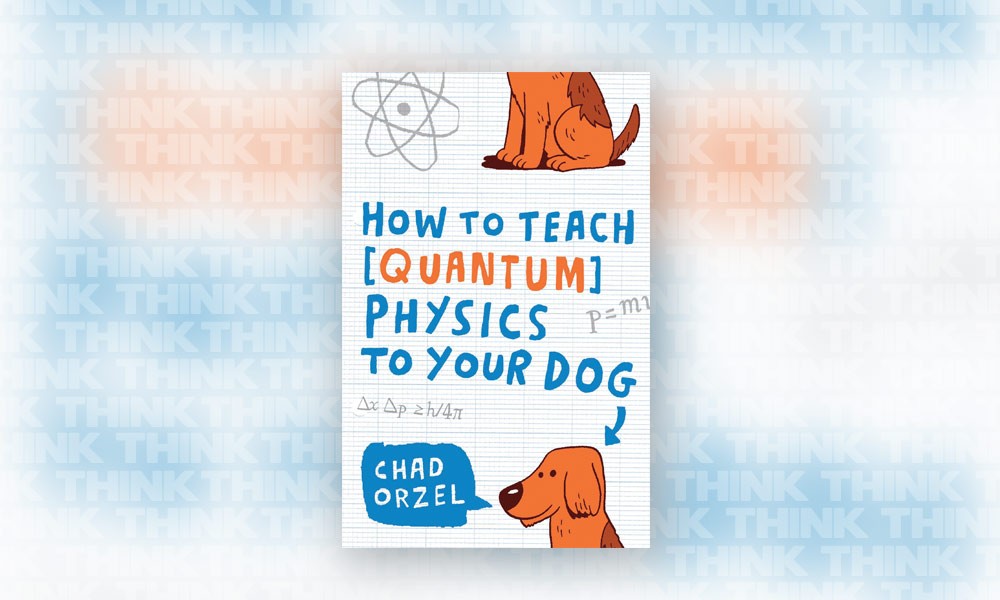
Book review by Andrea Marie Cini
The term quantum physics has struck fear into many hearts. Such a complex subject has, for many years, dumbfounded students, and, it seems, their dogs alike. Chad Orzel (a professor at Union College,New York) in his book, How To Teach Quantum Physics To Your Dog, tries to accomplish just that; how do you explain sub-atomic physics in a fun and easy way? Using his dog Emmy as a fellow narrator, Orzel explains quantum physics from a different, more canine-oriented perspective, and actually manages to make it work!
Making use of situations that dogs encounter on a nearly daily basis, such as rabbit chasings, evil squirrels and squeaky toys, the author explains some of the most complex theories and experiments in science. Sound bites as particle-wave duality, Heisenberg’s uncertainty principle, and quantum tunnelling are just a few of the many topics covered and are colourfully explained within this book. Making use of simple diagrams and modern references, these previously baffling topics are simplified in a way even a dog could understand (if dogs were capable of learning science—debatable). Orzel’s ideology is pretty simple: if a dog could understand his explanations then a human surely would.
Apart from being a sturdy foundation for the topic of quantum physics, the fun-loving and comical conversations between Orzel and Emmy the dog are a captivating read. Emmy’s curious questions and Orzel’s exceptionally patient answers make it almost impossible for readers to forget. Within this novel it feels as if the reader is really strolling in a park with the duo. Apart from this professor’s incredible explanations and handy diagrams, another distinguishable feature of his book is the fascinating footnotes—a source of unforgettable fun facts. For example, did you know that the great scientist, Schrödinger, was a notorious womaniser?
While I would not recommend How To Teach Quantum Physics To Your Dog to pass the next quantum mechanics exam, it is great foundation material. Studying quantum physics has never been more fun and the book is a great read—highly recommended.



Comments are closed for this article!