
In the last 100 years, Einstein’s theory of general relativity has proven invaluable to explain the nature of the universe. That being said, Einstein’s model of gravity does at times fail to comply with what we actually observe when looking up at the night sky.
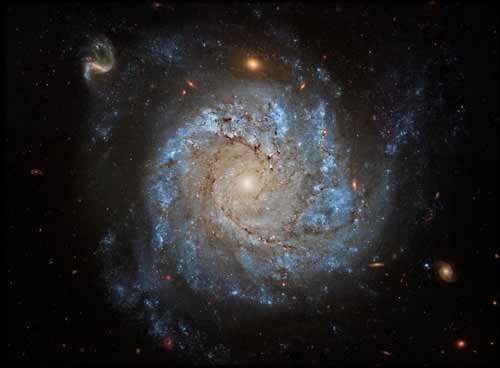
Galaxies offer one of the most impressive laboratories where general relativity just does not work. Stellar objects in galaxies tend to orbit the galactic centre of mass. General relativity predicts that as one goes further from the centre of the galaxy, these orbital speeds drop off. Observational data shows that these velocities tend to stay constant along the radius of a galaxy. However, dark matter can be artificially introduced to account for this. The other argument is that such failures indicate the inability of general relativity to fully explain how the universe works. If this is so, it seems necessary to construct what are called alternative or modified theories of gravity. Such theories would have to be capable of correctly explaining all observed phenomena including those that general relativity fails to produce.
Andrew Finch (supervised by Dr Jackson Levi Said) is looking into the new concept of treating gravity as a torsional dominated system instead of a curvature dominated one, which is the concept explained by general relativity. The new models are being developed with the intention of agreeing with galactic rotation curves while managing to explain everything that general relativity already does. It is only possible to vigorously test such models because of the large amount of freely available data which has been gathered on galaxies. As models are obtained, the cluster in the ISSA (Institute of Space Science and Astronomy) laboratory is being used in order to determine model parameters. Using this data, Finch aims to compare Einstein’s theory with the new model being developed. Will it improve on Einstein’s ideas? Only Finch will tell…
This research is being performed as part of a Masters Degree in Astrophysics being read at the Institute of Space Sciences and Astronomy, University of Malta.
Andrew Finch




Comments are closed for this article!