
Sarah Schembri talks about the importance of seagrass meadows for marine ecosystems.
Seagrass meadows support a diverse range of organisms. When this habitat is fragmented all species suffer. Fish that previously had large stretches of seagrass meadows to forage in would have to face the prospect of swimming to a different patch more often and this exposes them to predators.

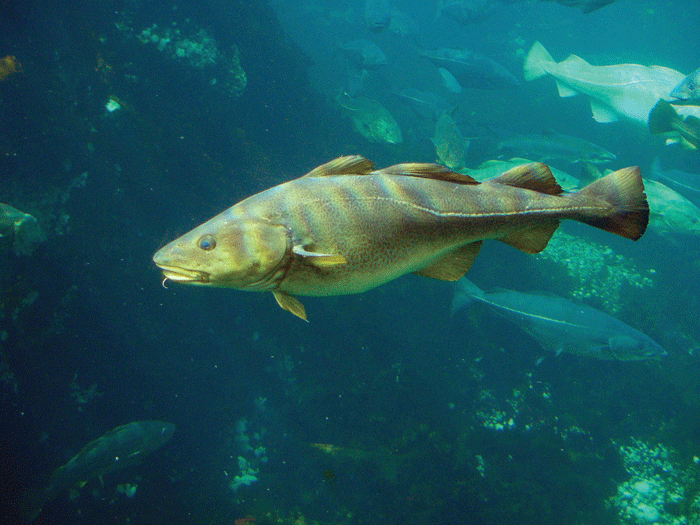
One of these species is that fish and chips staple, the cod (Gadus spp.), which as a juvenile uses eelgrass (Zostera marina) meadows as nursery areas in the North West Atlantic. A series of experiments were performed in 2009 at the Memorial University of Newfoundland, Canada in a tank with two fake grass patches. Researchers observed the gap crossing behaviour of juvenile cod when alone and in the presence of other cod. Then the data was analysed by Sarah Schembri (supervised by Dr Shaun Killen and Prof. Jason Matthiopoulos) using statistical models and turned into a computer simulation for fish movement in the tank.
Repeated simulations showed that fish grow bolder in crossing from one grass patch to another both when there are more fish present in the tank as well as when they are larger in size. However, the simulations allowed the researchers to distinguish a difference in this response; larger fish tend to be bolder and less decisive, they are quicker to leave the release patch but slower to enter the destination patch, while groups of fish tend to leave a release patch and swim quickly to the destination patch as a group. There was another difference. The total number of fish in the tank had an impact on gap crossing behaviour but not on the number of fish in the immediate vicinity. Juvenile cod communicate to coordinate their movement even at distances that seem relatively large compared to their size.
The conclusions drawn in this study could form the basis of hypothesis for larger studies, such as those to determine marine habitats that qualify for Marine Protected Area status.•
This research is partially funded by the Master it! Scholarship Scheme (Malta), part-financed by the European Union—European Social Fund (ESF).




Comments are closed for this article!