
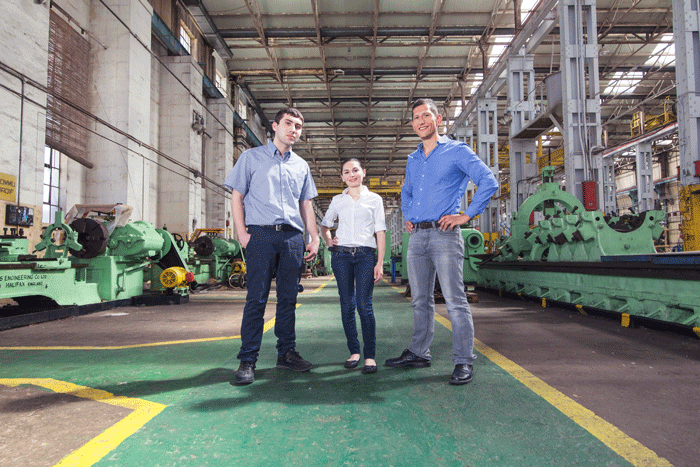
A new hallmark for graphene, the wonder material of the 21st century, has been found. It has a range of applications—from biomedical to new, smart materials. To gain a better understanding of this discovery, Claire Testa met metamaterials researcher Professor Joseph N. Grima and his team (Department of Chemistry, University of Malta). Photos by Elisa von Brockdorff.
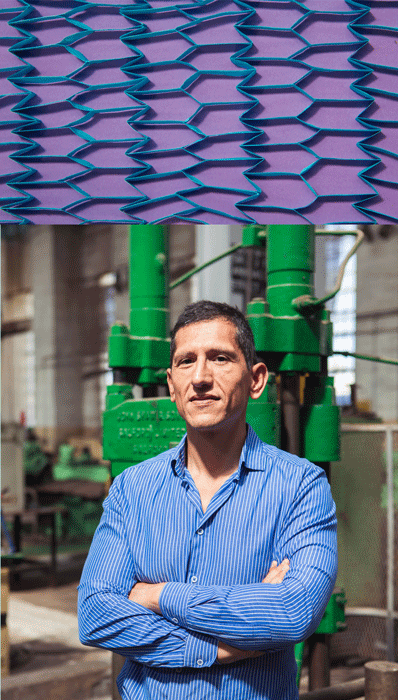
The crumpled paper in the dustbin next to your office desk appears like a mundane object. However, if you grab a piece of paper and pull from both ends to open it up, it will grow longer and fatter. This seemingly unremarkable property could result in the next revolutionary material.
Professor Joseph Grima is one of the leaders in the field of auxetic materials. He starts by explaining the obvious. When something is stretched it tends to become longer and thinner. Auxetics defy this logic. They become wider when stretched. The extent to which a material gets fatter or thinner is called the Poisson’s ratio. A positive Poisson’s ratio is when the material gets thinner, a rubberband is a good example; while if a material widens when pulled it has a negative Poisson’s ratio. This makes a material auxetic. This property is ‘scale independent,’ explains Dr Daphne Attard—a researcher in Grima’s lab—and may exist in large and small structures.
A strange material
Graphene has been proclaimed as ‘the wonder material of the 21st century.’ Its potenti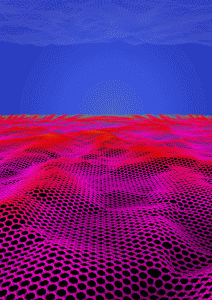 al is astounding with applications in display screens, electrical circuits, tissue engineering, water filtration, and nanotechnology. In 2010, Andre K. Geim and Konstantin S. Novoselov received the Nobel Prize in Physics for their work on this super material.
Luke Mizzi, a young Ph.D. student, explains how graphene is a form of carbon made of single atom-thick layers. They appear like sheets of paper with clouds of electrons on each side. These are really thin layers, graphene is amongst the thinnest materials that ever existed. One graphene layer, for example, is invisible to the human eye being thinner than a soap bubble film, yet nearly as strong as diamond. This unique structure combines strength with an ability to pass electricity and heat. Thus making it promising for several future applications.
Making the connection
Grima compares graphene sheets to the sea in autumn. The small ripples on the surface of the sea resemble graphene sheets, which are not perfectly flat. Graphene has ripples in it. Nevertheless, unlike the crumpled paper mentioned before, graphene is not naturally auxetic. It does not get wider when stretched.
Grima’s team shows how graphene’s already remarkable properties may be improved by modifying its nanostructure. Graphene has a perfect arrangement of atoms. To make it auxetic, Grima explains, ‘one needs to disturb its perfect arrangement of atoms, which looks like chicken wire.’ The atoms in graphene are arranged like a net of hexagons. This can be performed at ambient conditions by the removal of certain atoms and by the setting up of new connections. This introduced some five-sided pentagons in a layer that previously only contained six-sided hexagons. The presence of these pentagons geometrically disturbs the graphene sheet, which dramatically increases the amount of ripples.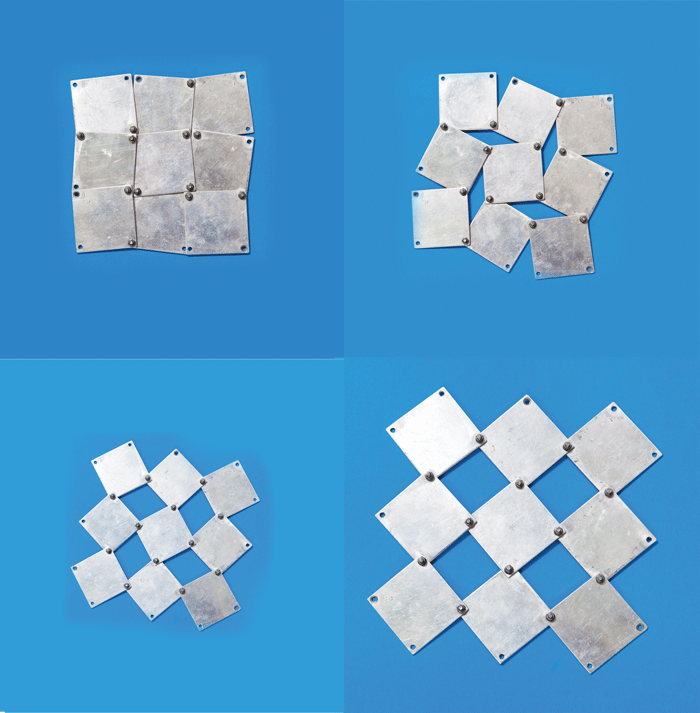
Grima’s team succeeded in showing that putting enough defects in graphene imparts it with auxetic properties. As a result of these defects, ‘the imperfect graphene’ adopted a real crumpled shape, giving it the necessary geometry similar to that of a ‘highly wrinkled paper’, so that when one stretches it, it also widens, explains Grima. Additionally, Grima says that one can increase the extent of auxetic behaviour by increasing the amount of defects.
Grima and his team (including collaborators from the Polish Academy of Science and Gdansk University of Technology) used realistic computer simulations to study whether graphene could be auxetic in the real world. The simulations took months of supercomputer power to verify that this modified graphene works. These calculations represent the ‘blueprint’ for making graphene, as well as other sheet-like materials, auxetic. The possibilities are phenomenal.
Smaller than Small
This new material ‘shows a very elegant link between the macroscale and the nanoscale,’ says Grima. He goes on to state that this is indeed a fantastic material with ‘multifunctional characteristics’. Here, one needs to consider two points. First of all, that graphene is a super material in itself with numerous applications. Secondly, that auxetic materials have wonderful properties. By combining these two features, Grima explains how a highly complex material such as graphene has been shown to mirror almost everything that is typically observed on a large scale into a crumpled sheet of paper.
Try and wrap a sheet of paper around your elbow. This becomes saddle-shaped and it does not cover your elbow properly, explains Grima. Now open up a crumpled sheet of paper and try to cover your elbow with this instead. The wrinkled paper drapes more easily over your elbow because auxetic materials tend to form a nice dome shape. A scaledown of this fabulous feature could potentially lead to applications of graphene with a negative Poisson’s ratio in nano-domes. These domes could make the perfect protective material.
Dr Ruben Gatt, a lead researcher in Grima’s team, described another amazing property of auxetic materials. When one tries to firmly press a cushion, it tends to shrink in all directions. The cushion gets smaller. Auxetic materials act differently. They densify where you press, which means that if you try and push the foam, the material gets larger not smaller. ‘Imperfect graph
ene can also be potentially used as a nano-cushion’, said Grima. Auxetic graphene could also be used to make smart nanoelectromechanical devices or smart filters.
Grima worked with his whole team to make this discovery. It was well known that, by adding defects to graphene, it would have more wrinkles, as was the auxetic nature of a crumpled sheet of paper. But they ‘connected the dots’. The dots were already present, but the team linked them all together.
Auxeticity is a marvellous property which opens up enormous possibilities, ‘as broad as the imagination can stretch,’ explains Attard. This leaves us to wonder what other fabulous material Grima’s team will come up with next.
Further reading
- Grima, J., Winczewski, S., Mizzi, L., Grech, M., Cauchi, R., Gatt, R., Attard, D., Wojciechowski, K. W. and Rybicki, J. (2014). Tailoring Graphene to Achieve Negative Poisson’s Ratio Properties. Adv. Mater., 27(8), pp.1455-1459.



Comments are closed for this article!