
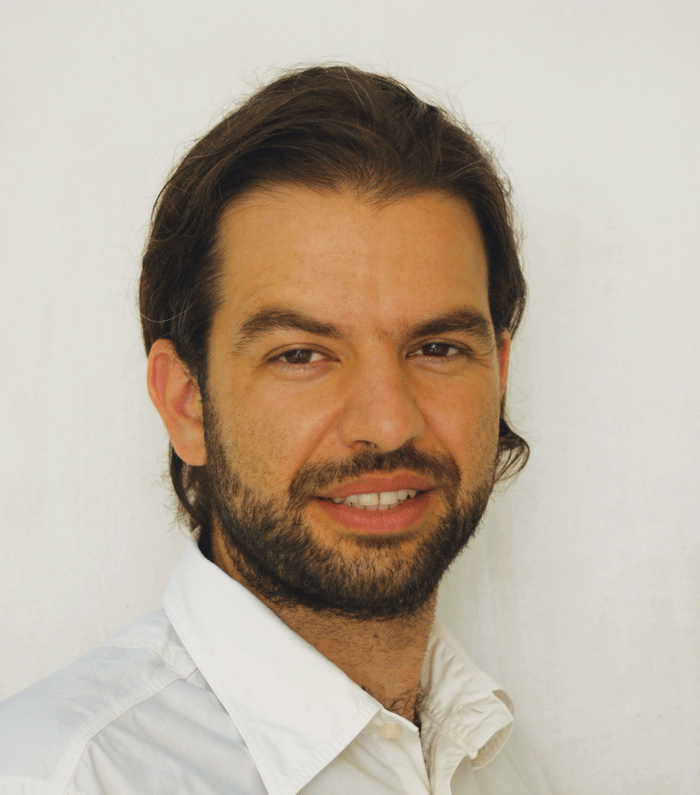
Dr Vasilis Valdramidis speaks about funding opportunities.
My research at the University of Malta would not have been possible without EU funding. Till 2020 the EU’s research funding stream is the Horizon 2020 EU framework Programme for Research and Innovation (R&I). With an overall budget of €79 billion (in current market prices), it is a great opportunity for local researchers, the largest R&I programme ever, and focuses on three pillars: excellent science, industrial leadership, and societal challenges. The way it operates is that the European Commission will issue calls for proposals under different work programmes to attract entities from all over Europe and beyond to come together to propose research ideas for funding. Ideas are then evaluated and the top ranking proposals are funded.
Compared to its predecessor, the seventh framework Programme (FP7), the new Horizon 2020 has been simplified. Projects are managed with one single funding rate per action: up to 100% for research actions and up to 70% for innovation actions, with the exception of non-profit organisations such as the University of Malta which can also receive up to 100% of direct eligible costs. Indirect costs are reimbursed at a single funding flat rate of 25% of direct eligible costs. Another improvement is that the maximum time to grant the funds to applicants is capped at eight months after the call’s deadline. Proposals are now evaluated as they are, without the possibility of further budget negotiations between the European Commission and the prospective consortium*. All publications from Horizon funded research need to be published in open access peer-reviewed journals that will make scientific findings more accessible.
These funds are extremely competitive but it is not impossible to be successful—even from Malta. One can only succeed if they try and try again. The international exposure and collaboration of successfully winning these funds helps academics develop independent research activities. These funds help support groups that can go beyond cutting edge research and receive international recognition.
I think that the main challenge in Horizon 2020 is to find the right consortia, topic, and call that best suit your research idea. Each member state should have the right structure to help in supporting, guiding and hand holding applicants throughout the process.
“The international exposure and collaboration of successfully winning these funds helps academics develop independent research activities.”
The level of support provided by the University of Malta (Project Support Office and my faculty) and the Malta Council for Science and Technology has encouraged me to tap into various funding programmes and I have been successful in at least four EU projects from a Marie Curie Career Integration Grant and FP7 – Capacities—SME to Erasmus+: Cooperation for innovation and exchange of good practices. These brought the UoM around €500K in EU funding. This funding permitted me to develop a research group of Ph.D. and M.Sc. by research students, invest on expanding our research laboratory facilities and putting in the scene our group by participating to international conferences and workshops.
Familiarise yourself with this EU funding instrument and have a look at the Horizon 2020 Participant. It is worth it. •
vasilis.valdramidis@um.edu.mt
+356 2340 1157



Comments are closed for this article!