
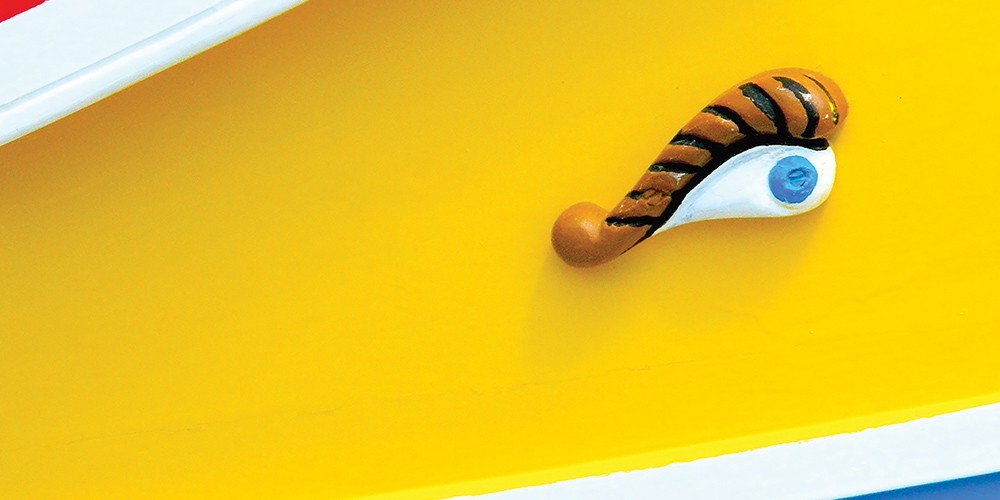
Strolling along Malta’s coast, you’ll be mesmerised by the rainbow of traditional fishing boats ambling on the water—that and all the eyes ogling at you from their bows. Katre Tatrik takes a closer look at the hidden meaning behind the luzzu’s colours.
The Maltese luzzu dates back to the time of the ancient Phoenicians. For generations, Maltese fishermen have painted them in a kaleidoscope of bright colours, turning them into a national icon. But is there rhyme or reason to the hues they choose? Lifelong fishermen, brothers Charles (62) and Carmelo (70) from Marsaxlokk, paint their luzzus twice a year in bold blues, reds, and yellows. It’s no easy task, requiring thorough cleaning and six layers of paint. Despite their dedication, Charles and Carmelo, like many others, are largely unaware of the hidden meanings the colours on their boats carry. ‘They’re all the same,’ Carmelo says. ‘It’s just for beauty.’ Charles adds that ‘these boats have always looked the way they look.’
But in 2016, Prof. Anthony Aquilina from the University of Malta embarked on a project that would uncover more. ‘Contrary to what you have been told, there is a lot of meaning in the way our traditional boats are painted,’ he explains. Aquilina edited and published The Boats of Malta – The Art of the Fisherman, written by world-famous anthropologist Desmond Morris.
Morris resided in Malta for six years in the 1970s, visiting each of the fishing villages on the islands. During his stay, he sketched some 400 of the 700 traditional boats anchored in the coastal villages. He wrote: ‘to visit a Maltese fishing village is like entering a huge, open-air art exhibition.’
Summing up Morris’ work, Aquilina says that ‘even in a small country, you can see the difference between one locality and another. But at the same time, there is the individual stamp of the fisherman, of that particular person.’
To visit a Maltese fishing village is like entering a huge, open-air art exhibition.
Morris’ main findings show that some traditional rules come into play when choosing the colour palette for a luzzu.
Whilst reddish brown or maroon was typically painted on the lower half of the boat to mark the waterline, the locality of a boat’s owner could be identified by the colour of its mustaċċ. The mustaċċ is the band above the lower half of the boat, shaped like a moustache, which gives the feature its name. A red mustaċċ would indicate that the boat came from St Paul’s Bay, for example. A lemon yellow indicated a boat from
Msida or St Julian’s, whilst an ochre yellow one would identify the boat as hailing from the Marsaxlokk and Marsascala area. When a mustaċċ was painted black, it denoted mourning for a death in the family.
In addition to colours, decorations also send a message. In more than half of luzzus, signature eyes are painted on the bow or the stern—symbols of protection for fishermen out at sea. Where the eyes are not seen, other symbols such as a rising sun, a Maltese cross, fish, shooting stars, or lions are painted on. The gangway, usually varnished brown, can be heavily decorated or engraved with symbols of the sea and the island: shells, mermaids, birds, flowers. Religious insignia are common too, with doves, olivebranches, and lambs often making an appearance.
Political or religious influences also come into play where a luzzu’s name is concerned. During the time we spent in Marsaxlokk, we saw San Mikiel (Saint Michael the Archangel, patron saint of Isla), John F. Kennedy, and Ben Hur.
Even if Charles and Carmelo couldn’t tell us what the luzzu’s colours mean, their dedication to tradition is undeniable. Before we left, they said they were fearful that this part of Malta’s heritage may fade away as featureless carbon-fibre boats wade in. I hope they’re wrong.




Comments are closed for this article!