
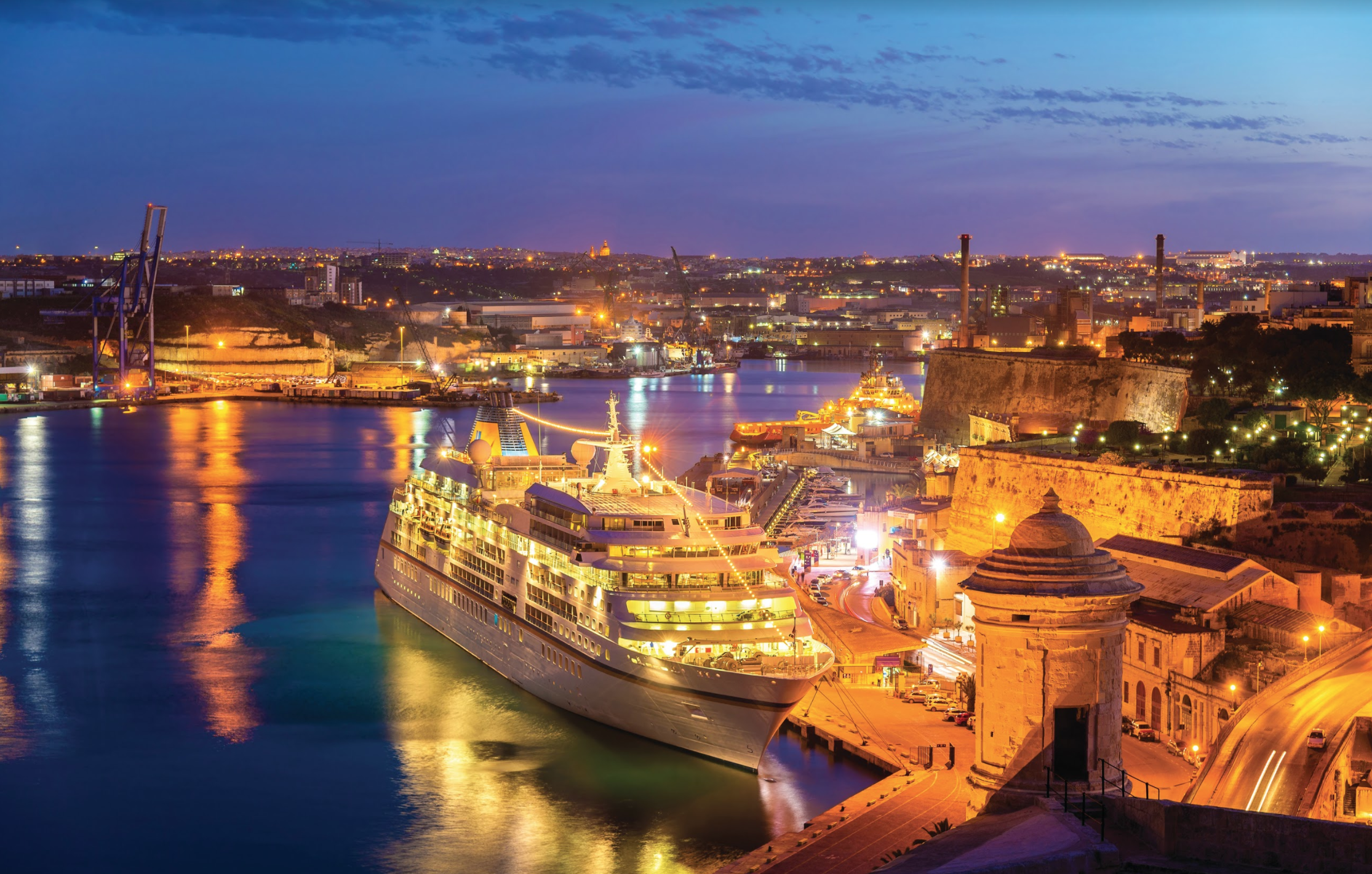
As the sun sets and the sky darkens, a black velvety curtain adorned with flecks of twinkling lights is drawn across the heavens, and a milky white band of fuzzy glow stretches majestically overhead. Unfortunately, this experience is nowadays denied to us thanks to artificial lighting. The sky is often left awash in a cold, jarring glow, making Malta one of only five countries whose citizens are denied the possibility of observing the Milky Way from their home.
A few select coastal sites remain where we can see the Milky Way. But even those are under continuous threat. In 2002 the Malta Environment and Planning Authority designated a number of sites in Gozo and Comino as Dark Sky Heritage Areas, stating that ‘reflective signs shall be employed to guide driving at night, whilst the installation of lighting which is not related to aerial or maritime navigation, shall be strongly discouraged.’ Since then, light pollution has still been increasing and is seriously impinging upon these areas.
To some, the ability to appreciate and study the night sky might be less of a priority, but light pollution affects our lives in many more ways. Our night-time environment is fast becoming a vista of blindingly cold light, and we need to act now to reverse this. Badly designed lighting can result in glare, which is especially dangerous while driving. Light trespassing into people’s homes creates a myriad of problems, ranging from mild discomfort to serious sleep disruption. Studies have linked bright LED lighting with adverse health effects, as it can interfere with our circadian (daily) rhythm. Light pollution also disturbs wildlife. For example, conserving colonies of birds that make their home at the cliffs of Dwejra, like Scopoli’s Shearwater and Yelkouan Shearwater, depends heavily on our efforts to curb light pollution.
The solution is not as drastic as switching off all our lights, but adopting full cutoff lighting in streets to illuminate the ground without spilling light everywhere else.
Luckily, light pollution is a reversible problem. Authorities can choose to bring about positive change, sometimes requiring little effort. Do we really need our public monuments, churches, building facades, and playing fields to be illuminated all night long, oftentimes with skyward-pointing floodlighting? When planning new lights for a road or a public space, should we not consider the impact the proposed lighting will have on the surrounding community and environment?
Conservation of our natural environment is not diametrically opposed to human activity and business interests. Other countries have long recognised the night sky’s potential for eco-tourism.
The Department of Physics (Faculty of Science, University of Malta [UM]) and Institute of Space Sciences and Astronomy (UM) are currently embarking on a new study of our islands’ night sky’s brightness. Interested parties, authorities, and non-governmental organisations alike are most welcome and encouraged to get in touch. It is only through awareness, dedication, and proper coordination that we can help ensure that future generations can still enjoy the peaceful beauty of the Maltese night sky.
Further reading: Falchi et al., ‘The new world atlas of artificial night sky brightness’, Science Advances, vol. 2, no. 6, 2016, e1600377




Comments are closed for this article!